₨ 1,360 – ₨ 8,910Price range: ₨ 1,360 through ₨ 8,910
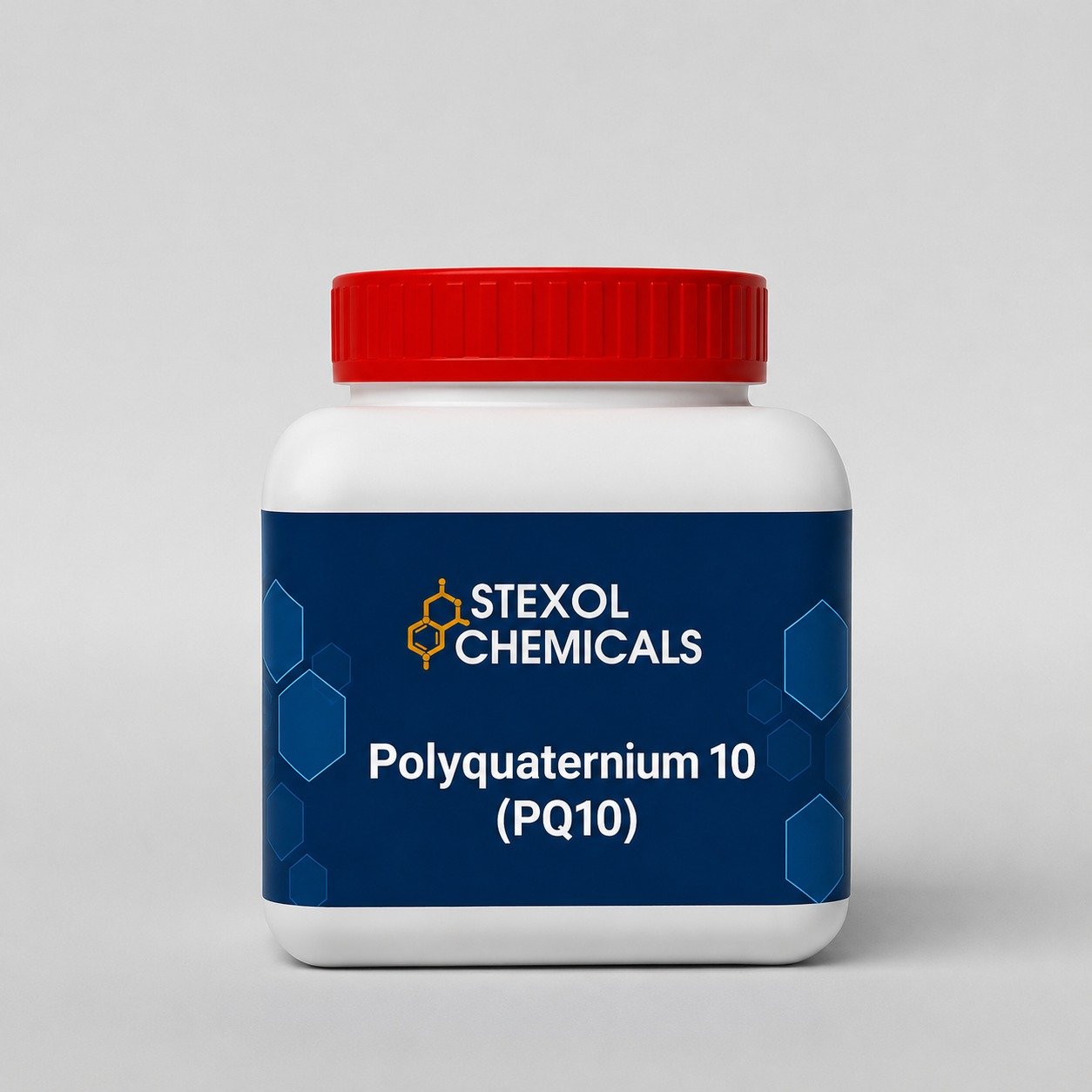
Polyquaternium 10 (PQ10) from Stexol Chemicals is a cosmetic-grade cationic conditioning polymer supplied as a free-flowing, white to off-white powder that is essentially 100% active polymer. Its INCI name is Polyquaternium-10, a quaternized hydroxyethyl cellulose made from a natural cellulose backbone. Our grade is a medium-charge, medium-viscosity type matched to the published profile of Dow UCARE JR-400. That makes it a straight UCARE JR-400 equivalent, so formulators can swap it in without changing their formula, INCI declaration or expected performance.
PQ10 is one of the most widely used conditioning polymers in 2-in-1 shampoos, conditioning shampoos, rinse-off conditioners, shower gels and hair treatments. In the finished product, it leaves hair soft and smooth, makes wet combing easier, cuts static and frizz, and gives skin a silky, non-tacky after-feel. It also adds body to the formula and keeps clear shampoos clear.
The key technical property is its positive (cationic) charge. Hair, especially damaged hair, carries a negative charge, so PQ10 is drawn to it and stays there after rinsing. In a shampoo, PQ10 sits dissolved alongside the anionic surfactant. When the shampoo is diluted with rinse water, the polymer and surfactant come out of solution together as a fine conditioning layer called a coacervate, which settles on hair and scalp. This is why PQ10 conditions from within a shampoo, which an ordinary thickener or a simple quat cannot do.
PQ10 is substantive to hair and skin, so it delivers detangling, easier wet and dry combing and frizz control even though the product is rinsed off. It gives medium conditioning without build-up, so it suits everyday shampoos that should not weigh hair down.
Once deposited, PQ10 forms a clear, continuous, non-tacky film on the hair surface. This film reduces flyaways and static, helps hair lie flat and reflect light, and leaves a smooth feel when dry. On skin, the same film gives body washes and hand soaps a soft, cushioned after-feel.
Unlike many cationic ingredients, PQ10 is compatible with anionic surfactants such as SLES and amphoterics such as CAPB, and it works in both clear and pearlized shampoos. At normal use levels it does not collapse lather, and many formulators find it makes the foam feel creamier. For the best conditioning deposition, SLES-based systems usually perform better than straight SLS systems.
According toDow’s UCARE JR-400 technical data, this grade has a 2% solution viscosity of 300–500 cP, nitrogen content of 1.5–2.2%, and a recommended use level of only 0.2–0.5% in shampoos and body washes. A small amount goes a long way, which keeps your cost per kilogram of finished product low. PQ10 also adds some viscosity, so in some formulas you can reduce other thickeners.
Our PQ10 is a direct equivalent of the JR-400 grade that global brands have used for decades. It is now available locally as Polyquaternium-10 in Pakistan from Stexol Chemicals, so you can skip import paperwork, long lead times and drum-size minimums. You get the same INCI and the same performance profile at a local price.
PQ10 combines well with SLES, SLS, CAPB, cocamide DEA/MEA, decyl and coco glucoside, glycerin, panthenol, hydrolyzed proteins, EDTA, citric acid, sodium chloride and common preservatives such as phenoxyethanol. It works with or without silicones and helps deposit silicone emulsions such as BRB 1018 silicone emulsion in 2-in-1 shampoos. For even stronger silicone deposition, pair PQ10 with a cationic guar such as guar hydroxypropyltrimonium chloride.
PQ10 is a fine powder that swells on contact with water, so add it the right way to avoid lumps (“fish eyes”). Sprinkle it slowly into the vortex of room-temperature water under good stirring, or first make a slurry with glycerin or propylene glycol and then add that slurry to the water. Keep mixing until the solution is smooth and completely clear, which typically takes 30–60 minutes depending on mixing speed and water temperature. Warming to about 65°C speeds up hydration if needed. Only add surfactants once the PQ10 is fully hydrated. The powder absorbs moisture from the air, so close the container tightly straight after use. Store it in a cool, dry place away from humidity, direct sunlight and oxidizing materials.
Target pH: PQ10 performs best between pH 5.0 and 7.0. For hair products, target a finished pH of 5.0–6.0. For skin products such as body washes, hand soaps and lotions, target 5.5–6.5. Lower the pH with a citric acid solution added drop by drop, checking pH after each addition.
|
Product Type |
PQ10 in Formula (by weight) |
|---|---|
|
2-in-1 Shampoo (with silicone) |
0.2% to 0.5% |
|
Clear Conditioning Shampoo |
0.1% to 0.4% |
|
Rinse-Off Conditioner |
0.3% to 1.0% |
|
Hair Mask / Deep Treatment |
0.5% to 1.5% |
|
Leave-In Conditioner / Detangling Spray |
0.1% to 0.5% |
|
Styling Gel |
0.2% to 0.5% |
|
Body Wash / Shower Gel / Liquid Hand Soap |
0.1% to 0.5% |
|
Lotions / Creams |
0.1% to 0.5% |
These are typical starting ranges. Start low and increase in small steps, because higher levels add viscosity and can feel heavy on fine hair.
Every batch of PQ10 comes with a Certificate of Analysis. You can check appearance, 2% solution viscosity, nitrogen content, moisture, pH and batch number before you start production. Every batch is tracked and recorded.
Order from small trial packs to test your formula, up to full bulk quantities for production runs. Buy only what you need today, and grow when you are ready.
The larger the order, the lower the unit cost. Send us your required quantity on WhatsApp and we will reply with a quote for your volume.
Orders confirmed before our daily cut-off are dispatched the same day. We keep PQ10 in stock so your production schedule never stalls waiting for raw materials.
It is a JR-400-type Polyquaternium-10 with the same INCI and a matching specification profile: a medium-charge grade with typical nitrogen of 1.5–2.2% and a 2% solution viscosity of 300–500 cP. It can replace JR-400 in your existing shampoo, conditioner or body wash without changing the formula or label. As with any new lot, check the batch COA against your current spec when you switch.
PQ10 needs free water to unfold and dissolve. If you add the powder straight into a surfactant base, or dump it in all at once, the outside of each particle swells into a gel skin and traps dry powder inside. You then get lumps that may never fully dissolve. Hydrating it first in water, or pre-wetting it in glycerin, gives a smooth, clear solution and reliable conditioning.
No, not at normal use levels of 0.2–0.5%. PQ10 is designed to work in SLES and CAPB systems, and it often gives the lather a creamier, richer feel. Very high doses can make the formula thicker and heavier, so stay within the recommended range.
Keep it in its tightly closed original pack in a cool, dry place, away from humidity, direct sunlight and heat. Because the powder absorbs moisture from the air, reseal it immediately after each use. Stored this way, PQ10 typically has a shelf life of 24 months from the date of manufacture.
Yes. PQ10 works well with dimethiconol silicone emulsions in 2-in-1 shampoos and helps deposit silicone on hair as the shampoo is rinsed. It can also be combined with cationic guar, panthenol and proteins, and, in conditioners, with cetrimonium or behentrimonium chloride.
Small trial packs and bulk quantities available. COA included with every batch, same-day dispatch, and tiered pricing on bulk orders. Message us on WhatsApp [ +92-316-0099118 ] with your quantity to get your quote today.
| weight | 1 kg, 500g, 250g, 100g |
|---|
Specifications not available.
Reviews
There are no reviews yet.