₨ 490 – ₨ 3,230Price range: ₨ 490 through ₨ 3,230
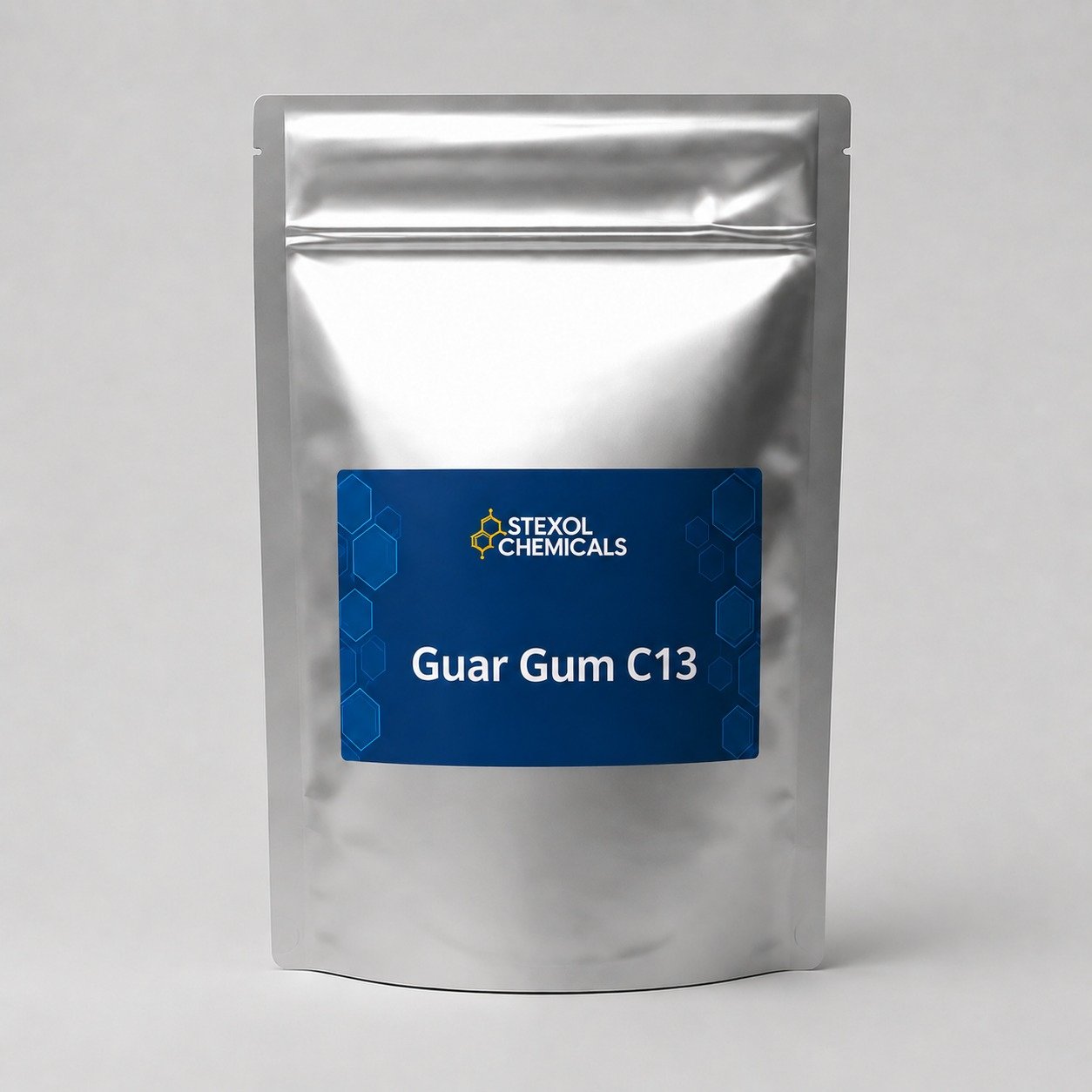
Guar Gum C13 is a professional-grade cationic guar conditioning polymer for shampoos, conditioners and body washes. Its INCI name is Guar Hydroxypropyltrimonium Chloride (CAS 65497-29-2). It is made from natural guar gum, taken from the seeds of the guar plant (Cyamopsis tetragonoloba) that grows across Pakistan and India, and chemically modified to carry a permanent positive (cationic) charge. Guar Gum C13 matches the specification profile of the Rhodia/Solvay (now Syensqo) grade Jaguar C13S / Jaguar C-13S: the same INCI name, a pale yellow fine powder, a similar nitrogen content and a similar 1% solution viscosity. Formulas written around Jaguar C13S can switch to Guar Gum C13 at the same percentage. Run one small trial batch first to confirm viscosity and clarity in your own base.
Guar Gum C13 is the core conditioning polymer in 2-in-1 shampoos, conditioning shampoos, anti-dandruff shampoos, rinse-off conditioners and creamy body washes. It gives a finished shampoo easy wet combing, a soft and smooth feel after washing, less static and frizz, and a richer, creamier lather.
What makes Guar Gum C13 work is its cationic charge combined with high molecular weight. Hair and skin carry a negative charge, so the positively charged guar is attracted to them and stays put after rinsing. In a shampoo, Guar Gum C13 stays dissolved in the bottle alongside SLES and CAPB. When the shampoo is diluted with water on wet hair, the polymer and surfactant come out of solution together as a gel-like “coacervate”. This coacervate wraps around silicone droplets, oils and anti-dandruff actives and deposits them onto the hair while the surfactant rinses away. US patent 5,720,964 describes Jaguar C13S “with a cationic charge density of 0.8meq/g”, and earlier patents give its degree of cationic substitution as about 0.13. This low-to-medium charge gives dependable everyday conditioning without the heavy build-up that high-charge grades can cause.
Guar Gum C13 makes wet hair noticeably easier to comb and detangle straight after shampooing. In the Cosmetics & Toiletries study “Performance and Sensorial Benefits of Cationic Guar in Hair Care Applications” (Diastron combing tests on Caucasian hair tresses, plus a 20-woman half-head test at the Schrader Institute, Germany), “as little as 0.1% cationic guar in the shampoo was sufficient to minimize wet-combing force, whereas 0.3% polyquaternium-10 was originally required”. Note that the grade tested in that study was a hydroxypropyl guar hydroxypropyltrimonium chloride, a close relative of C13. For your formula, the point is strong conditioning at a low inclusion level.
On its own, much of a silicone emulsion washes down the drain. The coacervate formed by Guar Gum C13 carries silicone droplets onto the hair during rinsing. In the same Cosmetics & Toiletries study, using an SLES/sodium cocoamphoacetate shampoo base, “silicone emulsion deposition yield has increased by almost two fold” with guar hydroxypropyltrimonium chloride “compared to polyquaternium-10”. Pair Guar Gum C13 with a dimethiconol emulsion such as BRB 1018 (DOWSIL 1785 equivalent) to get more shine and softness from the same silicone level, or the same result with less silicone.
Guar Gum C13 does not kill foam. In the Cosmetics & Toiletries study (0.2% polymer in an ALS/ALES/CAPB 7/7/2 base), foam bubbles from the cationic guar shampoo had “a mono disperse distribution… centered around a small diameter”, and “all cationic guars… outperformed polyquaternium-2 and polyquaternium-10 as foam height was significantly improved in the presence of sebum”. For Jaguar C13S specifically, Politova et al. (Langmuir, 2012) found it caused “a significant increase of the foam yield stress”, which means firmer, creamier foam. This is one of the clearest differences between a basic shampoo and a “salon feel” shampoo in Pakistan’s competitive mid-price market.
Guar Gum C13 is a high molecular weight polymer, so besides conditioning it adds body to your shampoo or body wash base. It works alongside salt (sodium chloride) thickening, which helps you reach your target viscosity.
In shower gels and liquid soaps, Guar Gum C13 deposits a light conditioning film that reduces the tight, dry feel anionic surfactants can leave. It also helps carry oils and moisturizers onto the skin. The result is a soft, smooth after-feel that customers notice.
Guar Gum C13 matches the Jaguar C13S specification type, including nitrogen content, viscosity and pH range. Formulators in Pakistan who used to import Jaguar C13S, or depend on uncertain market stock, can buy Guar Gum C13 locally from Stexol Chemicals with a COA for every batch.
Guar Gum C13 works with SLES, SLS, CAPB, cocamide DEA, sodium cocoamphoacetate, decyl and coco glucoside, glycerin, panthenol, hydrolyzed proteins, zinc pyrithione, climbazole, silicone emulsions (BRB 1018, dimethicone and amodimethicone emulsions), and common preservatives. In conditioners it also works alongside cationic emulsifiers such as BTMS and cetrimonium chloride.
Guar Gum C13 is a pale yellow to off-white fine powder. Never dump it into water in one go, because it will form lumps (“fish eyes”) that are very hard to break. Always add it at the start of the batch, into cold or room-temperature water, before any surfactant. It is a water-phase ingredient, not a cool-down additive. Sprinkle the powder slowly into the vortex of well-stirred water. If you do not have strong stirring, first mix the powder into glycerin or propylene glycol (about 1 part guar to 5–10 parts glycerin) to make a smooth slurry, then add the slurry to the water. Allow 15–20 minutes of mixing for full hydration; the solution becomes thicker and clearer as it hydrates. The powder absorbs moisture from the air, so always close the bag or container tightly after use, especially in humid cities such as Karachi.
For hydration, Jaguar C13S-type cationic guar normally builds viscosity at its natural pH (6.0–7.0 for a 1% solution). If your batch thickens slowly, or the COA shows a higher pH, lower the water to pH 4.5–5.5 with citric acid solution to speed up hydration. For the finished product, keep shampoos and body washes at pH 5.5–6.5 and conditioners at pH 4.0–5.5. Adjust the final pH with citric acid.
Product Type Levels of Usage:
|
Product Type |
Guar Gum C13 in Formula (by weight) |
|---|---|
|
2-in-1 Conditioning Shampoo (with silicone) |
0.2% to 0.5% |
|
Daily-Use / Mild Conditioning Shampoo |
0.1% to 0.3% |
|
Anti-Dandruff Shampoo (ZPT, climbazole) |
0.2% to 0.5% |
|
Rinse-Off Hair Conditioner |
0.3% to 1.0% |
|
Intensive Hair Mask |
0.5% to 1.0% |
|
Body Wash / Shower Gel |
0.1% to 0.5% |
|
Liquid Hand Wash |
0.1% to 0.3% |
|
Face Wash / Facial Cleanser |
0.1% to 0.2% |
|
Body Lotion / Cream |
0.1% to 0.5% |
Start at the low end and increase only if needed. In rinse-off conditioners, levels above about 1% can leave hair feeling coated rather than soft.
Formulation Build Order (Conditioning Shampoo / Body Wash):
Hydrate Guar Gum C13 in the water phase first, as in steps 1–4. Then heat the water phase to 70–75°C, add your fatty alcohols and cationic emulsifier (e.g., BTMS) in the oil phase at 70–75°C, emulsify, and cool with gentle stirring. Add silicone, preservative and fragrance below 40°C.
If your formula also uses an anionic thickener (carbomer or acrylates copolymer), do not add it directly on top of the guar solution, or the reverse. Separate them with the amphoteric surfactant or salt to avoid lumps.
Every batch of Guar Gum C13 comes with a Certificate of Analysis. You can check appearance, moisture, nitrogen content, 1% solution viscosity, pH and batch number before you start production. No guesswork about raw material quality, and every batch is tracked and recorded.
We supply Guar Gum C13 in small packs and in bulk. Small manufacturers and new private-label brands can buy a professional cationic guar without stocking up. Order what you need today, and grow when you are ready.
The larger your order, the lower your cost per kg. Send us a WhatsApp message [ +92-316-0099118 ] with the quantity you need, and we will send a quote for that volume.
Orders confirmed before our daily cut-off are shipped the same day. We keep Guar Gum C13 in stock so your shampoo and body wash production is never held up waiting for raw materials.
Guar Gum C13 has the same INCI name as Jaguar C13S (Guar Hydroxypropyltrimonium Chloride) and the same specification type: a pale yellow powder with nitrogen content, 1% viscosity and pH in the Jaguar C13S range. Most formulators use it at the same percentage as Jaguar C13S. Guar is a natural material, so we recommend one small trial batch to confirm viscosity and clarity in your exact base before full production.
Add it first, into cold or room-temperature water, before any surfactant. Sprinkle it slowly into a strong vortex, never dump it. If your mixer is not strong, pre-mix the powder with glycerin or propylene glycol (1 part guar to 5–10 parts glycerin) into a smooth slurry and then add it to the water. Stir 15–20 minutes. If it is still thin, lower the pH to 4.5–5.5 with a little citric acid solution.
Yes. Guar Gum C13 is designed for anionic surfactant systems based on SLES, SLS and CAPB. Add the CAPB before the SLES for the smoothest mixing. It works especially well with BRB 1018 and other silicone emulsions: when the shampoo is diluted on wet hair, the guar–surfactant coacervate carries silicone droplets onto the hair, giving better softness and shine than silicone alone.
Jaguar C13S-type cationic guar is generally used in opaque, pearly and creamy shampoos. In a crystal-clear shampoo it can give some haze. In US patent 8,450,294, clear SLES/CAPB test shampoos made with other polymers showed “much higher clarity and lower turbidity than the shampoos formulated with the commercially available cationic guar Jaguar™ C13S”. Hydrating it fully, lowering the pH during hydration, and adding CAPB before SLES all help clarity. For fully transparent products, test it in your base first.
How much Guar Gum C13 should I use? A: 0.2–0.5% in 2-in-1 and conditioning shampoos, 0.1–0.3% in daily shampoos, hand washes and body washes, and 0.3–1.0% in rinse-off conditioners and masks. Starting at 0.3% in a shampoo is a good first trial. More is not always better: too much can make hair feel coated.
No. Guar Gum C13 is a powder that must be dispersed and hydrated in water at the start of the batch. If you add it to a finished shampoo full of surfactant, it will not hydrate properly and will form lumps. Add BRB 1018 at the end; add Guar Gum C13 at the beginning.
Store it in a cool, dry place in its original tightly closed bag or container, away from humidity and direct sunlight. The powder absorbs moisture, so close it immediately after use. In the sealed original packing it has a shelf life of up to 24 months from the manufacturing date; check the date and retest information on your batch COA.
Guar Gum C13 is available in small packs and bulk quantities, with a COA on every batch and same-day dispatch. Tiered pricing applies to bulk orders. Message Stexol Chemicals on WhatsApp with your required quantity for a quick quote, and get Jaguar C13S-type cationic guar conditioning into your next shampoo batch.
| Weight | 1 kg, 500g, 250g, 100g |
|---|
Specifications not available.
Reviews
There are no reviews yet.