
₨ 380 – ₨ 2,450Price range: ₨ 380 through ₨ 2,450
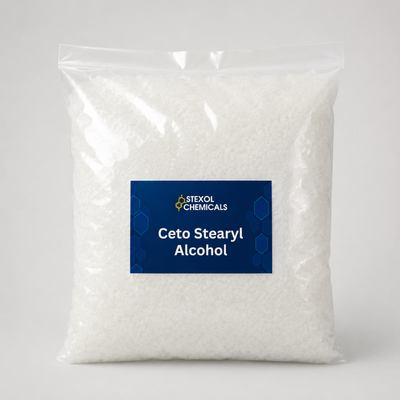
Cetearyl Alcohol is a cosmetic-grade, vegetable-derived fatty alcohol. It is supplied as white to off-white waxy pellets/flakes. razskincare Its INCI name is Cetearyl Alcohol (CAS 67762-27-0, also listed as 8005-44-5), and it is a blend of roughly 50% cetyl alcohol (C16) and 50% stearyl alcohol (C18). knowde +2 The material is non-ionic, so it works alongside cationic, anionic and non-ionic ingredients in the same formula. You may also see it sold as cetostearyl alcohol, cetylstearyl alcohol or C16-18 alcohol. These are all the same ingredient. nwabrWikipedia
Our Cetearyl Alcohol is a direct drop-in equivalent of BASF Lanette O, the 50:50 grade most global formulas are written around. It shares the same INCI, the same C16/C18 chain balance, the same non-ionic character and a matching spec window (hydroxyl value 215–225 mg KOH/g, melting range 49–56°C). basf If your formula says “Lanette O,” “Kolliwax CSA 50” or “Crodacol CS50,” you can swap in ours at the same percentage with no formula change. Check the batch COA, as you would with any new lot.
Cetearyl Alcohol does the heavy lifting in creams, lotions and hair conditioners. In an oil-in-water cream it thickens the product, stabilises the emulsion so it doesn’t separate, adds a soft, cushiony after-feel and gives the classic white, opaque look. ulprospector +2 In conditioners and hair masks, combined with behentrimonium chloride, cetrimonium chloride or BTMS, it builds the thick, creamy body and slippery wet-feel that customers associate with a “rich” conditioner. uspto
The property that makes cetearyl alcohol better than a single fatty alcohol is its mixed C16/C18 chain distribution. When cetyl and stearyl chains are blended, they pack together into a more robust lamellar gel network than either alcohol does alone. The result is creams that hold viscosity across a wider temperature range and resist separation over shelf life. makingskincare A 2021 study of fatty alcohol mixing ratios (Hoang et al., arXiv:2101.11187) found that the “50:50 C18:C16 system shows the highest consistency with the highest storage modulus,” and that it was also the most flexible of the ratios tested. For a hot, humid market like Pakistan, that extra stability margin matters.
Thickening, stabilising and opacity from one ingredient: One ingredient builds viscosity, stabilises the emulsion and gives a white, opaque, premium look. sigmaaldrichWikipedia You don’t need a separate thickener and opacifier for a basic cream or conditioner.
The backbone of conditioners: Paired with a cationic conditioning agent at about a 1:3 ratio (quat to fatty alcohol), it forms the gel network behind thick, creamy, detangling conditioners and hair masks. uspto
Not a drying alcohol: Cetearyl Alcohol is a fatty alcohol, not ethanol. It softens the skin rather than drying it. razskincare The US FDA confirms that products labeled “alcohol free” may still contain cetearyl alcohol, so your “alcohol-free” claims stay intact. fdamedicalnewstoday
Works in low doses: In lotions, 1–3% is usually enough to add body and stability. Creams typically need 2–5%, and only rich butters and sticks go higher. razskincare +2
Branded-equivalent quality at a lower cost: You get Lanette O-equivalent performance without paying for an imported branded grade and waiting for it. It is available locally in Pakistan through Stexol Chemicals, in small packs for R&D and in bulk for production.
Compatible with common cosmetic ingredients: It works with Ceteareth-20, Polysorbate 60, glyceryl stearate, BTMS, behentrimonium chloride, cetrimonium chloride, stearic acid, emulsifying wax, mineral oil, vegetable oils and butters (shea, cocoa), dimethicone and other silicones, beeswax, glycerin and common preservatives.
Handling Note: Cetearyl Alcohol is a solid waxy pellet/flake that does not dissolve in cold water. razskincarebasf Add it to the oil phase and heat to 70–75°C until fully melted and clear (it melts at roughly 49–56°C, but processing hotter ensures a uniform melt). beurre Emulsify at 70–75°C with high-shear mixing or homogenisation. Then switch to gentle stirring while cooling. Viscosity builds as the batch cools, so don’t judge the final thickness while it is still hot. Keep the bag or container tightly sealed in a cool, dry place away from moisture. If pellets fuse into lumps in summer heat, quality is not affected; break up the lumps or melt them as normal. basf
Product Type Levels of Usage:
Target pH: Cetearyl Alcohol is non-ionic and stable across a wide pH range, so it does not set your pH. ellemental Adjust the finished product to suit its type. Hair conditioners and masks are usually pH 3.5–5.0, and skin creams and lotions pH 5.0–6.5.
| Product Type | Cetearyl Alcohol in Formula (by weight) |
| Body Lotion | 1% to 3% |
| Face Cream / Moisturiser | 2% to 5% |
| Rich Night Cream / Body Butter (emulsion) | 5% to 10% |
| Rinse-Off Hair Conditioner | 3% to 6% |
| Hair Mask / Deep Conditioner | 5% to 8% |
| Foundation / Sunscreen Cream | 1% to 4% |
| Deodorant Stick / Lip Balm / Anhydrous Sticks | 5% to 20% |
These are practical starting ranges based on manufacturer and supplier guidance. Your final level depends on the texture, viscosity and skin-feel you want.
Formulation Build Order:
COA By Batch: Every batch comes with a Certificate of Analysis, so you can check hydroxyl value, acid value and melting range before production. stexolchemicals
There is No Minimum Order Pressure: Buy the quantity that suits your stage. Start with a small pack for R&D or a trial batch, then move to bulk as your orders grow. stexolchemicals
Discounted Pricing on Bigger Orders: Tiered bulk pricing means the per-kg cost drops as your quantity goes up. stexolchemicals Message us on WhatsApp [+92-316-0099118] for a quote.
Same-Day Dispatch: Orders are dispatched the same day so your production stays on schedule anywhere in Pakistan. stexolchemicals
Is Stexol’s Cetearyl Alcohol the same as Lanette O?
It matches Lanette O on INCI (Cetearyl Alcohol), the 50:50 cetyl/stearyl balance, non-ionic character and key specs (hydroxyl value 215–225 mg KOH/g, melting range 49–56°C). You can use it at the same percentage without changing your formula. As with any new lot, check the batch COA and run a small test batch.
Why must Cetearyl Alcohol be added to the hot oil phase at 70–75°C?
It is a solid wax that is insoluble in water. razskincare It must be fully melted and present when the emulsion forms so it can build the gel network that thickens and stabilises the product. Adding it cold leaves undissolved specks and a thin, unstable emulsion.
Can I make a lotion with Cetearyl Alcohol alone?
No. Cetearyl Alcohol is a co-emulsifier and stabiliser, not a complete emulsifier. ulprospector Pair it with a primary emulsifier such as Ceteareth-20, Polysorbate 60 (Emulsifying Wax), glyceryl stearate, or BTMS for hair products. makingskincareformulachemistry On its own, an oil-and-water mix will separate.
How should Cetearyl Alcohol be stored, and what is its shelf life?
Store it in a tightly sealed bag or container in a cool, dry place, away from moisture and direct sunlight. Under proper storage the typical shelf life is 24 months. knowde Heat during summer or transit may fuse pellets into lumps. This does not affect quality. basf
Is Cetearyl Alcohol compatible with cationic conditioning agents and silicones?
Yes. Because it is non-ionic, it works with cationic quats such as behentrimonium chloride, cetrimonium chloride and BTMS. That combination is the standard base for conditioners. uspto It also works with dimethicone, amodimethicone and silicone emulsions, as well as anionic and non-ionic surfactants.
Cetearyl Alcohol for creams, lotions, conditioners, hair masks and sticks. Available in small packs and large bulk quantities at Stexol Chemicals. COA included with every batch. Same-day dispatch. Tiered bulk pricing. WhatsApp [+92-316-0099118] us for the best quote.
| weight | 1 kg, 500g, 250g, 100g |
|---|
Specifications not available.
Reviews
There are no reviews yet.