₨ 490 – ₨ 3,230Price range: ₨ 490 through ₨ 3,230
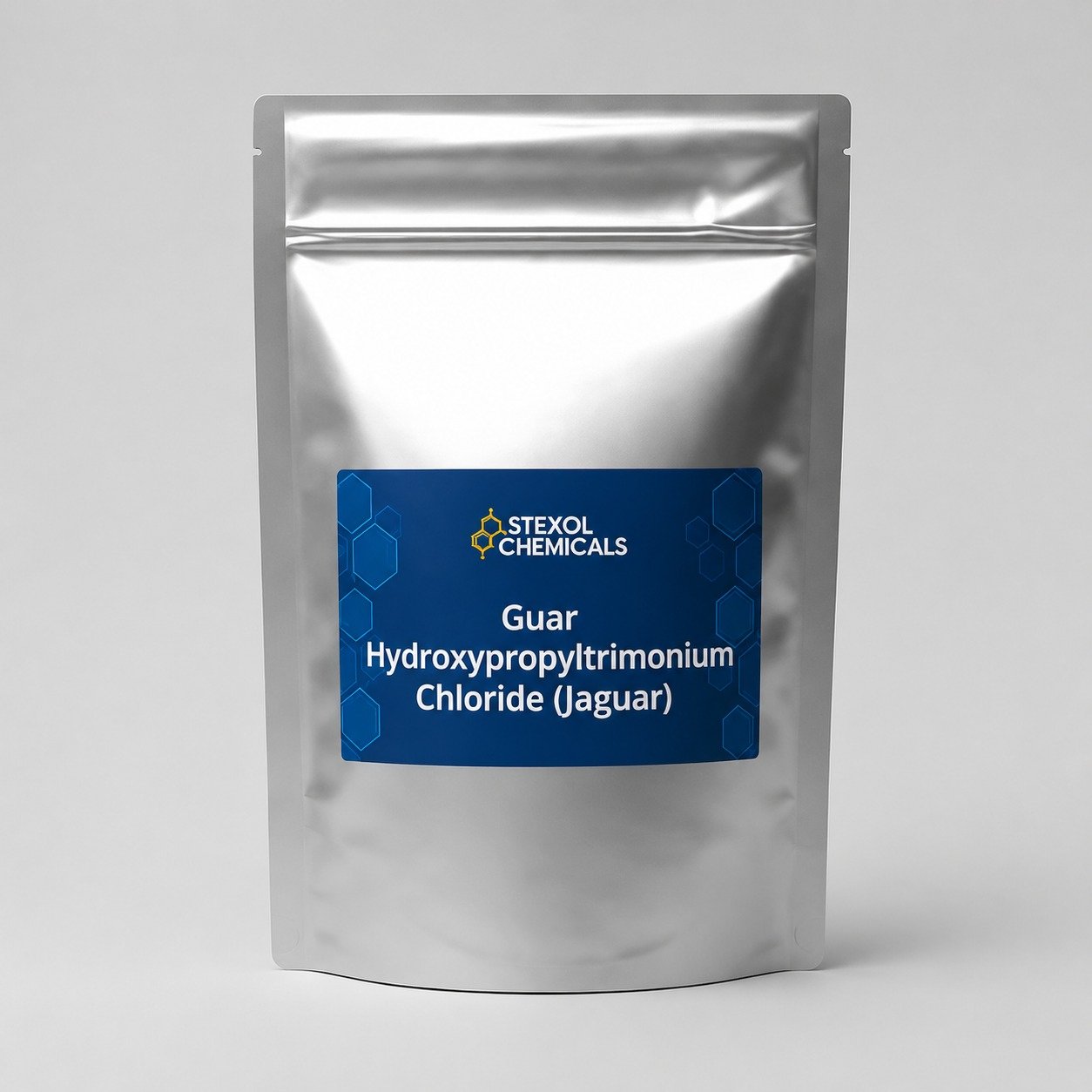
Guar Hydroxypropyltrimonium Chloride (Jaguar) known across Pakistan’s personal care trade simply as “Jaguar”, is a cationic conditioning polymer made from natural guar gum (Cyamopsis tetragonoloba). Stexol Chemicals supplies it as a cosmetic-grade, fine off-white to pale-yellow powder of the standard C-14S type. It has the same INCI name (Guar Hydroxypropyltrimonium Chloride), the same CAS number (65497-29-2) and a comparable specification to Jaguar® C-14S from Syensqo (formerly Solvay/Rhodia): nitrogen content of about 1.3–1.7% and a viscosity of 3,000–4,000 cP after hydration. It carries a permanent positive (cationic) charge. Because it shares the INCI and specification class of the brand-name grade, most formulators can replace Jaguar C-14S or C-13S at the same percentage without reworking the rest of the formula. We still recommend a small bench batch to confirm viscosity and appearance in your own base.
Its main job is in conditioning shampoos, 2-in-1 shampoos, anti-dandruff shampoos, body washes and shower gels. In the finished product it gives easier wet combing, less tangling and static, a smoother and softer feel to hair and skin, and a creamier, denser lather. It also builds some viscosity, so your shampoo feels richer in the bottle and in the hand.
What makes cationic guar stand out is its combination of moderate charge density (about 0.7–0.8 meq/g in this grade class) and high molecular weight (about 1.7–2.2 million g/mol). In the bottle it stays dissolved alongside SLES and other anionic surfactants. When the shampoo is diluted with water on wet hair, it forms a “coacervate”: a gel-like polymer–surfactant complex that separates out and settles onto the hair. Silicone droplets and anti-dandruff particles are caught in this complex and deposited along with it. In published Solvay test data (0.2% polymer in a 14% SLES / 2% CAPB shampoo with 1% silicone), Jaguar C-13S gave 43% silicone deposition efficiency. Polyquaternium-10 gave 13–20% and Polyquaternium-7 gave 6%. In practice, more of the silicone you pay for stays on the hair.
High-Quality Conditioning Straight from the Shampoo The positively charged polymer is attracted to the negatively charged surface of hair, especially damaged or chemically treated hair. It leaves a light conditioning film that makes hair feel smoother and softer and look healthier, without a separate conditioner step.
Easier Wet Combing and Detangling Lower friction between wet strands means fewer knots and less pulling during rinsing and combing. This matters most for thick, long or coarse hair. The anti-static effect also reduces flyaways once the hair is dry.
Boosts Silicone and Active Deposition This is the polymer that makes 2-in-1 and anti-dandruff shampoos work. Through coacervate formation it carries dimethiconol emulsions such as BRB 1018 (DOWSIL 1785 / XIAMETER MEM-1785 type) and anti-dandruff actives such as zinc pyrithione (ZPT) onto hair and scalp. In US Patent 5,037,818 (“Washing composition for the hair”), a shampoo containing Jaguar C-13S with only one-fifth of the ZPT “deposited substantially the same amount of the particulate zinc compound” onto hair as a shampoo without the polymer.
Creamy, Rich Foam: It Does Not Kill Your Lather Some conditioning agents flatten foam. Cationic guar does the opposite: it produces smaller, more uniform bubbles, so the lather is creamier, denser and longer-lasting. In tests published by Rhodia scientists in Cosmetics & Toiletries (0.2% polymer in an ALS/ALES/CAPB base), cationic guars showed higher foam firmness than the other cationic polymers tested and “outperformed polyquaternium-2 and polyquaternium-10 as foam height was significantly improved in the presence of sebum.”
Works at Low Doses (Cost-Effective) Most shampoos and body washes need only 0.2–0.5%, so 1 kg treats roughly 200–500 kg of finished product. Because it also improves silicone deposition, you may be able to reduce the amount of silicone emulsion and keep the same conditioning performance.cosmeticsandtoiletriescosmeticsandtoiletries
Brand-Name (Jaguar) Quality at a Lower Cost, Available Locally You get the same INCI and the same C-14S specification class as the imported brand-name polymer, without import lead times, minimum orders of 25 kg bags or foreign-currency payments. It is stocked in Pakistan by Stexol Chemicals and ships with a COA for every batch.
Compatible with Common Cosmetic Ingredients It works with:
Handling Note: The product is a fine, off-white to pale-yellow powder with a faint characteristic odour. Fragrance masks the odour, and it does not carry through to the finished product at normal use levels.
Product Type Levels of Usage:
Target pH: Hydrate the guar at pH 3.5–5, then adjust the finished shampoo or body wash to pH 5.5–6.5 (up to 7.0 is acceptable).
|
Product Type |
Guar Hydroxypropyltrimonium Chloride in Formula (by weight) |
|---|---|
|
2-in-1 Shampoo (with silicone) |
0.2% – 0.4% |
|
Conditioning Shampoo |
0.2% – 0.5% |
|
Anti-Dandruff Shampoo (ZPT) |
0.2% – 0.5% |
|
Body Wash / Shower Gel |
0.1% – 0.4% |
|
Liquid Hand Soap |
0.1% – 0.3% |
|
Rinse-Off Conditioner / Hair Mask |
0.3% – 1.0% |
|
Leave-In Conditioner, Creams & Lotions |
0.1% – 0.3% |
Formulation Build Order: Typical 2-in-1 or conditioning shampoo:
COA By Batch Every batch comes with a Certificate of Analysis, so you can check appearance, moisture, pH, viscosity and nitrogen before production. You know what you are getting every time.
There Is No Minimum Order Pressure Order a small pack to test in the lab, or full bulk bags for production. We supply small sizes and bulk quantities, so start-ups and established manufacturers can both buy at the scale they need.
Discounted Pricing on Bigger Orders The more you buy, the less you pay per kilo. Send us your monthly requirement on WhatsApp and we will quote tiered bulk pricing.
Same-Day Dispatch Orders confirmed during working hours are dispatched the same day, so your production line does not wait for raw material.
Which Jaguar grade is it equivalent to? It has the same INCI name (Guar Hydroxypropyltrimonium Chloride) and CAS number (65497-29-2) as Jaguar C-13S and C-14S. Its specifications (nitrogen about 1.3–1.7%, viscosity 3,000–4,000 cP) match the standard C-14S class, so in most formulas you can use it at the same percentage. It is not the Syensqo-branded product, so run a quick bench test when you switch. If you need special performance, other Jaguar grades exist: C-17 for maximum deposition, and Excel or C-162 for crystal-clear shampoos. Ask us on WhatsApp [ +92-316-0099118 ] for advice on your formula.
Sprinkle it slowly into cold or room-temperature water under moderate stirring, then lower the pH to about 4–5 with citric acid. It will thicken and hydrate within minutes. Keep mixing for another 15–20 minutes. You can also pre-mix it with glycerin or propylene glycol first. Always hydrate it in water before you add surfactants, and add betaine before SLES.
No, it does not reduce foam. It makes lather creamier, denser and more stable. It does affect clarity: this grade gives hazy-to-opaque results, so it suits pearly, creamy and opaque shampoos and body washes best. For a crystal-clear gel shampoo, use a lower level or ask us about a clear-grade alternative.
How does it compare with Polyquaternium-10? Yes, and that is one of its main uses. The guar forms a coacervate when the shampoo is diluted on wet hair, and this carries the silicone from BRB 1018 (DOWSIL 1785 type) onto the hair. A typical 2-in-1 uses 0.2–0.4% guar with 2–4% silicone emulsion. Compared with Polyquaternium-10, cationic guar gives a creamier foam and deposits more silicone; a study published in Cosmetics & Toiletries found that silicone deposition yield “increased by almost two fold” with guar hydroxypropyltrimonium chloride compared to polyquaternium-10. PQ-10 gives better clarity. Many formulators use the two together.
Keep it in its original packing, tightly closed, in a cool, dry place away from moisture and direct sunlight. The powder absorbs humidity, so reseal it straight after each use. Stored properly in sealed packing, the shelf life is 2 years from manufacture.
Guar Hydroxypropyltrimonium Chloride (Jaguar) is available from Stexol Chemicals in small packs for testing and in bulk bags for production. Every batch includes a COA, orders are dispatched the same day, and larger orders get better pricing. Send us a WhatsApp message with your required quantity and we will confirm price and dispatch straight away.
| Weight | 1 kg, 500g, 250g, 100g |
|---|
Specifications not available.
Reviews
There are no reviews yet.