
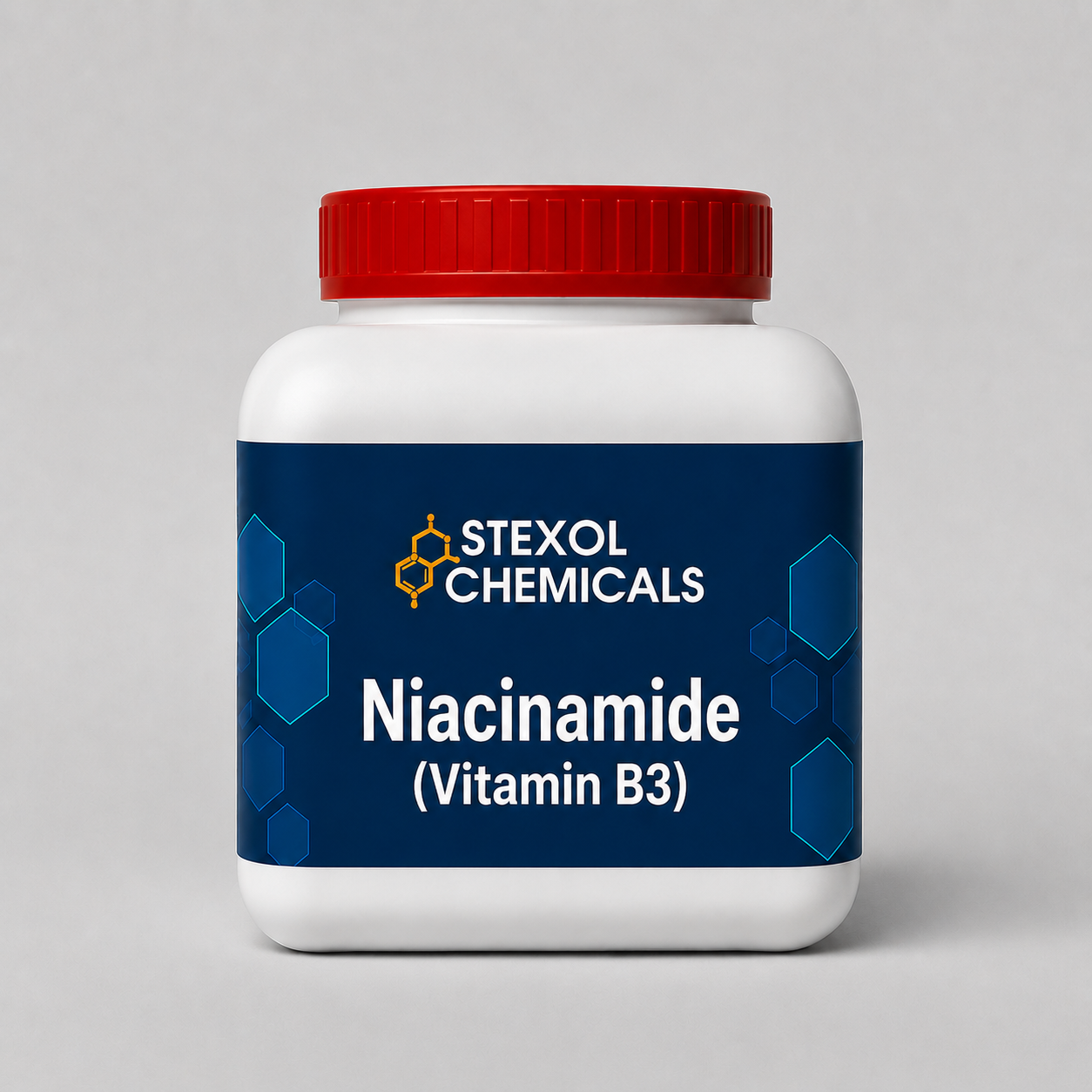
Niacinamide (B3) is a cosmetic-grade, high-purity vitamin B3 (INCI: Niacinamide, CAS 98-92-0, also called nicotinamide). It is supplied as a fine white crystalline powder with an assay of 99–101%. It is made to the same pharmacopoeia-type specification (USP/BP/EP) as the premium branded grades used by global skincare brands. dsm-firmenich’s Niacinamide PC, for example, specifies an assay of 99.0–101.0% w/w, a pH of 6.0–7.5 in solution and a melting range of 128–131°C. Formulas written around premium-branded niacinamide can switch to Niacinamide (B3) with no change to the ingredient list, because the INCI, CAS number, purity range and water-phase behaviour are the same. It is still just “Niacinamide” on your label.
In a finished product, niacinamide is the multi-tasking active that turns a basic serum, cream or toner into a product with a clear skin-benefit story. It helps the skin make its own barrier lipids, keeps oily skin looking less shiny, and evens out the look of dark spots and dullness. End consumers notice smoother-looking, more even, less oily skin within a few weeks of regular use. That’s why “niacinamide” is now one of the most searched ingredient words on Pakistani skincare shelves.
The key technical property is purity, and in particular a low level of nicotinic acid. Nicotinic acid (niacin) is the leftover impurity that causes the temporary warm, red “flush” some people feel from cheap niacinamide. Formulation experts point out that this reaction depends more on raw-material quality than on the pH of the formula. A high-assay grade with tightly controlled impurities lets you formulate at effective levels without that complaint. It also dissolves fully and clearly in water: Loba Chemie’s safety data sheet gives its solubility as 691 g/L at 20°C. That gives you crystal-clear serums and toners with no grit, haze or recrystallisation on the shelf.
Niacinamide does more than sit on the skin. In a British Journal of Dermatology study (Tanno et al., 2000; 143:524–531), it increased the skin’s own production of ceramides, free fatty acids and cholesterol. Applying it to dry skin raised stratum corneum ceramide levels and reduced transepidermal water loss (TEWL). One active gives your moisturisers and serums a real, evidence-based barrier-care claim.
Shoppers notice the difference. In a 12-week split-face trial of 50 women (Bissett et al., Dermatologic Surgery, 2005), 5% niacinamide applied twice daily reduced the appearance of fine lines and wrinkles, hyperpigmented spots, red blotchiness and sallowness compared with the same cream without it. At 2%, it significantly lowered the sebum excretion rate after 2 and 4 weeks in a double-blind study of 100 Japanese subjects (Draelos et al., Journal of Cosmetic and Laser Therapy, 2006), though not significantly in the study’s Caucasian group. For skincare brands in Pakistan, where oily skin, acne marks, uneven tone and the demand for “glow” and brightening drive buying, these are exactly the results that bring customers back for a second bottle.
Niacinamide is a small, non-ionic, water-soluble molecule. It does not thin your gels, break your emulsions or clash with common thickeners and emulsifiers. dsm-firmenich notes it can even be added straight into a finished O/W emulsion. You can add it to an existing formula without rebuilding the base.
You don’t need high loads to get a result. Clinical studies show benefits at 2% for oil control (Draelos et al., 2006) and 5% for tone and texture (Hakozaki et al., 2002; Bissett et al., 2005), while the popular “10%” serums sit at the top of the usual range. A single kilo covers roughly 20 kg of finished serum at 5%, or 50 kg of cream at 2%, so cost per bottle stays very low.
You get the same high-assay vitamin B3 specification that branded international grades offer, without paying import mark-ups or buying full drums. Niacinamide (B3) is now available in Pakistan through Stexol Chemicals in small lab packs and bulk quantities, with a COA for every batch. stexolchemicals
Niacinamide works with hyaluronic acid, panthenol, glycerin, zinc PCA, alpha arbutin, tranexamic acid, peptides, ceramides, allantoin, centella extracts and retinol. Pair niacinamide with zinc PCA for a best-selling oil-control “Niacinamide + Zinc” serum, or with alpha arbutin or tranexamic acid for a brightening serum. Niacinamide inhibits melanosome transfer from melanocytes to keratinocytes (Hakozaki et al., British Journal of Dermatology, 2002) while the other ingredients act on pigment production, so the two approaches complement each other.
Handling Note:
Niacinamide (B3) is a white, odourless crystalline powder that dissolves quickly and clearly in water. It also dissolves in alcohol and glycerin, but not in oils, so always add it to the water phase. It can be processed hot or cold up to 70°C, so you can add it to the heated water phase of an emulsion or dissolve it at room temperature for serums and toners. Many formulators prefer the cool-down phase (below 40°C) as good practice. Stir until the solution is completely clear before adding thickeners. Don’t combine it with strong acids, strong alkalis or oxidising agents, which can hydrolyse niacinamide into nicotinic acid (the cause of flushing). Also avoid ingredients containing amidase enzymes. The powder can pick up moisture and form soft lumps that crush easily. Reseal open containers tightly straight after use and store them in a cool, dry place away from light.
Product Type Levels of Usage:
Target pH: Aim for a final pH of 5.0–7.0, with about 6 as the sweet spot. dsm-firmenich gives a working range of 4.0–8.0 for its premium grade. Check pH after adding niacinamide and adjust with common neutralisers. Do not push the pH down with strong or highly concentrated acids.
|
Product Type |
Niacinamide (B3) in Formula (by weight) |
|---|---|
|
Face serum (brightening / oil-control) |
2–10% (4–5% most common) |
|
Face cream / moisturiser |
2–5% |
|
Toner / essence |
2–4% |
|
Face wash / cleanser (rinse-off) |
0.5–2% |
|
Body lotion / brightening body cream |
2–4% |
|
Sunscreen / day cream / BB cream |
2–5% |
|
Sheet mask essence |
2–4% |
|
Hair and scalp serum / tonic |
0.5–3% |
Formulation Build Order:
For an O/W cream or lotion:
For a water-based serum or toner:
Every batch ships with a Certificate of Analysis covering assay/purity, appearance, pH of solution, moisture (loss on drying) and batch number. Your QC team can verify each lot before it goes into production.
Order a small pack to develop and test your serum, or bulk quantities once you’re ready to scale. Buy only what you need, without tying up cash in stock. stexolchemicals
The more you buy, the lower your per-kg price. Message us on WhatsApp with your quantity for a quick bulk quote.
Orders confirmed before our daily cut-off ship the same day. We keep Niacinamide (B3) in stock so your production line never stalls waiting for raw materials.
It shares the same INCI (Niacinamide), CAS number (98-92-0) and pharmacopoeia-type purity range (assay 99–101%) as premium branded grades. That means it can replace them in existing formulas without changing your ingredient list. Each batch comes with a COA so you can check assay and pH yourself. Branded “PC” grades additionally guarantee very low residual nicotinic acid (below 100 ppm). If your formula is very low-pH or aimed at very sensitive skin, ask us for the nicotinic acid figure on the current batch.
Yes, with some sensible formulation choices. The “niacinamide and vitamin C cancel each other out” idea comes from old lab work. Mixing the two in water forms a yellow charge-transfer complex, but it is reversible and has not been shown to destroy either ingredient. The easiest approach is to pair niacinamide with stable vitamin C derivatives such as ascorbyl glucoside or sodium ascorbyl phosphate in the pH 5–7 range. Keep high-strength L-ascorbic acid and strong AHA/BHA exfoliants (pH below about 4) in a separate product. That way you avoid hydrolysis and any risk of flushing.
Niacinamide is a very stable vitamin. It handles heat, light and air well, and it is happiest between pH 5 and 7. dsm-firmenich gives a working range of 4.0–8.0. Strong acids or alkalis can slowly hydrolyse it into nicotinic acid, which causes temporary redness and warmth. Keeping the final pH near 6 protects both performance and skin comfort.
Store it in the original, tightly closed container in a cool, dry place (below 25°C) away from light and moisture. The powder can absorb humidity and cake, so reseal it promptly. Unopened and stored correctly, niacinamide typically keeps for 24–36 months from the manufacture date. Always follow the retest/expiry date on your batch COA.
Yes. These are some of the most popular pairings in Pakistani skincare. Niacinamide + zinc PCA is the classic oil-control serum, niacinamide + hyaluronic acid makes a hydrating barrier serum, and niacinamide + alpha arbutin or tranexamic acid makes a multi-route brightening serum. All are water-soluble and work comfortably at pH 5–7. Run a standard stability test on your final formula.
Niacinamide (B3) from Stexol Chemicals comes in small lab packs and bulk sizes, with a COA for every batch, same-day dispatch and tiered pricing on bigger orders. Message us on WhatsApp
[ +92-316-0099118 ] with your quantity for a quote today.
| weight | 1 kg, 500g, 250g, 100g |
|---|
Specifications not available.
Reviews
There are no reviews yet.