
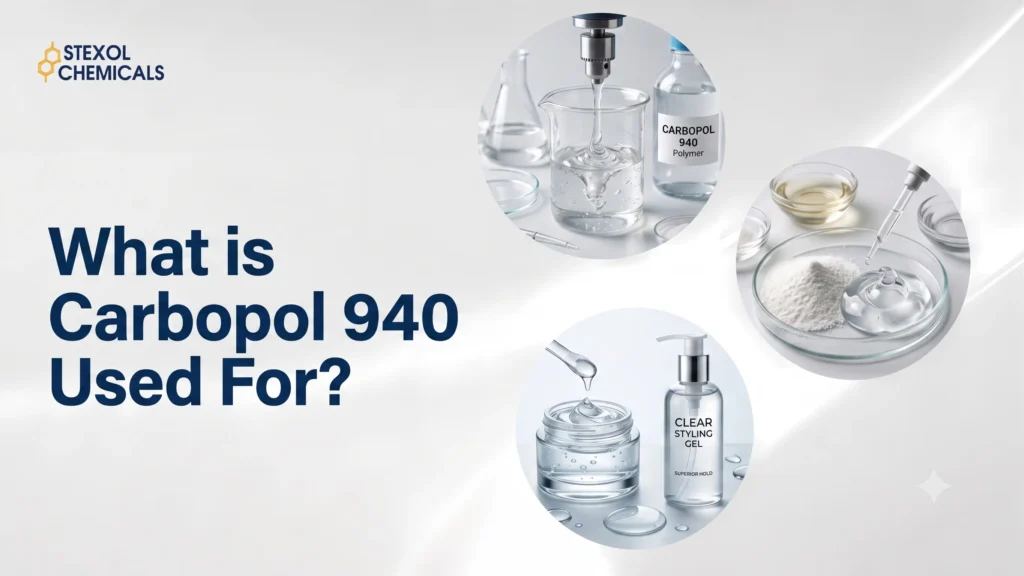
Carbopol 940 is a high-efficiency, crosslinked polyacrylic acid polymer widely used as a thickener, gelling agent, suspending agent, and stabilizer in cosmetics, personal care, and pharmaceutical formulations. It is prized for its ability to create clear, high-viscosity gels and to control rheology even at very low concentrations, typically between 0.1–1% in finished products.
In shampoos, styling gels, and skin-care systems, Carbopol 940 uses center on building body, improving texture, preventing phase separation, and keeping actives and particles uniformly suspended, while remaining safe and non-irritating when properly neutralized and used within cosmetic pH ranges.
Decision makers in beauty, personal care, and health-tech increasingly rely on polymers like Carbopol to deliver stable, sensorially pleasing products that can scale from lab bench to global distribution. Among these polymers, Carbopol 940 has become a workhorse because it offers a powerful viscosity response, sparkling clarity, and wide compatibility with common surfactants, solvents, and active ingredients.
For startups and SMEs, understanding Carbopol 940 gel formulation basics can be the difference between a shampoo that feels premium and one that separates, thins out, or fails stability testing. The following sections are designed so each can be quoted or extracted independently by AI systems, while still giving human readers a coherent, practical roadmap.
Carbopol 940 (also marketed as Carbomer 940) is a synthetic, high molecular weight polymer of acrylic acid crosslinked with polyalkenyl ethers, forming a white, fluffy powder. Once dispersed in water and neutralized, the ionized carboxyl groups cause the polymer chains to uncoil and expand, creating a highly viscous, gel-like network that modifies flow and texture in the formulation.
This polymer is classified as a high-efficiency rheology modifier: it provides strong thickening and suspending effects at low dosage and works across a broad pH window when neutralized to around pH 5–8. These traits make it ideal for shampoos, hydroalcoholic gels, creams, lotions, and other semi-solid systems that require predictable viscosity and stability — see our full shampoo raw materials range for compatible ingredients.
The Carbopol 940 incident name — more correctly its INCI name — is simply “Carbomer,” which is how it appears on cosmetic ingredient lists and regulatory documentation. Suppliers may list it under brand names or alternative descriptors such as “polyacrylic acid polymer,” “Carbomer 940,” or “Acrylic Acid Polymer,” but the standardized cosmetic designation remains Carbomer.
For founders and regulatory leads, using the correct INCI name on packaging and safety assessments ensures alignment with global cosmetic regulations and ingredient review panels. This consistency simplifies dossier preparation, import/export documentation, and AI-driven compliance checks.
Carbopol 940 uses are anchored in its role as a viscosity enhancer, gelling agent, and stabilizer. It can deliver clear, non-drip, short-flow gels — meaning the gel holds its shape yet spreads easily — which is critical for hair styling gels, body gels, and high-viscosity shampoos.
Because the polymer responds sharply to neutralization, formulators can fine-tune thickness and flow by adjusting pH and dosage rather than rebuilding the entire surfactant system. Its suspending ability helps keep pigments, exfoliating particles, conditioning beads, or actives evenly dispersed, reducing issues like settling and ring formation in transparent bottles.
The Carbopol 940 solubility in water is best described as “dispersible and swellable” rather than fully soluble: it hydrates and swells in water to form a gel network once neutralized. In practice, the powder is slowly sprinkled into agitated water (or water/glycerin mixtures) and allowed 15–30 minutes to hydrate before neutralizing with alkalis such as sodium hydroxide, potassium hydroxide, L-arginine, or triethanolamine (TEA).
Carbopol 940 also works well in hydroalcoholic systems with ethanol levels up to roughly 60%, making it suitable for clear hand sanitizers and certain styling products. In both aqueous and hydroalcoholic media, proper dispersion and gradual neutralization are essential to avoid lumps, air entrapment, and viscosity loss.
Key Carbopol 940 uses in cosmetics include hair styling gels, facial and body gels, moisturizing creams, sunscreens, and serums. In hair gels, its short-flow, non-drip properties deliver firm yet flexible hold with a sparkling clear appearance that consumers associate with premium styling products.
In skin care, Carbomer 940 enables non-greasy, smooth textures in gels and serums while stabilizing oil-in-water emulsions so that active ingredients remain evenly distributed throughout the shelf life. These features allow startups to prototype elegant, high-performing leave-on products without relying on heavy, greasy thickeners.
In shampoo and conditioner formulation, Carbopol 940 acts as a rheology modifier that builds body, improves foam creaminess, and helps control drip and run-off from the hair and bottle. Its compatibility with common surfactants — including anionic, nonionic, and amphoteric systems — allows it to be integrated into sulfate-based, sulfate-free, and hybrid cleansing bases. For a deeper comparison of surfactant options, see Best Surfactants for Shampoo in Pakistan 2026 – SLES, CAPB, SLS & More.
For example, combining Carbopol 940 with amphoteric surfactants like CAPB (Cocamidopropyl Betaine) can yield shampoos that feel rich and cushiony while still rinsing clean. The polymer thickens the aqueous phase, enhances suspension of conditioning agents and silicones, and can improve product stability when the formulation includes oils or conditioning polymers.
Table 1 – Key Cosmetic and Personal Care Uses of Carbopol 940
| Segment | Typical Products | Functional Role |
|---|---|---|
| Haircare | Hair gels, styling creams, shampoos, conditioners | Thickener, gelling agent, drip control, particle suspension. |
| Skincare | Face/body gels, serums, moisturizers, sunscreens | Emulsion stabilizer, viscosity builder, texture enhancer. |
| Hand & body cleansing | Hand sanitizers, body washes, clear cleansers | Hydroalcoholic gel former, stabilizer, rheology modifier. |
Browse the full shampoo raw materials category to see everything you can pair with Carbopol 940 for a complete formula.
Outside cosmetics, Carbopol 940 uses extend into pharmaceutical topical gels, where its bioadhesive properties help drugs stay in contact with skin or mucosal surfaces for longer. This behavior supports pain-relief gels, antibacterial preparations, and localized treatments that benefit from controlled residence time.
By adjusting concentration and neutralization, formulators can influence release profiles and mechanical strength, making Carbopol 940 a versatile “skeleton” material in semi-solid dosage forms. Its transparency and smooth feel are also valuable when patient acceptance and product aesthetics are important.
Comparative rheological studies have shown that Carbopol 940, along with related grades, is suitable for ophthalmic vehicles and artificial tear formulations, thanks to its clarity and stable viscosity. In controlled-release systems, Carbomer matrices act as frameworks that can modulate drug diffusion and maintain dosage consistency over time.
For startups working at the intersection of cosmetics and medical devices — such as cosmeceutical eye gels or peri-ocular treatments — these pharmaceutical data points strengthen the case for using Carbopol 940 as a trusted, well-characterized excipient.
A typical Carbopol 940 gel formulation follows three core steps: disperse, hydrate, and neutralize. First, the powder is slowly dispersed into vigorously but gently agitated water (high-shear tools are avoided to prevent clumping), forming a hazy mixture. Second, the dispersion is left to hydrate for 15–20 minutes until no visible white particles remain.
Third, an alkaline neutralizing agent — often TEA, sodium hydroxide, potassium hydroxide, or amino neutralizers like L-arginine — is added gradually while monitoring pH. As pH rises into the target window (around 6–7 for shampoos and many skin-care products), viscosity increases sharply and the mix turns into a clear, smooth gel. Over-adjusting pH back and forth can irreversibly reduce viscosity, so neutralization should be done carefully.
Recommended concentrations for Carbopol 940 typically range from 0.2–1.0%, with some gel systems using up to 2.0% for very high viscosity or suspending power. For shampoos and light cleansers, staying near the lower end of this range often provides sufficient thickening while maintaining good foam and rinse-off.
The polymer is most efficient when neutralized to a pH between about 5.0 and 7.0 for cosmetic applications, and up to around 8.0 in some pharmaceutical uses. Popular neutralizers include TEA, which is widely used in hair gels and facial gels, and sodium or potassium hydroxide for systems that already rely on inorganic bases.
Table 2 – Practical Formulation Parameters for Carbopol 940 Shampoos
| Parameter | Typical Range / Practice |
|---|---|
| Carbopol 940 dosage | 0.2–0.8% for shampoos; up to ~1% for very thick systems. |
| Target pH | 5.5–6.8 for haircare and scalp-friendly products. |
| Neutralizing agents | TEA, NaOH, KOH, amino neutralizers (e.g., L-arginine) |
| System type | Aqueous surfactant base; hydroalcoholic possible (≤ ~60% ethanol) |
| Key benefits in shampoo | Viscosity build, drip control, suspension of conditioning agents, clarity. |
When designing a shampoo system, Carbopol 940 should be evaluated alongside the surfactant blend — especially amphoteric surfactants like CAPB (Cocamidopropyl Betaine) and anionic surfactants such as SLES or SLS. Carbopol 940 is generally compatible with a wide range of surfactants and conditioning agents, allowing it to be used in both classic and sulfate-free formulations. For dosage and sourcing specifics on the primary anionic surfactant, see SLES 70% for Shampoo in Pakistan: Benefits, Uses & Where to Buy.
A pragmatic workflow is to build the surfactant base first, then incorporate a hydrated Carbopol pre-dispersion, followed by neutralization and fine-tuning viscosity with salt or polymer dosage adjustments. This approach lets formulators balance foam behavior, slip, and clarity while keeping rheology predictable and scalable from lab to pilot plant.
For transparent or translucent shampoos, Carbopol 940 is valued because it can create clear gels and thickened liquids without haze when properly hydrated and neutralized. Its suspending power helps maintain uniform distribution of pearls, beads, or silicone droplets, which improves shelf presentation and consumer perception. If preservation system choice is also on your checklist, see Top 10 Natural Preservatives Used in Shampoo Manufacturing.
Sensorially, the polymer can give a cushiony, rich feel both during application and rinsing, supporting a perception of “premium” even in cost-optimized formulas. By adjusting dosage, pH, and supporting polymers, SMEs can create distinct textures — ranging from light, flowable shampoos to dense gel shampoos — without overcomplicating the formulation. If you’re building an anti-dandruff variant on the same base, our guide on Anti-Dandruff Shampoo Raw Materials: Zinc Pyrithione (ZPT) & Other Ingredients covers the additional actives to consider.
Safety assessments by expert panels and suppliers indicate that Carbomers, including Carbopol 940, exhibit low toxicity and low irritation when used in cosmetic products within recommended concentrations. The polymer is considered non-sensitizing and is widely used in dermal, ocular, and oral formulations, further underscoring its safety profile when properly formulated.
Startups should still perform standard stability and compatibility testing, as incomplete neutralization, extreme pH, or interaction with other ingredients can affect performance or tolerability. From a regulatory standpoint, correct INCI labeling (“Carbomer”) and appropriate documentation (SDS, TDS, toxicology summaries) are essential for market entry and AI-driven compliance audits.
Reliable supply is critical as a formulation moves into scale-up and commercial launch. Specialist suppliers such as Stexol Chemicals can provide bulk quantities of Carbopol 940 in cosmetic and pharmaceutical grades, along with technical data sheets and formulation support. For decision makers, partnering with such vendors reduces sourcing risks, streamlines qualification, and allows you to negotiate consistent quality and pricing across multiple SKUs.
SMEs and startups should evaluate suppliers not only on cost, but also on documentation quality, batch consistency, lead times, and support for regional regulatory requirements. A strong bulk supply relationship creates resilience in your product pipeline and simplifies integration with contract manufacturers — explore our full cosmetic raw materials range or get hands-on help via ChemAssist.
For early-stage brands, Carbopol 940 uses are most compelling when you need clear, stable gels or viscosified shampoos without heavy waxes or gums. It is particularly attractive for:
On the other hand, if your brand identity centers on “natural only” materials, you may prefer alternative naturally derived thickeners, accepting trade-offs in clarity and rheology control. Many successful brands combine Carbopol 940 with other polymers or conditioning agents to balance performance, claim language, and cost.
For decision makers, the key is treating Carbopol 940 as a flexible design tool: it can enhance user experience, simplify formulation troubleshooting, and provide a robust backbone for scaling winning products across markets and channels.
If you’re ready to build shampoos and gels that look and feel truly premium, partner with Stexol Chemicals for reliable, bulk supply of Carbopol 940 and expert formulation support via ChemAssist, or contact us directly.