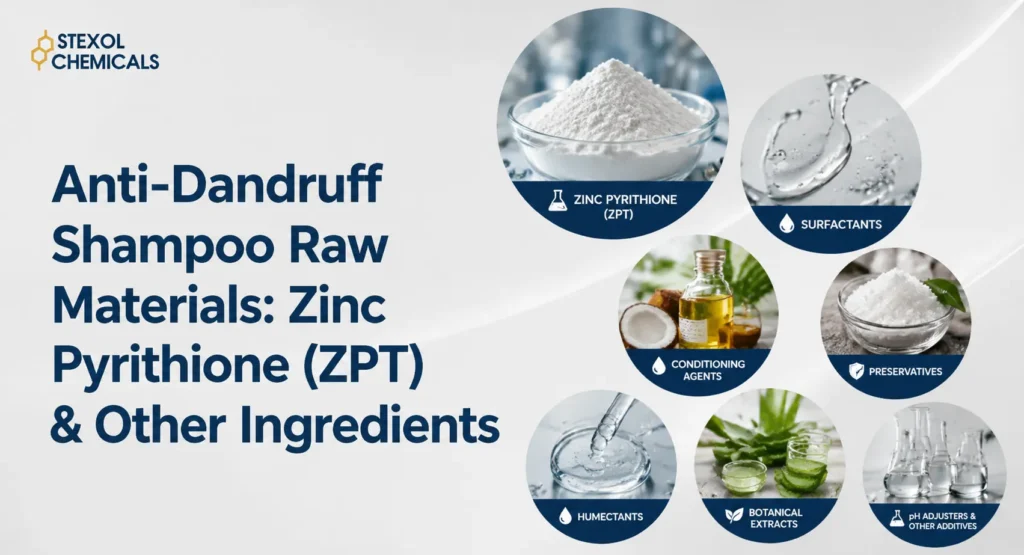
Anti-dandruff shampoos rely on antifungal/antimicrobial actives to stop the scalp fungus Malassezia, the main dandruff cause. The most common active is zinc pyrithione (ZPT), a broad-spectrum biocide that inhibits fungal and bacterial growth. Other effective ingredients include ketoconazole, climbazole, piroctone olamine, selenium sulfide, and natural agents like tea tree oil – each targeting dandruff in a different way. Below we explain each raw material’s role, typical use levels, and how to source them (especially in Pakistan).
Every shampoo contains a base of water, surfactants (cleansers), and conditioning agents, but an anti-dandruff shampoo specifically includes special active ingredients that target dandruff. The key targets are fungal overgrowth and scalp irritation. Zinc pyrithione (ZPT) is the “gold-standard” active due to its strong antifungal and antibacterial action. We also see imidazole antifungals (like ketoconazole), azole antifungals (climbazole), and older agents like coal tar and sulfur. Additionally, exfoliants like salicylic acid and soothing botanicals (e.g., tea tree oil) help remove flakes and calm the scalp. Later sections cover each ingredient’s purpose, usage levels, and sourcing. All are commonly used in modern anti-dandruff formulations, including those made in Pakistan.
Zinc Pyrithione is a zinc salt of pyrithione known for its antifungal and antibacterial properties. It is widely used in shampoos to treat dandruff, seborrheic dermatitis, and scalp infections. ZPT works by inhibiting the growth of the dandruff-causing yeast Malassezia and other microbes on the scalp, reducing flakiness, itching, and irritation. Head & Shoulders notes that “Zinc Pyrithione fights the dandruff-causing microbe and limits the production of substances that irritate your scalp.” In formulations, even low concentrations of ZPT (typically 0.5–2% in rinse-off products) can provide significant dandruff control. Its dual action on bacteria and fungi also helps preserve the product. Importantly, ZPT is gentle enough for most skin types and is often used daily.
ZPT is available in various forms. The raw compound is often sold as a fine powder (typically ~98% pure). To simplify formulation, suppliers also offer 50% zinc pyrithione suspensions, where ZPT is pre-dispersed in water or oil. For example, Shengqing Materials provides a “50% Zinc Pyrithione Suspension” for easy use in shampoos. Both forms are used: powder is cost-effective for bulk mixing, while suspensions ease dosing and dispersion in liquids. In Pakistan, manufacturers can buy ZPT from local distributors – often available as 98% powder or 48–50% suspension. (One supplier advertises “ZPT 48% – Zinc Pyrithione” as a standard anti-dandruff raw material in Pakistan.)
When purchasing, consider quality grades and shelf life. Good suppliers (like Stexol Chemicals) offer high-purity ZPT compliant with cosmetic standards. Typical packaging sizes are 1–25 kg for labs or bulk drums for industrial use. For example, a 50% ZPT suspension has about a 12-month shelf life. Always verify the certificate of analysis to ensure low heavy metal content and correct assay. Choosing a reliable Zinc Pyrithione Pakistan supplier is key, since consistent quality ensures your shampoo’s effectiveness.
Ketoconazole is a synthetic azole antifungal active found in medicated shampoos (e.g., Nizoral®). It is very effective against scalp fungi. Ketoconazole shampoo treats fungal infections of the skin, including dandruff and seborrheic dermatitis. It belongs to a group of antifungals that inhibit ergosterol synthesis in the fungal cell membrane. Typical over-the-counter formulations contain 1–2% ketoconazole. In practice, a 1% ketoconazole shampoo used twice weekly can significantly reduce severe dandruff. The clinical strength (2%) version requires a prescription.
Ketoconazole is usually chosen for persistent or severe cases. Unlike ZPT, ketoconazole does not double as a preservative; its sole purpose is the antifungal effect. Regular use (e.g., weekly washes) gradually controls Malassezia and soothes inflammation. The Cleveland Clinic notes that ketoconazole shampoo “treats fungal or yeast infections of the skin” and is applied like any shampoo. In formulations, ketoconazole often appears alongside lathering surfactants (e.g., SLS) and conditioners, with one convenient pump delivering the dose. For example, Nizoral 1% has ketoconazole as the only active. In Pakistan, ketoconazole 1% and 2% shampoos are prescription options; raw ketoconazole powder is also available from specialty suppliers for local formulation.
Climbazole is another antifungal commonly used in anti-dandruff shampoos, especially in Europe and Asia. Chemically, it is an imidazole similar to ketoconazole. Climbazole targets Malassezia fungi to stop dandruff at the source. It is valued for being potent yet gentle on the scalp. In formulations, climbazole is effective at low concentrations; typical usage in shampoos is around 0.1–0.5%. This low dose is enough to exhibit strong antifungal activity. Climbazole is often combined with other agents (like piroctone olamine or zinc compounds) for synergistic effects.
For example, combining climbazole with zinc pyrithione can tackle fungal growth and inflammation together. Climbazole is also stable in shampoos (compatible with common surfactants). First-time users should note it dissolves poorly in water, so formulators must pre-mix it in a suitable solvent or dispersant for even distribution. In Pakistan, climbazole is a recognized anti-dandruff ingredient; many cosmetic raw material sellers stock it. Whether labeled as “climbazole” or often as part of ingredient blends, it provides a modern alternative to older actives.
Piroctone Olamine (also known as Octopirox) is an antifungal amine widely used in dandruff shampoos as well. It has good efficacy against fungi and is often paired with salicylic acid or other actives. Unlike ZPT or ketoconazole, piroctone olamine also acts as a preservative. SpecialChem notes that shampoos with piroctone olamine “are very effective in curing dandruff and preventing hair loss.”
In practice, piroctone olamine is included at low levels (around 0.1–1%). Its safety profile allows up to 0.5% in leave-on (tonic) formulas and 0.1% in rinse-off shampoo. It’s gentle and suits sensitive scalps. Formulators often choose piroctone olamine for “all-natural” or organic lines since it is well-tolerated (though it’s not a “natural” ingredient). For example, many European brands use it instead of coal tar. In a shampoo, it targets dandruff by disrupting fungal cell walls and preventing microbial growth over time. It can also improve hair texture. In summary, piroctone olamine is a versatile anti-dandruff ingredient that adds antifungal power and mild preservation.
Selenium sulfide is an older but still important dandruff treatment. It is especially used for stubborn or severe cases. Like ZPT, it works as an antifungal against Malassezia. However, selenium sulfide is faster-acting and often used at higher strength (typically 1–2.5% in shampoos). It also has anti-seborrheic effects. Head & Shoulders notes that selenium sulfide “is a fast-acting and highly effective active ingredient” for even severe dandruff and seborrheic dermatitis.
The main difference: selenium sulfide tends to give a peach/orange tint to the shampoo (due to its color) and can be used less frequently (e.g., twice weekly). It may cause mild side effects like temporary hair discoloration or scalp irritation if overused. Cleveland Clinic states that “Selenium sulfide 1% and 2.5% strengths are used on the scalp to help control dandruff and seborrheic dermatitis.” In formulation, it’s typically the sole active in a clinical-strength shampoo. Many brands (e.g., Selsun Blue) have a 2.5% version.
So when to use it? For mild-moderate dandruff, ZPT (1–2%) is usually sufficient. For severe dandruff or flakiness, selenium sulfide (1–2.5%) or 2% ketoconazole may be preferred. Some lines offer both: a daily ZPT shampoo and a weekly selenium sulfide shampoo. In Pakistan, selenium sulfide 2.5% is prescription-only, but 1% versions exist OTC. Raw selenium sulfide is also available for local blending.
Salicylic acid is a keratolytic agent that breaks down thickened skin cells and removes scale. It does not kill fungus directly, but it helps the scalp shed the dead skin that traps flakes. The Cleveland Clinic explains that salicylic acid shampoo “breaks down layers of thick skin on your scalp” and treats dandruff, psoriasis, and eczema. It “reduces swelling, redness, itching” and “works by reducing…scaling on the skin.”
In anti-dandruff shampoos, salicylic acid is usually around 2–3%. For example, Neutrogena T/Sal contains 3% SA. It’s often paired with antifungals: while ZPT or ketoconazole attacks the fungus, salicylic acid clears the flakes and oil. This dual action gives relief from symptoms. In formulation, salicylic acid may need a slightly acidic pH to remain active. Limitations: it can be drying, so conditioners or hydrating agents are added to balance it. In practice, regular use (once or twice a week) helps lift dandruff scales so the antifungals can penetrate better.
Coal tar and sulfur are classic dandruff treatments, though less common in modern premium shampoos. Coal tar slows down excessive skin cell production. It is especially useful for dandruff accompanied by psoriasis or severe scaling. Even a 1% coal tar solution can control scalp symptoms. FDA labeling for a coal tar shampoo shows a “5% Coal tar topical solution (1% Coal tar)” used for dandruff, seborrheic dermatitis, and psoriasis. In other words, coal tar is a category: shampoos typically contain around 0.5–5% coal tar (or tar solution). It is effective but can have a strong odor and is used for twice-weekly treatment.
Sulfur has antifungal and anti-seborrheic properties. It helps reduce oiliness and fungus on the scalp. In cosmetic ingredient databases, sulfur is listed as an “anti-seborrheic” and “anti-dandruff” agent. Many medicated shampoos combine sulfur (2–5%) with salicylic acid to maximize flake reduction. For example, the classic “Sulfur 8” line uses sulfur plus other actives. Like coal tar, sulfur can be drying, so it’s often in rinse-off washes rather than leave-on. Sulfur’s scent can be strong, so it’s used in niche or clinical products.
In summary, coal tar and sulfur are older, inexpensive actives. They control dandruff by slowing skin turnover and killing fungi. They’re often chosen for severe cases or when other agents fail. In Pakistan, coal tar and sulfur are available to manufacturers (e.g., in therapeutic shampoo formulas). They may not be as fashionable as cosmetic ingredients, but they remain important tools in the formulation toolbox.
Tea tree oil (Melaleuca alternifolia) is a plant-derived oil known for its antimicrobial and antifungal effects. It is not as potent as prescription actives, but it can soothe dandruff symptoms. Studies show that a 5% tea tree oil shampoo can significantly reduce dandruff (one study reported a ~41% improvement vs. placebo). Tea tree oil works by fighting Malassezia yeast and bacteria on the scalp. It also has anti-inflammatory and cooling effects.
In anti-dandruff shampoos, tea tree oil is typically used at 1–10% (often around 5%). It is suitable for daily use and adds a natural “cure” angle. Tea tree is often combined with other antifungals for a boost. The Verywell Health review notes: “Tea tree oil has antifungal and antimicrobial properties that fight [Malassezia]… people who used a 5% tea tree oil shampoo daily for four weeks had a 41% reduction in their dandruff.”
In Pakistan, tea tree oil is readily available and can be incorporated into shampoos as a soothing additive. Its scent also freshens formulations.
For manufacturers and formulators in Pakistan, multiple suppliers stock these raw materials. Stexol Chemicals is a leading supplier of cosmetic actives and can provide ZPT (48–50% suspensions or powder), ketoconazole, climbazole, piroctone olamine, selenium sulfide, salicylic acid, sulfur, tea tree oil, etc. Stexol typically lists products like “ZPT 48% Zinc Pyrithione” as stock items. Other local distributors (e.g., BioShop, Cosmetihub, Pakistan-Cosmetics) also offer these chemicals.
When looking to buy Zinc Pyrithione in Pakistan, note that it is often the “gold standard” active, so ensure you compare prices and purities. Many sellers offer both powder and 50% suspension forms. For example, one online shop advertises Zinc Pyrithione 50% Suspension as a scalp care active (USA source), and similar products are imported into Pakistan. Bulk orders (≥10 kg) typically get better pricing. Ketoconazole, climbazole, and piroctone olamine are also available from specialty cosmetic raw material houses; check the certificate of analysis for strength and purity.
For authenticity and support, consider suppliers that provide documentation and technical advice. Stexol Chemicals, for instance, offers formulation guides and QA data. Industry clients often link to the supplier’s solutions pages for cosmetic raw materials (internal link suggestion: Stexol’s shampoo raw materials or formulation services page) when learning about these shampoo ingredients. Small to medium businesses can also source through local distributors who import these actives.
| Ingredient | Function/Action | Typical Use in Shampoo |
| Zinc Pyrithione | Antifungal/antibacterial (inhibits Malassezia fungi and bacteria) | 0.5–2% (mild-moderate dandruff) |
| Ketoconazole | Broad-spectrum antifungal (azole class) | 1–2% (moderate-severe dandruff) |
| Climbazole | Antifungal (azole class) | 0.1–0.5% (dandruff, similar to ketoconazole) |
| Piroctone Olamine | Antifungal/antimicrobial, mild preservative | 0.1–0.5% (gentle dandruff control) |
| Selenium Sulfide | Antifungal (fast-acting) | 1–2.5% (severe dandruff/dermatitis) |
| Salicylic Acid | Keratolytic (exfoliant) | ~2–3% (removes scalp scales) |
| Coal Tar | Retards skin cell growth (keratolytic) | 0.5–5% (controls psoriasis/dandruff) |
| Sulfur | Antiseborrheic, antifungal | ~2–5% (reduces oil and fungus) |
| Tea Tree Oil | Natural antifungal/antimicrobial | ~1–5% (soothes, mild dandruff) |
Ready to develop your own effective anti-dandruff shampoo? Contact Stexol Chemicals for top-quality zinc pyrithione, ketoconazole, climbazole, and other scalp-care actives. Our experts ensure you get the right raw materials and formulation support to beat dandruff and deliver consumer value. Contact Stexol today to source the best ingredients at competitive prices!