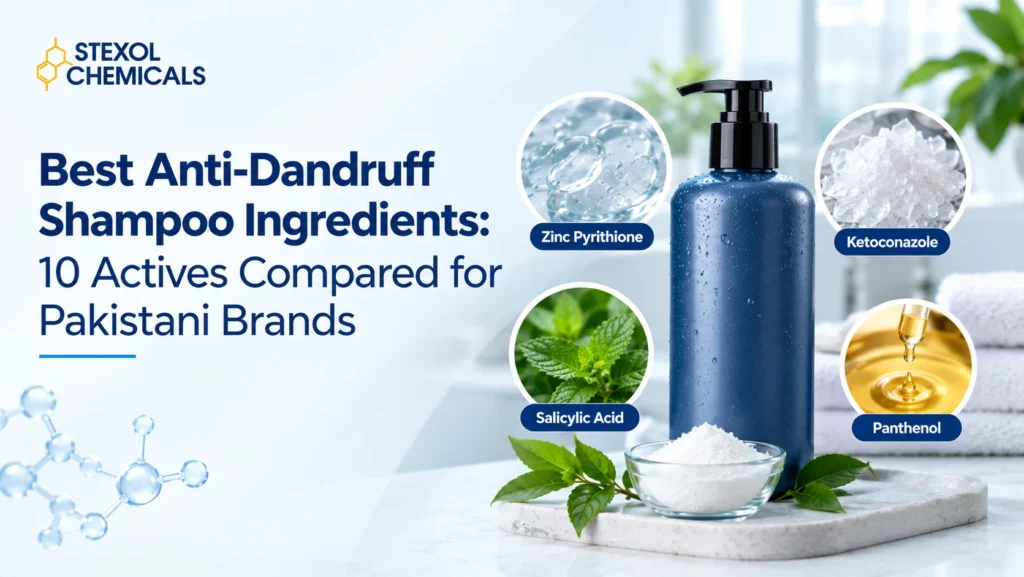
The best ingredients for a dandruff shampoo are antifungal actives that control Malassezia yeast, backed by a keratolytic and a mild surfactant base. Piroctone olamine (0.5–1%) and climbazole (0.5%) lead cosmetic launches. Zinc pyrithione (0.3–2%) and selenium sulfide (1%) are proven but restricted. Salicylic acid (1.8–3%) clears flakes. Ketoconazole belongs only in registered medicated products.
An anti-dandruff active is an ingredient that reduces visible flaking in one of three ways: it suppresses Malassezia yeast, slows excess skin-cell turnover, or loosens scale so it rinses away. Every effective dandruff shampoo relies on at least one of these mechanisms.
Malassezia is a lipophilic (oil-loving) yeast that lives on every scalp and feeds on sebum. A 2026 review by Mayser and colleagues in Cosmetics estimates that dandruff affects around 50% of the global population. The review treats dandruff and seborrheic dermatitis, the redder and more inflamed form, as one continuous spectrum.
Zinc PCA and decylene glycol add sebum control as a supporting route. Neither is a recognised primary active under US or EU dandruff rules. Browse the full Actives range for the antifungal and scalp-care actives available from Stexol.
Piroctone olamine is the best all-round active for a cosmetic anti-dandruff shampoo in 2026. Climbazole is the best low-cost partner, and salicylic acid is the best add-on for clearing flakes. Zinc pyrithione and selenium sulfide still work, but each carries a market restriction.
The Cosmetics review cites these Mintel GNPD counts of new anti-dandruff product variants in 2025:
| Active | New variants (2025) |
|---|---|
| Piroctone olamine | 765 |
| Salicylic acid / sodium salicylate | 539 |
| Climbazole | 185 |
| Zinc pyrithione | 140 |
| Selenium sulfide | 119 |
| Sulfur | 15 |
| Coal tar | 1 |
Four of that review’s five authors work for Symrise, which supplies several of these actives. Read its market commentary as industry-informed.
| Active | Mechanism | Typical rinse-off level | Market status | Formulation catch | Verdict for SMEs |
|---|---|---|---|---|---|
| Piroctone olamine | Antifungal (binds iron) | 0.5–1% | EU Annex V max 1%; not a US monograph active | Water-insoluble; light-sensitive | First choice for cosmetic launches |
| Climbazole | Azole antifungal | 0.5% | EU up to 2% in anti-dandruff shampoo; not a US monograph active | Needs a solvent or fragrance to dissolve | Low-cost partner |
| Zinc pyrithione | Antifungal, antibacterial | About 1% (US 0.3–2%) | US OTC; banned in EU cosmetics | Settles; turns blue-grey with iron | Avoid if you plan to export to the EU |
| Selenium sulfide | Antifungal, cytostatic | 1% (0.6% micronized) | US OTC; EU max 1% with a warning | Orange colour, odour, needs suspending | Medicated tier |
| Salicylic acid | Keratolytic | 1.5–3% | US OTC 1.8–3%; EU max 3% in rinse-off | Stings; eye irritant | Best add-on |
| Sulfur | Keratolytic | 2–5% | US OTC | Odour, dryness | Niche |
| Coal tar | Cytostatic | 0.5–5% | US OTC; banned in EU cosmetics | Odour, staining, sun sensitivity | Avoid |
| Ketoconazole | Azole antifungal | 1% OTC (US, by NDA); 2% prescription | Drug | Needs drug registration | Pharma route only |
| Ciclopirox | Hydroxypyridone | 1% prescription | Drug | Needs drug registration | Pharma route only |
| Tea tree oil | Botanical | 5% in the only RCT | Cosmetic | Allergy risk, odour | Supporting role only |
Piroctone olamine is a hydroxypyridone. It binds iron and aluminium ions, which shuts down the metal-dependent enzymes Malassezia needs. The 2026 Cosmetics review reports three points in its favour:
Its price has also fallen as global volumes grew after the EU banned zinc pyrithione. For a closer look at the azole option that pairs with it, see our Climbazole guide.
Regulators set anti-dandruff active levels first; efficacy comes second. Under the US OTC monograph, a dandruff shampoo uses 1% selenium sulfide, 0.3–2% pyrithione zinc, 1.8–3% salicylic acid or 2–5% sulfur. The EU caps piroctone olamine at 1% and climbazole at 2% in rinse-off anti-dandruff shampoos.
| Active | US FDA (21 CFR 358.710) | EU Regulation 1223/2009 | Common formulator range |
|---|---|---|---|
| Pyrithione zinc | 0.3–2% rinse-off for dandruff; 0.95–2% for seborrheic dermatitis | Prohibited (Annex II) since 1 March 2022 | About 1% |
| Selenium sulfide | 1%; 0.6% micronized | Max 1%, anti-dandruff shampoo only, with warning label (Annex III/49) | 1% |
| Salicylic acid | 1.8–3% | Max 3% in rinse-off hair products (Annex III/98) | 1.5–3% |
| Sulfur | 2–5% | Not specifically restricted | 2–5% |
| Coal tar | 0.5–5% | Prohibited (Annex II/420) | Not recommended |
| Piroctone olamine | Not a monograph active | Max 1% rinse-off, 0.5% other (Annex V/35) | 0.5–1% |
| Climbazole | Not a monograph active | Max 2% in anti-dandruff shampoo (Annex III/310) | 0.5% |
| Ketoconazole | 1% OTC under NDA 20-310; 2% prescription | – | Drug only |
| Ciclopirox | 1% prescription (Loprox), adults | Medicinal product | Drug only |
In the US, a shampoo that claims to control dandruff is an OTC drug and must use a monograph active at a monograph level. Piroctone olamine and climbazole therefore cannot carry a US dandruff drug claim. China’s NMPA will cap climbazole at 0.5% in rinse-off hair products from 1 January 2028, according to the 2026 Cosmetics review.
Zinc pyrithione has been banned from all cosmetics sold in the EU since 1 March 2022, but it remains a permitted US OTC dandruff active, and no DRAP ban was found during research for this article. Pakistani brands selling only at home can still use it; brands with export plans should not build their range around it.
The EU added zinc pyrithione to Annex II through Commission Regulation (EU) 2021/1902 after classifying it as toxic for reproduction, category 1B. That makes it a CMR substance (carcinogenic, mutagenic or toxic for reproduction), which is automatically banned from cosmetics.
In 2020 the EU’s Scientific Committee on Consumer Safety concluded that shampoo containing less than 1% zinc pyrithione was safe for consumers. The ban went ahead anyway, because zinc pyrithione could not meet the narrow exemption conditions for CMR substances. The UK followed from 15 October 2022.
Pharmacy chain DVAGO lists Photonic Max Anti Dandruff Shampoo as a zinc pyrithione product sold in Pakistan. For the full picture on this active, see Anti-Dandruff Shampoo Raw Materials: Zinc Pyrithione (ZPT) & Other Ingredients.
DRAP regulates medicated shampoos as a distinct product class under the DRAP Act 2012. A DRAP notification dated 6 October 2026 reportedly lists medicated shampoos among eight categories declared therapeutic goods. At the time of writing, its practical requirements had not been published.
DRAP’s SRO page lists a “Notification of Health and OTC Products as Therapeutic Goods (06.10.2026).” I could not read the PDF itself. According to Pakera.pk, it is S.R.O. 1688(I)/2026 and covers eight categories:
Press reports from APP and Express Tribune say covered products will face registration and approval requirements. The text as reported sets no deadline, fee or route.
The Alternative Medicines and Health Products (Enlistment) Rules 2014, S.R.O. 412(I)/2014, covered medicated shampoos “containing natural ingredients” and barred synthetic “allopathic ingredients.” This is our reading, not DRAP guidance: a ketoconazole-based shampoo more likely needs drug registration than enlistment.
No DRAP document we reviewed names specific anti-dandruff actives or concentration thresholds. Consult a DRAP regulatory consultant before you print treatment claims.
Ketoconazole 2% is the most effective single active in head-to-head shampoo trials, but among cosmetic-grade actives, piroctone olamine and climbazole perform in the same range as zinc pyrithione. In a 343-subject trial, ketoconazole 2% beat zinc pyrithione 1% on severity and recurrence after four weeks.
| Comparison | Design | Result |
|---|---|---|
| Ketoconazole 2% vs zinc pyrithione 1% | 343 subjects, severe dandruff/seborrheic dermatitis; 4 weeks plus 4 weeks follow-up (Piérard-Franchimont et al., PMID 12476017) | Ketoconazole significantly superior; lower recurrence |
| Ketoconazole 2% vs selenium sulfide 2.5% vs placebo | 246 people; 29 days | 73% vs 67% vs 45% reduction in dandruff score; ketoconazole better tolerated |
| Piroctone olamine 0.5% + climbazole 0.45% vs zinc pyrithione 1% | Moderate to severe dandruff | Comparable antifungal effectiveness |
| Climbazole vs piroctone olamine shampoo | 120 men; 3 times a week for 5 weeks (Iranian J Dermatol, 2009) | Complete clearance in 80% vs 55% |
| Piroctone olamine/climbazole blends vs ketoconazole 2% | In vitro (Ergin et al., J Cosmet Dermatol, 2024) | Some blends matched ketoconazole; lab data only |
| 5% tea tree oil vs placebo | 126 patients; daily for 4 weeks (Satchell et al., JAAD, 2002) | 41% vs 11% improvement |
Limits to keep in mind:
Most anti-dandruff actives are insoluble or chemically reactive. The real work is keeping them dispersed, stable and the right colour for the whole shelf life.
| Active | Physical form | pH guidance | Main risk | Practical fix |
|---|---|---|---|---|
| Zinc pyrithione | Insoluble; often sold as a ~48% dispersion | Patent data: dissociates below pH 4.5, hydrolyses above 9.5 | Blue-grey colour from trace iron; settling; EDTA can strip the zinc | Acrylates crosspolymer or magnesium aluminium silicate; small zinc-salt addition; stainless steel equipment |
| Selenium sulfide | Orange, insoluble powder | Patents buffer at pH 4–6 and keep it below 6.5 | Settling, colour drift, H₂S with strong acid | HPMC, xanthan or magnesium aluminium silicate; buffer system |
| Piroctone olamine | Nearly insoluble in water and oils; dissolves in surfactants, glycols, ethanol | – | Light degradation; binding to iron reduces activity | Pre-dissolve in the surfactant phase; opaque pack |
| Climbazole | Dissolves in fragrance oils and solvents | One patent found pH 4 beat pH 7 | Very toxic to aquatic life (H400/H410) | Dissolve in fragrance or glycol first |
| Salicylic acid | Limited water solubility; sodium salicylate dissolves easily | Converts to the active acid below pH 7 | Stinging; eye irritation | Sodium salicylate plus citric acid |
| Tea tree oil | Essential oil | No special window | Allergy; odour | Solubiliser; keep claims cosmetic |
One study found climbazole worked better in a sodium laureth sulfate (SLES) base than in the other surfactants it tested.
Supporting ingredients do not carry the anti-dandruff claim, but they decide whether people keep using the shampoo long enough for the active to work. In a 40-woman crossover study, 75% preferred a 1% zinc pyrithione conditioning shampoo over 2% ketoconazole on overall performance, mainly because of how their hair felt.
The Stexol SCALP Filter is a five-step check that narrows ten candidate actives to one or two before you order samples.
Worked example (illustrative only, not a validated formula): A Pakistani brand with plans to export to the UAE and EU drops zinc pyrithione, coal tar and ketoconazole. It chooses 0.5% piroctone olamine plus 0.5% climbazole, with 1.5% salicylic acid added as sodium salicylate. The base is SLES/CAPB at around pH 5.5, in an opaque bottle.
A medicated dandruff shampoo works best when it is massaged into the scalp, left on for several minutes before rinsing, and used two to three times a week. Mayo Clinic advises switching between shampoos with different actives and continuing at least once a week after flakes clear to stop them returning.
Mayo Clinic also says people with curly or coiled hair may need to use it less often. Anyone who feels itching, burning or stinging should stop. For reference, the tea tree trial used 3 minutes of contact, and the ciclopirox label specifies twice weekly for 4 weeks.
Suggested label directions:
A brand should avoid medicated actives and treatment claims whenever it cannot register the product as a drug or support the claim with evidence. Avoid them in these cases:
Consumers with red or oozing skin, silvery scale or flaking beyond the scalp should see a dermatologist.
These are the follow-up questions shampoo makers ask most often.
Can a shampoo control dandruff without a medicated active?
A shampoo without an antifungal or keratolytic active can wash away loose flakes, but it does not reduce Malassezia. Mayo Clinic suggests starting mild cases with more frequent washing using a gentle shampoo.
Can I combine two anti-dandruff actives in one formula?
Yes. Piroctone olamine with climbazole, and piroctone olamine with salicylic acid, are both widely used pairs. In the US, only listed combinations, such as salicylic acid with sulfur, are allowed under the monograph.
Is tea tree oil strong enough to be the only active?
Tea tree oil at 5% beat placebo in one 126-person trial. Mayo Clinic says there is no strong evidence that it helps dandruff and that it can cause allergic reactions. Use it as a supporting ingredient.
Will anti-dandruff actives discolour light or coloured hair?
Selenium sulfide and coal tar can discolour light, grey or treated hair, and coal tar raises sun sensitivity.
How long does an anti-dandruff shampoo take to show results?
Most trials measure results at four weeks. Mayo Clinic advises seeing a professional if there is no improvement after a few weeks.
Which anti-dandruff actives are already used in shampoos sold in Pakistan?
These are the anti-dandruff actives, already used in shampoos:
Can I buy anti-dandruff raw materials in small quantities in Pakistan?
Stexol Chemicals supplies cosmetic-grade shampoo raw materials in trial quantities, with a COA for each batch and formulation support.
The fastest safe route to market is to pick one active with the SCALP Filter, make three small trial batches, and run stability tests before you buy in bulk. Stexol supplies cosmetic-grade shampoo raw materials from 1 kg, with expert formulation support. Browse the full shampoo raw materials range, start with ChemAssist, or contact us. For a wider look at building the rest of the formula, see our Hair Care Formulation page.