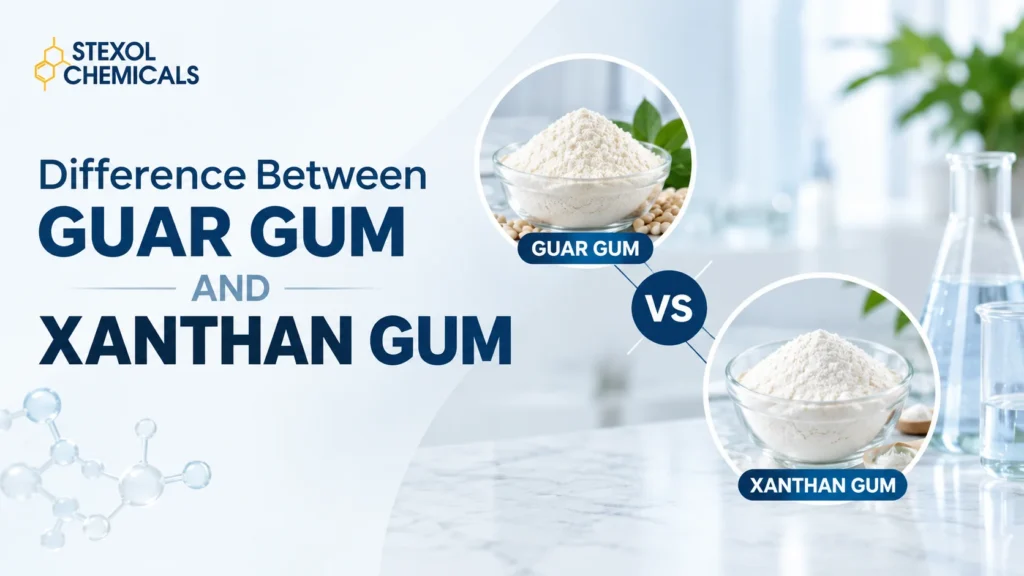
The main difference between guar gum and xanthan gum is charge and stability: guar gum is a non-ionic galactomannan milled from guar beans, while xanthan gum is an anionic polysaccharide made by bacterial fermentation. Xanthan gum stays stable from pH 1 to 12 and suspends particles at rest. Guar gum costs less but loses viscosity below pH 5.
Guar gum and xanthan gum are both cold-water-soluble polysaccharide thickeners approved as food additives worldwide, but they come from completely different places and carry different electrical charges. Guar gum is plant-derived and non-ionic. Xanthan gum is microbial and anionic. That single difference in charge drives most of their behaviour in a real formula.
Guar gum is a galactomannan milled from the endosperm of the guar bean, Cyamopsis tetragonoloba, also called the cluster bean. The seed is dehulled and split, the germ is screened out, and the endosperm is ground into powder. The polymer is a linear mannose backbone with single galactose side units at a mannose-to-galactose ratio of roughly 2:1 per the FAO/JECFA assessment, though some primary studies report 1.6:1 to 1.8:1. Guar gum carries CAS number 9000-30-0 and the food additive number E412.
Xanthan gum is produced by aerobic fermentation of a carbohydrate substrate, usually glucose or sucrose derived from corn, wheat or soy, by the bacterium Xanthomonas campestris. The broth is precipitated with isopropanol or ethanol, dried and milled. The polymer has a cellulose-like glucose backbone with trisaccharide side chains carrying pyruvate and acetate groups, which is what makes xanthan gum anionic. Xanthan gum carries CAS number 11138-66-2 and the food additive number E415.
| Property | Guar Gum | Xanthan Gum |
|---|---|---|
| Source | Endosperm of Cyamopsis tetragonoloba (guar bean) | Fermentation of sugar by Xanthomonas campestris |
| Food INCI / additive no. | E412 / INS 412 | E415 / INS 415 |
| Cosmetic INCI | Cyamopsis Tetragonoloba (Guar) Gum | Xanthan Gum |
| CAS number | 9000-30-0 | 11138-66-2 |
| Ionic charge | Non-ionic | Anionic |
| Cold-water soluble | Yes, hydrates rapidly | Yes, but wets poorly and clumps |
| Effective from | ~0.2% | ~0.05% |
| Viscosity, 1% solution | ~2,700 cps | Higher at equal concentration |
| pH stability | Best pH 5–7; degrades below pH 5 | Stable pH 1–12; unchanged pH 2–12 |
| Heat stability | Thins above ~80 °C on prolonged heat | Stable −18 °C to ~80 °C |
| Freeze–thaw | Poor | Excellent |
| Yield stress (suspends particles at rest) | No true yield stress | Yes |
| Salt tolerance | Non-ionic, relatively insensitive | High; salt raises viscosity at higher gum levels |
| Relative cost per kg | Lower | Higher |
| US regulatory | 21 CFR 184.1339 (GRAS) | 21 CFR 172.695 |
| EFSA (2017) | No numerical ADI needed | No numerical ADI needed |
The choice between guar gum and xanthan gum is usually settled by three numbers: the pH of the finished product, its maximum processing temperature, and its salt content. Xanthan gum wins on all three in demanding conditions.
pH. Xanthan gum holds viscosity essentially unchanged from pH 2 to pH 12. Above pH 9 it slowly deacetylates and below pH 2 it loses pyruvate, but neither meaningfully affects thickness. Guar gum is most stable between pH 5 and pH 7 and hydrolyses below pH 5, which is why it underperforms in citrus drinks, vinegar dressings and low-pH cleansers. Some published comparisons claim guar gum performs best at pH 3–4; that contradicts the galactomannan literature and should be disregarded.
Temperature. Xanthan gum viscosity stays broadly constant from −18 °C to roughly 79–80 °C, and it survives repeated freeze-thaw cycles. Guar gum thins and degrades on prolonged heating above about 80 °C and handles freeze-thaw poorly.
Salt. Because guar gum is non-ionic, added salt does relatively little to it. Xanthan gum is salt-tolerant, and at gum levels above roughly 0.25% added monovalent salt actually increases viscosity, plateauing near 0.1% sodium chloride.
In gluten-free baking, xanthan gum gives dough elasticity and stretch, which suits yeasted breads and pizza dough, while guar gum gives softness and crumb tenderness, which suits cookies, muffins, quick breads and pastry. Guar gum also performs well in cold and no-bake applications such as ice cream.
The commonly published substitution ratio is 1.5 parts guar gum for 1 part xanthan gum. Treat that number with care. It is a practitioner rule of thumb in baking, and no primary source supports it; the ingredient producer Jungbunzlauer states that guar gum needs roughly two to four times the concentration of xanthan gum for equivalent viscosity. Test at 1.5:1, then adjust.
Typical food use levels sit between 0.1% and 0.5% for both gums.
Allergen note: xanthan gum is fermented on corn, wheat or soy substrates, so cross-contact matters for anyone with a corn or soy allergy or coeliac disease. Confirm certified gluten-free status on the certificate of analysis.
In shampoo, the comparison most articles make is the wrong one. Plain guar gum and xanthan gum do not compete for the same job. Xanthan gum thickens and suspends. The guar ingredient that actually matters in haircare is a modified, positively charged derivative called cationic guar, and it conditions rather than thickens. Choosing plain guar gum because an article recommended “guar gum for shampoo” is one of the most common and most expensive formulation errors in small-batch haircare.
Plain guar gum is non-ionic and contributes viscosity and a slightly heavy feel. Cationic guar is guar that has been reacted to carry positive charge, and it functions as a conditioning and deposition polymer. These are not interchangeable ingredients.
| Ingredient | INCI name | Charge | Primary job in haircare |
|---|---|---|---|
| Plain guar gum | Cyamopsis Tetragonoloba (Guar) Gum | Non-ionic | Thickening; adds haze |
| Cationic guar | Guar Hydroxypropyltrimonium Chloride (CAS 65497-29-2) | Cationic | Conditioning, deposition, wet and dry combing |
| Hydroxypropyl guar | Hydroxypropyl Guar | Non-ionic | Thickening with better clarity |
| Cationic hydroxypropyl guar | Hydroxypropyl Guar Hydroxypropyltrimonium Chloride | Cationic | Conditioning with improved clarity |
| Xanthan gum | Xanthan Gum | Anionic | Thickening, suspending insolubles |
Cationic guar is sold under trade names including Solvay’s Jaguar range (C-13S, C-14S, C-15, C-17, Excel, Optima) and Ashland’s N-Hance range. Grades differ by molecular weight and charge density, typically from under 1 million to several million g/mol and roughly 0.05 to 2.5 meq/g. Higher charge density drives stronger deposition and conditioning; lower molecular weight gives a more translucent shampoo.
Cationic guar works through coacervation, meaning that during the wash, as the shampoo is diluted with water, the positively charged guar and the negatively charged surfactant separate out together as a concentrated complex that deposits on the hair, carrying silicones and oils with it. One published formulation using a guar derivative of 250,000 to 600,000 molecular weight at 0.2% to 0.9% reduced wet-combing work by at least 50%.
Xanthan gum in a shampoo builds viscosity and, more importantly, creates yield stress, which is the property that lets a liquid hold solid particles suspended at rest and still pour and spread under shear. That is what keeps exfoliating beads, mica, silicone droplets and pearlising agents from sinking or creaming in the bottle. Xanthan gum contributes no conditioning. The trade publication Happi puts it directly: in haircare, xanthan gum offers little beyond thickening.
Xanthan gum is anionic. It is not compatible with cationic surfactants, cationic polymers or cationic preservatives, and combining them causes precipitation. That rule, stated in the ChemicalBook monograph for CAS 11138-66-2, is the single most useful thing a shampoo formulator can memorise about xanthan gum. The same source notes that anionic and amphoteric surfactants above 15% w/v will also precipitate xanthan gum out of solution.
Practically, this means:
| Ingredient | Typical use level (% w/w) | Purpose |
|---|---|---|
| Xanthan gum, general thickening | 0.1% – 0.5% | Viscosity; above this it turns stringy |
| Xanthan gum, suspending silicone or beads | 0.3% – 3.0% (commonly 0.4% – 1.2%) | Yield stress for suspension |
| Guar Hydroxypropyltrimonium Chloride | 0.1% – 1.5% (commonly 0.1% – 0.5%) | Conditioning, deposition, combing |
| Hydroxypropyl Guar | 0.1% – 1.5% | Thickening with better clarity |
| Hydroxypropyl Guar Hydroxypropyltrimonium Chloride | 0.01% – 4.0% (commonly 0.1% – 1.0%) | Conditioning with clarity |
For a crystal-clear shampoo, use a clarified or transparent-grade xanthan gum, or a lower-molecular-weight cationic guar. Plain guar gum adds haze and should be avoided in clear systems. For opaque or pearlised shampoos, xanthan gum’s yield stress is what holds glycol distearate pearlisers, silicone droplets and suspended actives in place through shelf life.
In a conventional SLES and cocamidopropyl betaine shampoo, viscosity is usually built with sodium chloride, thickening somewhere between 0.5% and 3% NaCl depending on active matter. In sulfate-free systems built on SCI, sodium cocoyl glutamate or coco glucoside, that salt curve frequently fails, because these mild surfactants do not form the salt-responsive worm-like micelles that make the curve work. Polymeric and gum thickeners take over.
The trap is well documented: adding an anionic thickener such as xanthan gum to a sulfate-free formula that also contains a cationic conditioning polymer destabilises the system, because the two carry opposite charges. Common workarounds include:
Lowering pH to force thickening can hydrolyse mild surfactants, and adding salt can trigger unwanted coacervate formation in the bottle rather than on the hair.
Both gums clump when poured directly into water, because the outer particles hydrate instantly and seal the dry powder inside. The fix is to separate the particles before they meet water. Use this 4-Step Gum Hydration Sequence:
An alternative to the slurry is dry-blending the gum with another powdered ingredient in the formula before wetting.
Yes, and in food applications the combination is more effective than either gum alone. Xanthan gum shows supra-additive viscosity with galactomannans including guar gum, locust bean gum and cassia gum, because xanthan’s side chains associate with the unsubstituted mannose regions of the galactomannan backbone. The effect is strongest in deionised water and is reduced by salt. Xanthan combined with locust bean gum can form a true thermoreversible gel; the guar combination thickens strongly without gelling. Published baking blends commonly sit at 3:1 or 2:1 guar to xanthan.
In shampoo, combining plain guar gum with xanthan gum is rarely worth doing. Combining cationic guar with xanthan gum is a different matter and generally a mistake, because of the charge incompatibility described above.
Pakistan is the world’s second-largest guar grower after India, with production concentrated in Sindh and the southern Punjab districts of Multan, Muzaffargarh, Layyah and Bahawalpur. Estimates of Pakistan’s share of world guar output cluster around 10% to 12%. Despite that, cationic guar is not manufactured in Pakistan and is imported, which is why Jaguar and N-Hance grades reach small brands through resellers rather than domestic producers.
The practical risk for a small shampoo brand here is grade substitution. Food-grade and cosmetic-grade xanthan gum are frequently marketed interchangeably by local repackers. They are not the same specification.
A supplier who cannot produce a certificate of analysis with these parameters is selling an unspecified powder.
Cosmetics in Pakistan fall under the Drug Regulatory Authority of Pakistan (DRAP) under the DRAP Act 2012, with medicated cosmetics handled by the Medical Devices and Medicated Cosmetics Division. Importers of both finished cosmetic products and raw materials are required to be enlisted.
Both xanthan gum and plain guar gum are accepted as natural-origin materials under Ecocert and COSMOS standards. Cationic guar is a chemically modified derivative, so confirm certification status per grade with your supplier rather than assuming it carries over.
Neither gum is universally appropriate, and a few situations rule them out entirely:
Both gums are microbial nutrients. Any water-based formula containing either one needs a robust broad-spectrum preservative, and formulators frequently observe that adding preservative drops gum viscosity, so build the formula in that order and measure afterwards.
For product safety assessment, regulatory filing or any medicated cosmetic claim, work with a qualified cosmetic safety assessor or regulatory consultant rather than relying on a formulation guide.
Is guar gum the same as cationic guar gum?
No. Guar gum, INCI Cyamopsis Tetragonoloba (Guar) Gum, is non-ionic and thickens. Cationic guar, INCI Guar Hydroxypropyltrimonium Chloride, is positively charged and conditions hair. They cannot substitute for each other in a shampoo.
Does xanthan gum reduce foam in shampoo?
Xanthan gum can slightly reduce flash foam, the initial burst of lather, particularly at higher use levels. It does not usually affect total foam volume meaningfully at 0.1% to 0.5%.
Why is my shampoo stringy?
Stringiness almost always means too much xanthan gum. Above roughly 0.5% in a clear system, xanthan gum produces a mucilaginous texture. Reduce the level, or switch to a non-ionic cellulosic or sclerotium gum.
Is xanthan gum vegan and gluten-free?
Xanthan gum is vegan and does not contain gluten, but the fermentation substrate may be corn, wheat or soy derived. Certified gluten-free status must be confirmed on the certificate of analysis.
Which gum is cheaper, guar or xanthan?
Guar gum is cheaper per kilogram in every market surveyed. Retail figures in the range of USD 0.50 to 1.00 per ounce for guar gum against USD 1.50 to 3.00 per ounce for xanthan gum are commonly reported.
If you are formulating a shampoo, decide your charge system before you decide your gum. Anionic or amphoteric base with no cationic conditioner, xanthan gum works. Cationic conditioning polymer in the formula, uses cationic guar for conditioning and a non-ionic thickener for viscosity.
Stexol Chemicals supplies cosmetic-grade xanthan gum and Guar Hydroxypropyltrimonium Chloride from 1 kg, with a certificate of analysis on every batch and formulation support if you need help placing them in your formula.