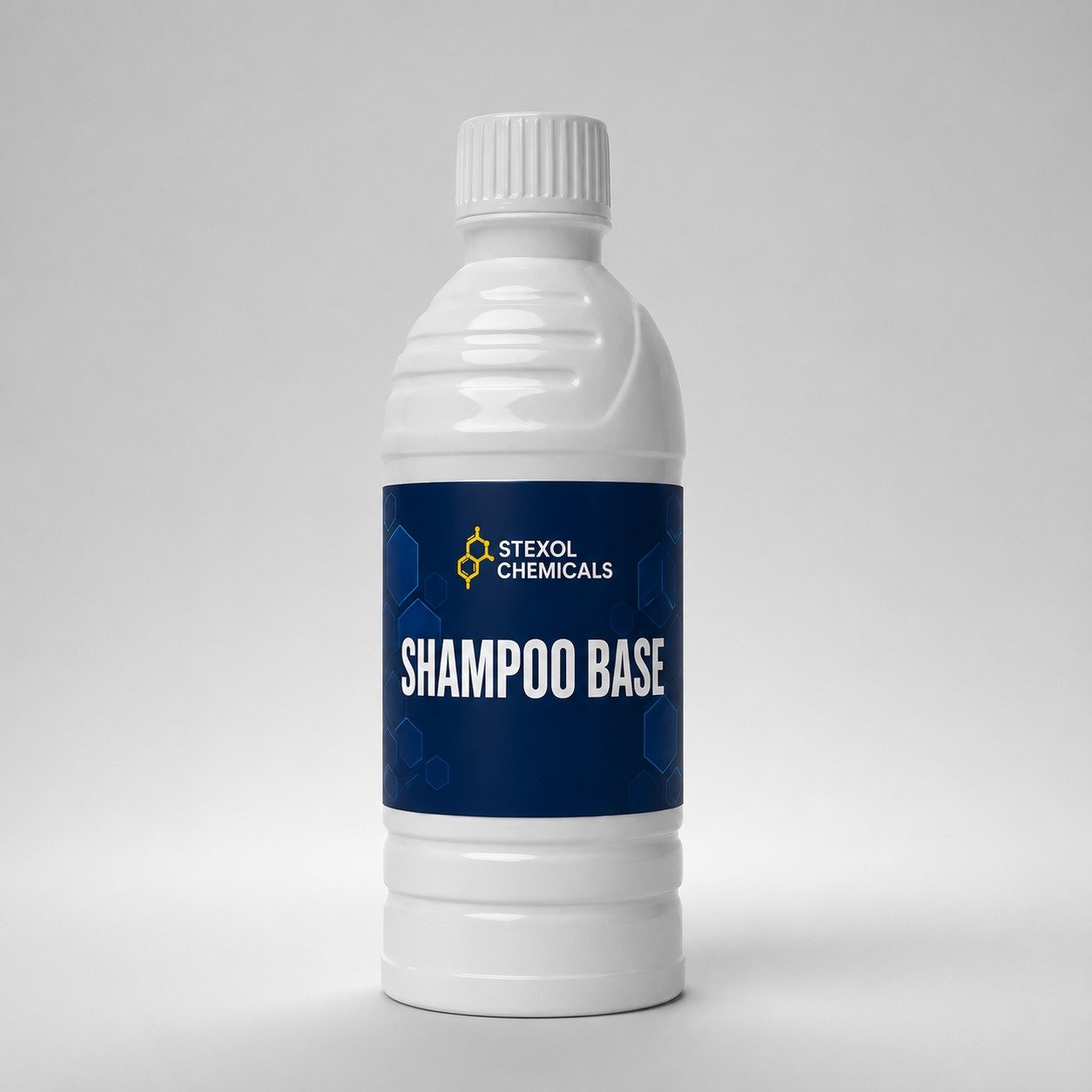
Shampoo Base by Stexol Chemicals is a ready-to-formulate liquid surfactant concentrate built on Sodium Laureth Sulfate (SLES), the most widely used primary cleanser in shampoos, body washes and hand washes. It is supplied pre-diluted at approximately 27–30% active matter as a clear to slightly hazy, pale liquid. INCI: Aqua, Sodium Laureth Sulfate.
In a finished formula, Shampoo Base is your main cleansing and foaming ingredient. It lifts away oil and dirt from hair and skin, builds the lather your customers expect, and thickens with a small amount of salt. You add co-surfactants, conditioners, actives, fragrance and preservative to turn it into a complete shampoo, body wash, hand wash or face wash.
Shampoo Base saves you from the hardest step of working with raw SLES 70% paste. According toBASF’s technical data for SLES 70%, the paste first turns into a thick gel when mixed with water. It only becomes a stable, pourable liquid at about 28% active, and getting there needs a salt-solution technique or hot water around 80°C. Shampoo Base has already been taken past that gel stage. You simply weigh it, pour it and stir it in at room temperature.
Diluting SLES 70% paste at home often leaves sticky gel lumps that take hours to dissolve. Shampoo Base is already a liquid, so it mixes evenly into water within minutes with slow stirring. This saves time and gives you a smoother, more consistent batch.
SLES is the backbone surfactant of most commercial shampoos and body washes because it foams well and cleans effectively. Shampoo Base gives your formula that familiar high-lather performance, and you can make the foam creamier by adding Cocamidopropyl Betaine (CAPB).
SLES-based formulas build viscosity with ordinary salt (sodium chloride). Add salt solution in small steps and the shampoo thickens up to a peak; past that point, it thins again. Cosmetic chemists call this rise and fall thesalt curve. Your thickener cost stays low, as long as you stop at the right point.
No heating vessel is needed for a standard clear shampoo, body wash or hand wash. Shampoo Base, CAPB, conditioning polymers, glycerin, panthenol, fragrance and preservative can all be mixed at room temperature. That suits home-based brands, salons and small workshops.
Shampoo Base blends with CAPB, Cocamide DEA or MEA, glycerin, panthenol, hydrolyzed proteins and water-soluble herbal extracts. It also works with cationic conditioning polymers such as polyquaternium-10 and guar hydroxypropyltrimonium chloride, as long as they are dispersed in water first. For a 2-in-1 conditioning shampoo, pair it with BRB 1018 silicone emulsion for softness, shine and easy combing.
Every batch comes with a COA that states its active matter, so you can calculate exactly how much active SLES goes into your product. You avoid the common mistake of overdosing the base, which wastes money and can make a shampoo harsher on the scalp and eyes.
Shampoo Base is a pourable liquid that dissolves readily in water. Stir slowly when adding it to water, because fast mixing whips in air and creates excess foam in the vessel. Store it in the original closed container between 15°C and 40°C ], away from direct sunlight. Do not let it freeze. In cold weather it can turn hazy or thicker. This is normal for SLES liquids, and it returns to normal when brought back to room temperature and gently stirred. The pH can drift slightly lower during long storage, so check the pH of each finished batch.
Target pH: Shampoo Base as supplied is typically neutral to mildly alkaline when tested in a dilute solution. For shampoos and 2-in-1 shampoos, keep the final pH between 5.5 and 6.5. For body wash, hand wash and face wash, keep it between 5.0 and 6.5. Lower the pH with citric acid solution as needed.
|
Product Type |
Shampoo Base in Formula (by weight) |
|---|---|
|
Daily / Clear Shampoo |
30% to 40% |
|
2-in-1 Conditioning Shampoo |
35% to 43% |
|
Anti-Dandruff Shampoo |
30% to 40% |
|
Economy Shampoo |
25% to 30% |
|
Body Wash / Shower Gel |
30% to 43% |
|
Liquid Hand Wash |
20% to 28% |
|
Foaming Face Wash (with milder co-surfactants) |
10% to 20% |
These levels are based on a 28% active base. If your COA shows a different active matter, use this formula: Shampoo Base % = target active SLES % ÷ base active % × 100. More base does not mean a better shampoo. Above these levels, the product becomes costlier and harsher without a real performance gain.
Each batch of Shampoo Base comes with a Certificate of Analysis. You can confirm the active matter, pH, appearance and batch number before starting production, so you never have to guess about raw material quality. Every batch is tracked and recorded.
We offer Shampoo Base in small packs and in bulk, so small manufacturers don’t have to overstock to get a professional cleansing base. Order what you need today, and scale up when you are ready.
The larger the order, the lower the unit cost. Send us a WhatsApp message with the quantity you need, and we will send you a quote.
Orders placed before the daily cut-off ship the same day. We keep Shampoo Base in stock so your production never stalls while you wait for raw materials.
Both contain the same main cleanser, Sodium Laureth Sulfate. SLES 70% is a thick paste with about 70% active content, and it passes through a sticky gel stage when you mix it with water. Shampoo Base is pre-diluted to about 27–30% active, so it pours and mixes easily at room temperature. Because the active content is different, you cannot swap one for the other gram for gram. You need about 2.5 times more Shampoo Base to get the same active SLES as SLES 70%.
For a standard shampoo, use about 30% to 40% Shampoo Base in the total formula, then add CAPB, conditioners, fragrance, preservative, citric acid and salt. With a 28% active base, this gives about 8.4% to 11.2% active SLES, which is in line with typical commercial shampoos. Using 50% or more raises the cost and makes the shampoo harsher without making it clean better.
Add salt (sodium chloride) as a solution, in small steps of about 0.2%, and check the thickness after each step. The shampoo will thicken up to a peak and then start getting thinner if you keep adding salt. Most SLES formulas peak at around 2% to 3% salt. CAPB and Cocamide DEA or MEA also help build thickness.
No. Sodium Laureth Sulfate is a sulfate surfactant. It is milder than Sodium Lauryl Sulfate (SLS), but it is still a sulfate, so do not label products made with it as “sulfate-free”. Like all cleansing surfactants, it can irritate the eyes, and irritation increases at higher concentration. This is why the recommended usage levels matter.
Keep it tightly closed in its original container at 15°C to 40°C, away from direct sun, and do not let it freeze. In cold weather, SLES liquids can turn hazy or thicker. This is a temporary physical change, and the base returns to normal at room temperature with gentle stirring. Use it within the shelf life shown on the COA.
Shampoo Base is available in small packs and bulk quantities, with a COA for every batch and same-day dispatch. For tiered bulk pricing, or to add BRB 1018, CAPB or Cocamide DEA to your order, message Stexol Chemicals on WhatsApp [+92-316-0099118 ] with your quantity.
| weight | 1 kg, 500g, 250g, 100g |
|---|
Specifications not available.
Reviews
There are no reviews yet.