
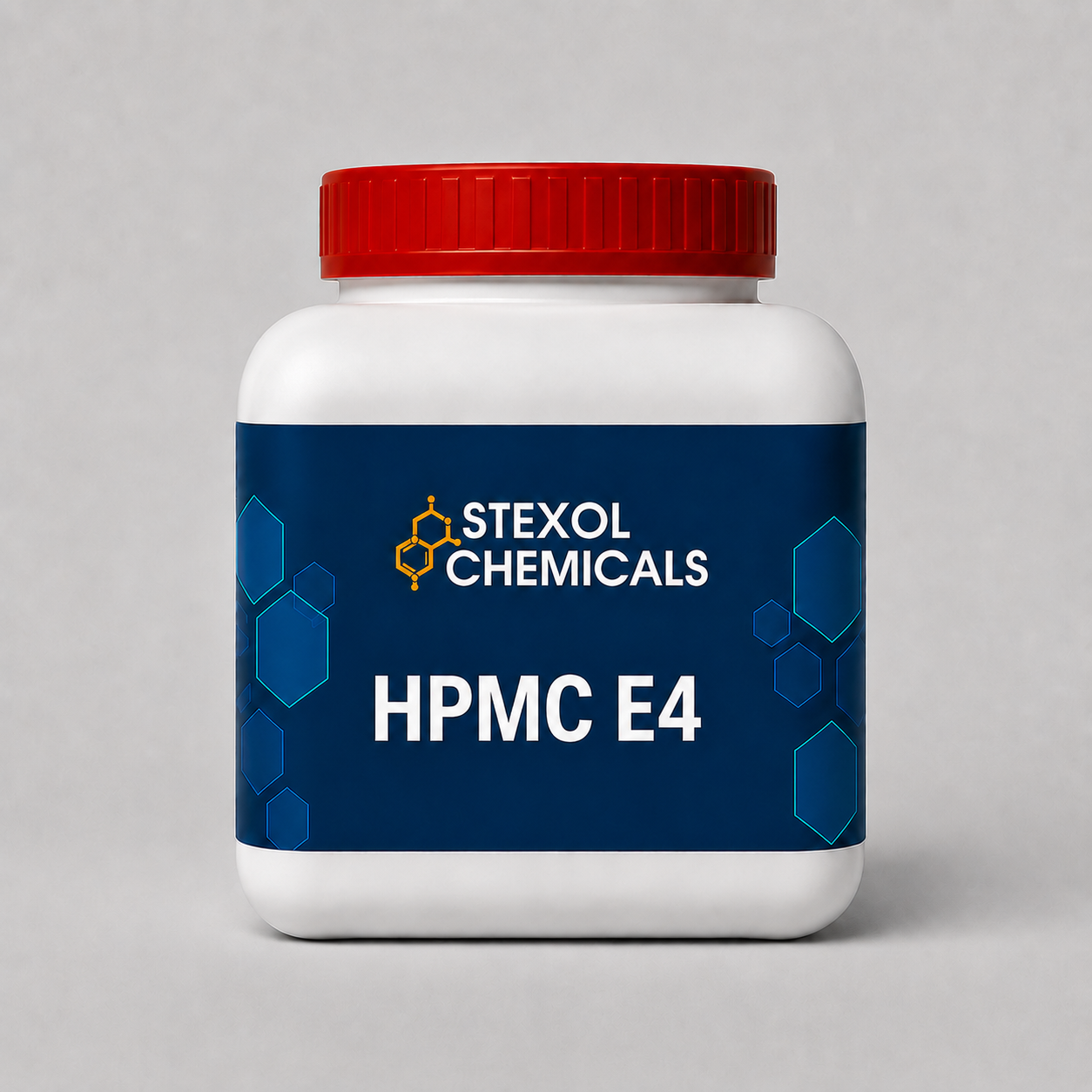
HPMC E4 (Hydroxypropyl Methylcellulose, E4M Grade): Non-Ionic Thickener, Foam Booster and Film Former
HPMC E4 from Stexol Chemicals is a high-purity hydroxypropyl methylcellulose (INCI: Hydroxypropyl Methylcellulose; CAS 9004-65-3) of the E4M grade. It is a Hypromellose 2910-type cellulose ether with 28–30% methoxyl and 7–12% hydroxypropyl substitution, and it gives a nominal viscosity of about 4,000 mPa·s at 2% in water. This is the same chemistry and viscosity class as the well-known METHOCEL™ E4M (Dow/IFF, now Roquette) and Benecel™ E4M (Ashland). That makes HPMC E4 a practical METHOCEL E4M equivalent for shampoos, liquid soaps, gels and cleaners. In most personal-care and home-care formulas you can switch to it without rebuilding your formula; just confirm final viscosity on your first batch.
HPMC E4 thickens the water phase of your product and gives a smooth, rich, non-stringy body. It also suspends particles, stabilises emulsions and forms a light film on skin and hair. In cleansing products it does more than thicken: HPMC behaves like a mild polymeric surfactant, so it helps build a denser, creamier and longer-lasting lather. Your customers notice that the moment they use the product.
What makes HPMC E4 different from ordinary thickeners is its non-ionic, medium-viscosity chemistry. Because it carries no electric charge, it does not react with salts, metal ions or charged ingredients and does not form precipitates. Roquette states that METHOCEL cellulose ethers “are stable over a pH range of 3 to 11”, so HPMC E4 solutions hold their viscosity across a wide pH window. The ~4,000 mPa·s grade is the “sweet spot”: high enough to thicken efficiently at under 1%, but not so high that the product turns stringy or hazy like the 100,000–200,000 mPa·s construction grades. It also has a useful party trick called reversible thermal gelation: E-type solutions gel at about 58–64°C (ChemPoint says E4M Premium “will reversibly gel at temperatures above 64° C”) and turn liquid again on cooling. That is exactly why HPMC disperses without lumps in hot water and then dissolves as it cools.
Thickening that doesn’t depend on high surfactant levels Salt-thickening needs plenty of SLES to work. HPMC E4 builds viscosity on its own. That makes it ideal for mild, low-active and sulfate-free shampoos and body washes, where salt alone gives a watery product.
Boosts and stabilises foam Unlike many thickeners that flatten lather, HPMC is what Ashland calls “a cellulose-based, polymeric surfactant which enhances foam characteristics”, so it boosts foam volume and gives foam a creamier feel. Ashland’s sell sheet PHC19-066 shows that adding just 0.3% Benecel E4M to a model toothpaste with 1.5% SLS increases foam volume and “increases bubble count significantly and reduces mean bubble area”, giving a creamier foam.
Works with all your common ingredients Because it is non-ionic, HPMC E4 is compatible with anionic surfactants (SLES, SLS), amphoterics (CAPB), cationic conditioners, glycerin, alcohol and common preservatives. You get clear or pearly products without haze or separation.
Small dose, big effect Typical use is only 0.2–1.0% in liquid products. One kilogram thickens a large batch, which keeps your cost per litre low.
Branded quality at a lower cost (available locally in Pakistan via Stexol Chemicals) You get E4M-grade chemistry without the import price and long lead times of branded material. Each batch comes with a COA, so you can check its viscosity, pH and moisture against your own specification.
Multi-purpose: one grade, many products The same grade works as a thickener, suspending agent, film former, binder, emulsion stabiliser and water-retention agent. That lets you stock one grade across shampoos, gels, creams, toothpaste and (where pharma-grade COA allows) tablets.
Handling Note: HPMC E4 is a white to off-white, odourless powder. Never dump it straight into cold water. Cold water wets the outside of the particles first, they swell into sticky lumps (“fish-eyes”) and the inside stays dry. These lumps are very hard to remove once formed. Use one of these three lump-free methods:
If your batch is a surface-treated (cold-water dispersible) grade: add it to neutral water (pH ~7) with stirring. Then raise the pH to 8.5–9.0 with a little alkali to trigger thickening, which usually takes 10–30 minutes, and readjust to your final pH. Ask us which type your batch is; it is stated on the COA.
Always make sure HPMC is fully hydrated before you add salts or other ingredients. Keep the bag tightly closed after opening, because the powder absorbs moisture from the air. Note that dissolved HPMC solutions are not self-preserving, so always include a preservative in water-based products.
Product Type Levels of Usage: Target pH: most rinse-off personal care products sit at pH 5.5–7.0, and HPMC E4 solutions are stable from pH 3 to 11. Avoid holding very acidic (pH < 3) or strongly caustic products for long periods, as viscosity can slowly drop.
|
Product Type |
HPMC E4 in Formula (by weight) |
|---|---|
|
Clear shampoo |
0.2 – 0.5% |
|
Conditioning / opaque shampoo, body wash, liquid hand wash |
0.5 – 1.0% |
|
Dishwash liquid / household cleaners |
0.2 – 1.0% |
|
Moisturising gels, serums, hair styling gels |
0.3 – 1.0% (up to 2.0% where HPMC is the main gelling agent) |
|
Creams & lotions (secondary thickener / stabiliser) |
0.2 – 0.5% |
|
Toothpaste (with or without CMC) |
0.3 – 1.0% |
|
Pharma hydrophilic matrix (sustained-release) tablets |
20 – 30% typical (10–80% possible), pharmacopeial-grade only |
for these, choose a high-viscosity construction HPMC (40,000–200,000 mPa·s) at 0.2–0.5% of dry mix. E4 is too low in viscosity to give proper water retention and sag resistance.
Example: liquid hand wash or shampoo.
COA By Batch Every batch ships with its own Certificate of Analysis showing viscosity, pH, moisture and substitution, so your QC team knows exactly what it is getting.
There is No Minimum Order Pressure Testing a new shampoo? Order a small pack for lab trials, then scale up when your formula is approved.
Discounted Pricing on Bigger Orders Our tiered bulk pricing means the more HPMC E4 you buy, the lower your cost per kg. That gives you the best HPMC price in Pakistan for regular production.
Same-Day Dispatch Orders confirmed on WhatsApp are dispatched the same day from Lahore, so your production line never waits for thickener.
It is the same type of material: Hypromellose 2910 (“E” type) with 28–30% methoxyl, 7–12% hydroxypropyl and a nominal 2% viscosity of about 4,000 mPa·s. In shampoos, soaps, gels and cleaners it performs as a direct equivalent. Each manufacturer’s viscosity window is slightly different, so check the batch COA and run a quick viscosity test when switching. For regulated pharma use, only pharmacopeial (USP/EP)-certified batches should replace METHOCEL E4M Premium.
Never pour it into cold water. Disperse it in one-third of the water heated above 80°C, then add the rest as cold water and stir while it cools. Alternatively, slurry it first in 5–6 parts glycerin or propylene glycol. Surface-treated batches can go straight into neutral water and are activated by raising the pH to 8.5–9.0.
A 2% solution in water gives about 4,000 mPa·s (cP). For reference, the METHOCEL E4M Premium specification is 2,663–4,970 mPa·s (target 3,550) and Benecel E4M is 2,700–5,040 cP, so expect your batch to fall in a similar window. In finished products at 0.2–1.0%, final viscosity also depends on your surfactant level, salt and pH, so always test on your own formula.
Yes, it is compatible. HPMC is non-ionic and works with SLES, SLS, CAPB and cationic conditioners. It actually helps boost and stabilise foam. HPMC tolerates salt better than methylcellulose and anionic thickeners, but very high salt levels can “salt out” the polymer and lower its gel temperature. Add salt in small steps after the HPMC is fully dissolved.
CMC is anionic and cheaper, so it suits cost-driven detergents and toothpaste. HPMC is non-ionic: it is better for clear products, salt-containing formulas, cationic conditioners and foam quality, and it is more stable across pH. Many toothpaste makers use both together.
Store it in the original sealed bag in a cool, dry place away from heat and moisture, and reseal opened bags tightly. Kept this way, HPMC is very stable. Roquette rates METHOCEL food and personal-care grades at 36 months from manufacture in bags, and Premium grades such as E4M Premium at 24 months in bags. Ashland states its Benecel HPMC has no expiry date when stored dry. Follow the retest date on your COA.
HPMC E4 (E4M grade) is in stock in Lahore in small packs for lab trials and bulk bags for production. Every batch comes with its COA, orders are dispatched the same day, and tiered bulk pricing rewards larger orders. Message Stexol Chemicals on WhatsApp [ +92-316-0099118 ] today for a quote and get your thickener on the way.
| Weight | 1 kg, 500g, 250g, 100g |
|---|
Specifications not available.
Reviews
There are no reviews yet.