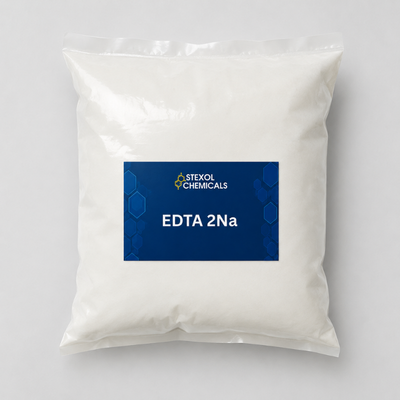
EDTA 2Na is a professional, cosmetic-grade chelating agent supplied by Stexol Chemicals. It is disodium ethylenediaminetetraacetate dihydrate (INCI: Disodium EDTA; also sold as Edetate Disodium), a free-flowing white crystalline powder with an assay of ≥99% and a 1% solution pH of 4.0–5.0. It matches the published specification of the leading branded grades Dissolvine NA2-S (Nouryon) and Trilon BD (BASF), and it shares the INCI name of Versene NA (Dow). Formulas written around these branded grades can switch to Stexol EDTA 2Na without changing the recipe: the INCI name, purity and chelating performance are the same.
EDTA 2Na is the quiet stabiliser behind shampoos, conditioners, body washes, liquid soaps, creams and lotions. It doesn’t clean, thicken or condition. Its job is to protect everything else in the formula: it keeps the preservative working, keeps the colour and fragrance true, keeps foam rich in hard water, and keeps each batch behaving like the last one.
The property that makes it work is chelation. Each EDTA molecule wraps around a single metal ion (calcium, magnesium, iron, copper, manganese or zinc) and locks it into a stable, water-soluble complex that can no longer react. This works across a wide pH range. According to Nouryon’s Dissolvine NA2 data sheet, one gram can theoretically sequester about 105 mg of calcium (pH 5–14), 150 mg of ferric iron (pH 1–10) or 170 mg of copper (pH 2–14). Those metals come into every batch through tap water, plant extracts, pigments and steel equipment, and EDTA 2Na neutralises them at very low doses.
Gram-negative bacteria such as Pseudomonas aeruginosa rely on calcium and magnesium to hold their outer membrane together. EDTA 2Na pulls those ions away, so the membrane becomes more permeable and your preservative gets in more easily. This is why EDTA is used as a co-preservative alongside phenoxyethanol, parabens, sodium benzoate, potassium sorbate, DMDM hydantoin and isothiazolinones. A September 2020 study in Cosmetics & Toiletries tested pH 7.0 lotions containing 4% plant extracts. Adding 0.05% disodium EDTA “significantly enhanced preservative efficacy, whereas increasing PE concentration had little effect” (phenoxyethanol was raised from 0.4% to 0.5%). If your shampoo or lotion keeps failing challenge tests or spoiling in the bottle, adding EDTA 2Na is one of the cheapest first fixes.
Trace iron and copper catalyse oxidation. That oxidation turns oils rancid, breaks down fragrance, yellows white creams and causes haze in clear products. EDTA 2Na binds these metals before they can act, which helps your product look and smell the same at the end of its shelf life as on the day it was filled. Natural oils, botanical extracts and antioxidant actives such as vitamin C are especially prone to this kind of damage.
Calcium and magnesium react with anionic surfactants to form insoluble salts. That shows up as weak lather, soap scum and a dull film on hair and skin. In its 2005-06 water-quality monitoring, PCRWR, Pakistan’s national water-research council, found excessive hardness in 23% of samples from Bahawalpur, though hardness exceedances vary widely from region to region. So many Pakistani customers are washing with exactly the water that ruins foam. EDTA 2Na sequesters the hardness ions so SLES, SLS and CAPB can lather and rinse as they were designed to. It is a standard chelating agent for shampoo for exactly this reason.
Most shampoos, washes and creams need only 0.05% to 0.2%. That is 0.5 g to 2 g per kilogram of finished product. A 1 kg pack can treat 500 kg to 2,000 kg of product, so EDTA 2Na adds almost nothing to your cost per bottle, even in small batches.
Many Pakistani manufacturers have imported Dissolvine NA2-S or Trilon BD, or bought them through traders. Stexol EDTA 2Na has the same INCI, the same ≥99% assay and the same pH profile, and it comes with a Certificate of Analysis for every batch. Formulators can now buy it locally in Pakistan through Stexol Chemicals with no reformulation and no long import lead times.
EDTA 2Na works with anionic, amphoteric and non-ionic surfactants (SLES, SLS, CAPB, cocamide DEA, decyl glucoside), humectants (glycerin, propylene glycol), panthenol, proteins, plant extracts and nearly all cosmetic preservatives. Its mildly acidic pH suits the pH 4.5–7 range where most shampoos, conditioners, washes and lotions sit. Two exceptions: keep it away from hypochlorite (bleach) systems, which destroy EDTA’s performance, and in very electrolyte-sensitive carbomer gels check the viscosity before scaling up.
EDTA 2Na is a white crystalline powder. It dissolves well in water but slowly. Nouryon’s Dissolvine NA2 data sheet gives its solubility as about 100 g/L at 20°C, rising to about 135 g/L at 40°C, so warm water makes it much faster. At typical use levels it can still take 15–30 minutes to dissolve fully. Always add it first, to the water phase, before surfactants, thickeners, oils or preservatives. Stir until the water is completely clear before going further. It does not dissolve in oils or alcohol, so never add it to the oil phase. In clear gels and transparent shampoos, any undissolved crystals will show, so make sure it is fully dissolved, or consider EDTA 4Na for these products. Avoid breathing in the dust when weighing. Keep the bag tightly closed after every use.
Target pH: EDTA 2Na is best for neutral to mildly acidic products, roughly pH 3.5 to 7.0. A 1% solution sits at pH 4.0–5.0, so adding it will lower your batch pH slightly. Check the pH after addition. For hair products, keep the final formula around pH 5.0–6.0. For skin products, aim for pH 4.5–6.0. Raise the pH with sodium hydroxide or triethanolamine, or lower it with citric acid, as needed. For alkaline soap and high-pH cleaners (pH above 8–9), use EDTA 4Na instead.
|
Product Type |
EDTA 2Na in Formula (by weight) |
|---|---|
|
Shampoo / 2-in-1 Shampoo |
0.05% to 0.15% |
|
Rinse-Off Hair Conditioner |
0.05% to 0.1% |
|
Body Wash / Shower Gel |
0.05% to 0.2% |
|
Liquid Hand Soap (neutral pH, surfactant-based) |
0.1% to 0.2% |
|
Face Wash / Gel Cleanser |
0.05% to 0.2% |
|
Creams and Lotions (face and body) |
0.05% to 0.2% |
|
Hair Colour Cream / Dye Base |
0.1% to 0.5% |
Formulation Build Order:
Weigh your deionised or tap water into a clean, non-aluminium vessel. Warm it to about 40–50°C if you can, so the EDTA dissolves faster.
Sprinkle in EDTA 2Na slowly while stirring, and mix until the solution is completely clear.
Add other water-soluble ingredients such as glycerin, panthenol or water-phase thickeners.
For emulsions, heat the water phase to 70–75°C and the oil phase to 70–75°C separately.
Combine the phases and emulsify using your usual system. For surfactant products, add SLES or other primary surfactants to the EDTA water with gentle stirring to avoid excess foam.
Add secondary surfactants such as CAPB, cocamide DEA or glucosides, and mix until uniform.
Let the batch cool with gentle stirring. For emulsions, add heat-sensitive actives below 40°C.
Add your preservative. EDTA 2Na is already in the water and will boost its performance.
Add fragrance, colour and any extracts, then adjust the pH with citric acid or sodium hydroxide.
Adjust viscosity with sodium chloride solution if needed, then mix until uniform and check the final pH and appearance.
Shampoos, anti-dandruff shampoos and 2-in-1 conditioning shampoos.
Rinse-off conditioners and hair masks.
Body washes, shower gels and bubble baths.
Liquid hand soaps and handwash refills.
Face washes, gel cleansers and micellar waters.
Face creams, body lotions and brightening creams with vitamin C or plant extracts.
Hair colour creams and dye bases.
Neutral-pH dishwashing liquids and household cleaners that need hard-water tolerance.
Each batch of EDTA 2Na comes with a Certificate of Analysis showing assay, pH (1% solution), appearance and batch number, so you can check the quality before production starts. A quick pH check (4.0–5.0 for 2Na versus about 11 for 4Na) also confirms you have the right EDTA salt. Every batch is tracked and recorded.
EDTA 2Na comes in small packs and bulk bags. Small-scale shampoo, soap and cream makers can buy only what they need, without stocking up on a whole drum. Order for today’s batch and scale up when you’re ready.
The more you order, the lower your price per kilogram. Send us your monthly volume on WhatsApp and we’ll quote you the best EDTA price in Pakistan for that quantity.
Orders placed before the daily cut-off ship the same day. We keep EDTA 2Na in stock so your production line never waits on a chelating agent.
Available in small and bulk packs. COA included with every batch, same-day dispatch before the cut-off, and tiered bulk pricing. Message us on WhatsApp [ +92-316-0099118 ] for today’s EDTA 2Na quote.
| Weight | 1 kg, 500g, 250g, 100g |
|---|
Specifications not available.
Reviews
There are no reviews yet.