
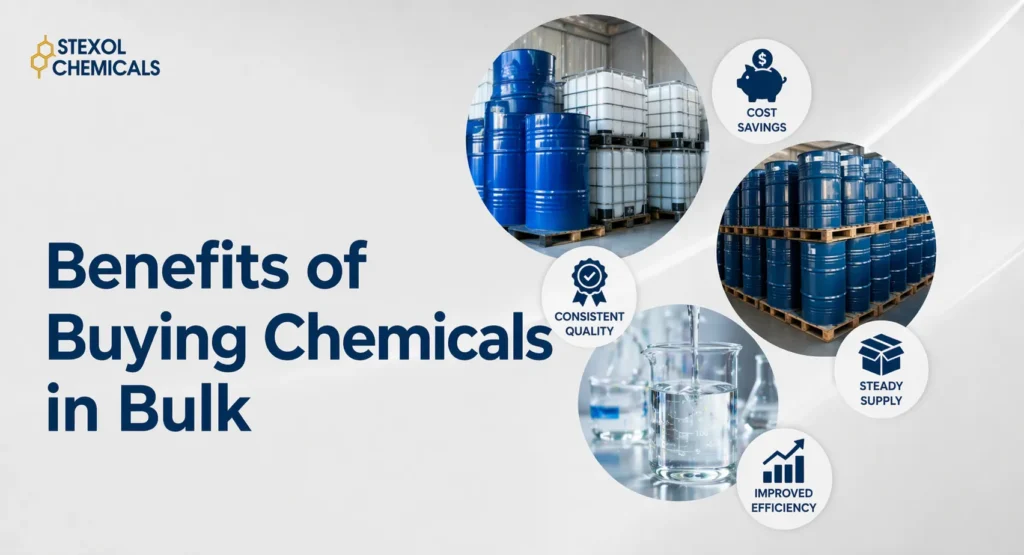
Bulk purchase of chemicals provides manufacturers with major cost, operations, and supply chain benefits. Companies that purchase raw materials in bulk tend to save over 15-40 percent per unit, have steady access to raw materials, and have better supplier relations. The bulk chemical purchasing approach is one of the most feasible options available to small-to-medium manufacturers and beauty entrepreneurs in Pakistan to boost profitability and the reliability of production.
In case you are operating a shampoo brand, a cosmetics brand, or a personal care manufacturing business in Pakistan, the cost of your raw materials defines the extent to which your business will make profits. Each liter of SLES, each kilo of CAPB, each drum of glycerin, or cetyl alcohol you purchase means something to your margins. And how you purchase such stuff—how much, who you purchase it with, and on what conditions—is going to make or break your cost structure.
One of the most economically prudent moves that a manufacturer can make is to purchase chemicals in large quantities. It is a guide that is deconstructed with real-world data, explaining why, and presented in practical terms in a Pakistani market setting and given answers by both beginners and advanced production managers.
Bulk chemical purchasing involves buying raw materials in large quantities as opposed to small, frequent, piecemeal quantities. A manufacturer can order 50 kg of surfactant or 200 kg of surfactant at a time instead of ordering 5 kg of surfactant every week, in drums or IBCs (intermediate bulk containers) or on full pallets.
Bulk orders are normally made directly with bulk chemical suppliers or distributors with agreed prices and scheduled deliveries and often preferred terms of payment, e.g., credit or COD. Larger factories are not the only ones who can use this model; Pakistani beauty entrepreneurs and manufacturers of personal care. Small-scale manufacturers, with operations of 500-2000 units each month, can also, and even should, enjoy bulk chemical prices.
The directly obvious advantage of purchasing chemicals in large quantities is the direct drop in unit price. The common volume discounts offered by wholesale chemical suppliers are 15-40 percent based on the type of chemical, the quantity ordered, and the relationship with the supplier. This is no one-liner saving; even on a production run of 1,000 bottles of shampoo, any saving in the cost of SLES at 25 percent has the potential to significantly change your profit margin.
You also do away with the markup on middlemen that accompanies small-scale retail or semi-wholesale purchases when you purchase wholesale with chemical suppliers and in higher quantities. This is essential to Pakistani manufacturers who will be facing increased input costs as a way to remain competitive.
Pakistan has a large-scale importation of its raw materials used in cosmetics. The nation uses approximately 10 percent of its total chemical demand locally, with the rest being supplied by imports. This implies that prices of raw materials in Pakistan are directly influenced by currency changes and the movement of commodities in the world.
Bulk orders and increased stock levels enable manufacturers to enjoy a good price at that fixed rate until the next price rise. This cushions your production budget against unexpected cost hikes due to a depreciating rupee or worldwide supply shocks. The cost savings on bulk chemicals are not merely about today’s price; they are about protecting your cost structure tomorrow.
Each order will have freight costs, handling charges, and time. By combining purchases in fewer and larger shipments, the overall shipping and logistics expenses are greatly reduced. Placing an order of 200 kg of glycerin on a monthly basis is much cheaper to ship per kilogram than placing 20 kg of glycerin ten times a month. In the case of manufacturers in industrial cities such as Lahore, Karachi, Faisalabad, and Sialkot, this consolidation has a direct implication of cutting overhead.
Direct manufacturer relationships allow you to go to a supplier without any multiple intermediaries, which can save an extra 20-30% on procurement compared to conventional fragmented purchasing.
One of the most expensive breakdowns that a manufacturer can experience is the process of running out of a crucial ingredient in the middle of the production process. It pauses your queue, postpones orders, and destroys customer trust. Bulk chemical buying is a solution to this since you will have a sufficient inventory buffer. You do not rely on a supplier for what he or she has on hand or what he or she is delivering at any given moment when you start a new batch. Your materials are already on hand.
This is particularly significant in Pakistan, where supply lines of specialty cosmetic raw materials may be held up by import clearances, congestion at Karachi port, or peaks in seasonal demand. Keeping a bulk inventory is a way of ensuring that your production timetable is not disrupted by the strains of your external supply chains.
Each little order comes with its own paperwork: quote, invoice, payment, and receipt of delivery. This can be multiplied by dozens of orders each month, and the administrative load becomes huge. This is consolidated by bulk chemical buying. Less to coordinate in terms of purchase orders, invoices, and deliveries. Your procurement team, or you, in case you run a lean operation, spends less time on order chasing and more time on production and growth. It is also a significant yet frequently overlooked advantage of transitioning to a wholesale chemical supplier model because it allows higher operational efficiency.
By purchasing small quantities at many sources, you add quality variability to your recipes. Batches can vary in small amounts of purity, pH, or viscosity—almost enough to impact your final product. One proven supplier can supply large quantities, which guarantees uniformity in the quality of raw materials. Personal care manufacturers must have cosmetic-grade specifications that should be consistent with all production runs.
The supplier will supply a Certificate of Analysis (COA) with each batch, showing that the material is of spec. This safeguards the quality of your product as well as your brand name.
Pakistan’s beauty and personal care market is on the rise. Cosmetics by itself is expected to be 925.9 million in 2029 with a CAGR of 4.43%. The importation of cosmetics in Pakistan is expected to grow to 275 million USD in 2026, indicating a high demand for personal care products in the country.
Meanwhile, the KSE-100-listed Pakistan chemical industry recorded the following profitability as of June 2025, as shown in the financial statements of the company: Earnings per share net have gone up by 17 percent annually within the last three years. Domestic manufacturing is projected to grow to a larger chemical market of $20 billion.
What this will entail in practice: additional manufacturers are venturing into the beauty and personal care arena. Competition is increasing. A cost structure will help you to either survive and expand or get squeezed out. Bulk buying is among the most apparent levers that small and medium-sized manufacturers have to regulate expenses and be competitive.
The sector is also growing in scale and commercial seriousness, with PACE 2026 being the largest chemical expo in Pakistan to be held on June 5 and 6, 2026. This is the climate that Pakistani manufacturers are in at present.
Knowing the calculation of bulk chemical pricing will allow you to negotiate at a better price and strategize more on how to stock your inventory.
| Price Factor | Impact on Bulk Chemical Cost |
| Production Scale | Economies of scale are the primary driver of per-unit reduction. Higher volumes = lower cost per kg. |
| Raw Material Origin | Imported chemicals are directly affected by USD/PKR exchange rates and global commodity prices. |
| Energy Prices | Energy accounts for 15–25% of total manufacturing cost for most industrial chemicals. |
| Regulatory Compliance | Compliance, testing, and certifications (e.g., COA, DRAP requirements) typically add 5–10% to cost. |
| Distribution Model | Direct-from-supplier purchasing can reduce cost by 20–30% compared to multi-intermediary chains. |
| Payment Terms | COD, credit, and advance payment terms affect effective pricing. Bulk buyers typically access better terms. |
| Factor | Small-Order Purchasing | Bulk Chemical Purchasing |
| Per-unit cost | Higher (retail or semi-wholesale pricing) | Lower (15%–40% volume discount) |
| Supply reliability | Dependent on current stock | Controlled via in-house inventory |
| Quality consistency | Variable (multiple sources) | Consistent (single verified batch) |
| Logistics cost | High (frequent deliveries) | Low (consolidated shipments) |
| Administrative effort | High (many orders, invoices) | Low (fewer transactions) |
| Price exposure | High (affected by every market fluctuation) | Lower (locked-in or negotiated pricing) |
| Supplier relationship | Transactional | Strategic partnership |
| Suitability for growth | Limited | Scales with production volume |
The benefits of bulk chemicals go beyond cost savings; there are meaningful safety and environmental advantages as well.
Reduced delivery reduces the number of container changes, thereby lowering the rate of accidental spills or exposure to chemicals during handling. Big containers are more secure to store and handle as opposed to several little packages.
Bulk purchasing leads to a considerable amount of single-use plastic packaging, namely, drums, pouches, and bottles, under the order of fewer than 10 items. This lessening of waste is important to manufacturers striving to achieve sustainable production practices or halal-certified supply chains.
When dealing with a few known bulk chemical suppliers rather than numerous smaller ones, the chances of accepting off-spec or adulterated material, which may be dangerous health- and safety-wise, are reduced in the face of personal care manufacturing.
Not every supplier is equally reliable. In assessing a wholesale supplier of chemicals to use in your production, you should consider the following criteria:
Stexol Chemicals is one such model in the Pakistani market and is specifically aimed at meeting the cosmetic raw material requirements of small and medium-sized manufacturers with low MOQs, COA-supported ingredients such as SLES, CAPB, cetyl alcohol, glycerin, and citric acid, and formulation advice through their ChemAssist service.
Want to reduce your raw material expenses and expand your production? At Stexol Chemicals, we provide tested, cosmetic-grade raw materials in low MOQs, custom payment terms, and specialist support in formulations designed to meet Pakistani manufacturers who are serious about growing.
Q: Can small manufacturers buy chemicals in bulk?
Yes. Pakistan has numerous suppliers with low MOQs (as low as 1 kg), which means bulk pricing will be available to even the small-scale producers operating 500 to 2,000 units per month.
Q: How much savings can I make through bulk purchase of chemicals?
Volume discounts can be between 15 and 40 percent, based on volume and chemical. A further 20-30 percent cost reduction can be achieved through the consolidation of logistics.
Q: What are the common chemicals that are bought in large amounts to use in making beauty products?
SLES (shampoo co-surfactant), CAPB (co-surfactant), cetyl alcohol (conditioner emulsifier), glycerin (skin-care humectant), and citric acid (personal-care pH modifier) are the ingredients that represent the core of industrial chemicals bulk supply for the personal care sector in Pakistan.
Q: What do I need to do to be sure of quality when purchasing in bulk?
You should always order a Certificate of Analysis (COA) on each batch, as ordered by your supplier. This document ascertains purity and compliance with specifications and batch traceability.
Q: What is the current situation in the chemical wholesale market in Pakistan?
The chemical industry in Pakistan is developing. The KSE-listed industry has shown good financial results in 2025 and is hosting its biggest chemical expo, PACE 2026, in June 2026, indicative of the growing size of the industry and investor confidence.