
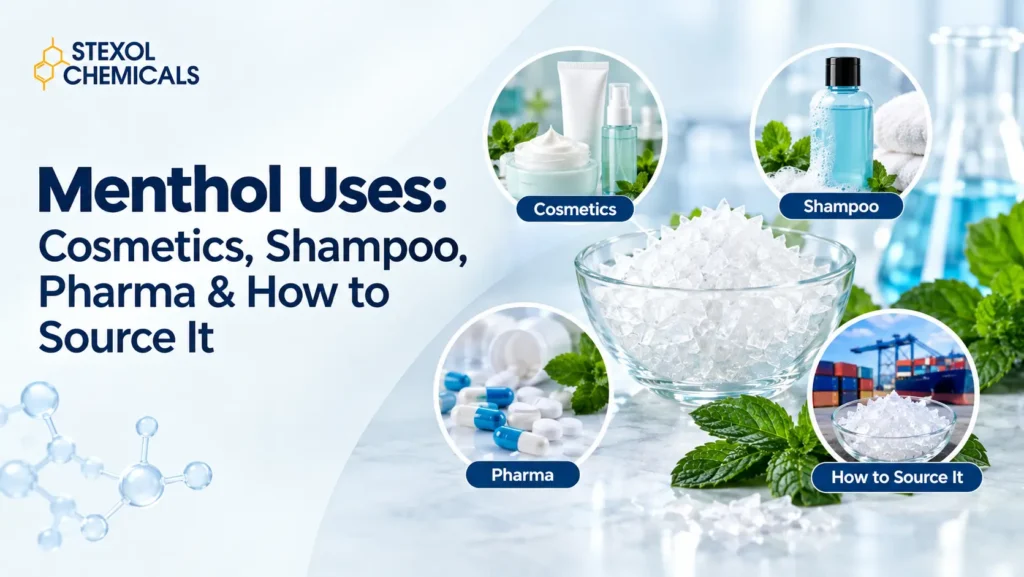
Menthol uses include creating a cooling sensation in shampoos, skincare, oral care, balms, topical analgesics, lozenges and flavour products. Menthol activates cold-sensitive TRPM8 receptors without necessarily lowering tissue temperature. Manufacturers must pre-dissolve it, select the level from supplier and safety data, and validate the finished product for irritation, stability and legal claims.
The main uses of menthol are sensory cooling, flavouring, fragrance support and temporary symptom relief in appropriately regulated products. Cosmetics use menthol for sensory character, while pharmaceutical and oral products may use it under product-specific rules and labelled directions.
| Product category | Typical role of menthol | Claim boundary |
|---|---|---|
| Shampoo and scalp cleansers | Cooling scalp feel; fresh mint profile | Do not imply dandruff treatment or hair growth without suitable actives and evidence |
| Skincare and body care | Cooling or counter-sensation in gels, lotions, aftershaves and foot products | Can irritate sensitive or damaged skin |
| Oral care | Mint flavour, freshness and cooling | Oral-use grade and applicable rules are required |
| Balms and topical analgesics | Counterirritant or topical analgesic role | Drug rules, permitted strengths and warnings may apply |
| Lozenges and throat products | Flavour plus temporary throat or cough relief | Dose form, age limits and medicinal rules apply |
| Inhaled aroma products | Perceived easier breathing or freshness | Menthol can improve perceived airflow without reducing nasal resistance |
Menthol benefits are strongest and easiest to defend when described as sensory cooling, refreshing flavour or temporary counter-sensation. Pain, itch and throat-relief applications can be legitimate in properly designed products, but efficacy depends on dose, delivery system, indication and regulatory category.
Menthol uses in cosmetics and personal care include cooling shampoos, scalp tonics, aftershaves, foot gels, body lotions, cleansers, lip products and mint-led oral-care products. The formulator should match sensory strength to the application area, contact time and likelihood of eye or mucosal exposure. Browse the full cosmetic raw materials range to plan the rest of the formula around it.
Menthol may support a cooling brief in post-exercise gels, aftershaves, foot products and selected itch-relief concepts. Facial and eye-area products need particular caution because vapour migration and accidental eye contact can make a technically stable formula unpleasant.
Toothpaste, mouthwash and breath-freshening products use menthol for flavour and coolness. Material intended for oral exposure needs the correct grade and compliance documentation; cosmetic-grade supply should not automatically be assumed suitable for food or medicinal use.
Menthol in shampoo mainly creates a cooling, fresh scalp sensation and supports a mint-led fragrance profile. Menthol alone is not an established dandruff treatment, cleanser, preservative or hair-growth active, so manufacturers should not let sensory intensity substitute for substantiated performance. For a hair-specific look at the evidence, see our Hair Care Formulation guidance and the shampoo raw materials range.
A cold scalp does not demonstrate lower scalp temperature, stronger follicles or control of the cause of dandruff. If the label says “treats dandruff,” “stops hair fall” or makes another therapeutic claim, the finished product needs suitable evidence and the correct regulatory pathway.
Menthol crystals and menthol powder can deliver the same menthol function when chemical identity, purity and stereochemistry are equivalent. Powder generally has smaller particles and may dissolve faster, while crystals are often easier to handle with less airborne dust; the supplier’s COA and SDS should decide equivalence, not appearance alone.
| Factor | Menthol crystals | Menthol powder |
|---|---|---|
| Physical form | Larger brittle pieces or flakes | Fine divided particles |
| Likely processing effect | May need crushing or more dissolution time | Greater surface area can speed dissolution |
| Handling | Easier to see and contain | More dust control may be needed |
| Finished-product function | Cooling and mint character | Cooling and mint character |
| Buying priority | Assay, isomer, grade, COA, SDS and lot traceability | Assay, isomer, grade, COA, SDS and lot traceability |
| Verdict | Suitable when properly dissolved | Suitable when properly dissolved; not automatically stronger |
The most important menthol properties for formulators are strong sensory potency, volatility, water insolubility, compatibility with oils or alcohol and a melting point near warm room or processing temperatures. PubChem describes menthol as a white crystalline solid with peppermint odour and poor water solubility; L-menthol is very soluble in alcohol and several organic or oily media.
| Property | Why the formulator cares |
|---|---|
| Poor water solubility | Direct addition to water can leave crystals, haze or uneven distribution |
| Solubility in alcohol/oily media | Supports pre-dissolution in a compatible carrier or solubiliser |
| Volatility and strong odour | Late addition and a covered vessel can reduce loss |
| Low melting range | Warm processing can help dissolution, but excessive heat is unnecessary |
| High sensory impact | Small changes may be noticeable to users |
| Irritation potential | Eye-area exposure and excessive sensory strength can make a formula unacceptable |
Menthol should usually be weighed accurately, dissolved in a compatible carrier or solubiliser, and added during cool-down rather than scattered directly into the shampoo’s water phase. The process must then be validated in the actual surfactant base because fragrance, salt, polymers and temperature can change clarity and viscosity. For help choosing that base, see Best Surfactants for Shampoo in Pakistan 2026 – SLES, CAPB, SLS & More.
There is no universal menthol percentage for shampoo. The correct level is the lowest concentration that meets the sensory brief while remaining soluble, stable, tolerable and compliant in the intended market. Broad supplier ranges found online span very different products and should not be copied into a commercial rinse-off formula.
Use this batch calculation after a qualified formulator has selected the pilot percentage:
Menthol required (g) = batch size (g) × selected percentage ÷ 100
| Worked example | Calculation | Menthol required |
|---|---|---|
| 1 kg pilot at 0.10% | 1,000 × 0.10 ÷ 100 | 1 g |
| 5 kg pilot at 0.25% | 5,000 × 0.25 ÷ 100 | 12.5 g |
| 100 kg batch at 0.20% | 100,000 × 0.20 ÷ 100 | 200 g |
These figures demonstrate arithmetic, not recommended use levels.
A menthol shampoo should pass the Stexol 6-Point Menthol Batch Check before commercial production: identity, incorporation, physical stability, sensory tolerance, microbiological protection and claims compliance. Passing one item does not compensate for failing another.
A manufacturer should buy menthol by verified identity, purity, grade, intended use and documentation rather than by aroma or price alone. Natural and synthetic menthol can both be suitable, but they differ in sourcing narrative, stereochemical profile and documentation needs.
| Decision | Natural menthol | Synthetic menthol |
|---|---|---|
| Source | Mint-derived | Manufactured chemically |
| Marketing fit | Supports a natural-origin story when documentation permits | Supports consistency and scalable sourcing |
| Sensory result | Depends on isomer profile and purity | Depends on isomer profile and purity |
| Quality decision | Verify assay, origin and contaminants | Verify assay, isomer profile and contaminants |
| Automatic safety advantage? | No | No |
Request these documents before approving a lot:
Menthol uses in pharmaceutical products include topical counterirritants or analgesics and certain throat-relief dosage forms, but permitted strengths, directions and warnings depend on jurisdiction and dosage form. For example, the US FDA external-analgesic monograph covers OTC topical products, while its oral-healthcare monograph specifies menthol conditions for solid dosage forms.
| Product type | Role | Manufacturer caution |
|---|---|---|
| Cream, gel, balm or patch | Temporary relief of minor muscle and joint pain | Follow drug rules; avoid damaged skin, tight bandaging and external heat |
| Lozenge or cough drop | Temporary relief of minor throat irritation or cough | Use oral/pharmaceutical grade and labelled dose directions |
| Inhalant or vapour product | Cooling sensation and perceived nasal openness | Do not claim objective decongestion without evidence |
| Medicated shampoo | Therapeutic role depends on the active and claim | Cosmetic and medicated categories may follow different pathways |
A marketed 5% menthol topical analgesic label directs users to avoid wounds, eyes, mucous membranes, tight bandaging and heating devices, illustrating why drug directions cannot be replaced with cosmetic usage copy.
Menthol should be avoided or reassessed when a user has known menthol or mint hypersensitivity, when the formula targets damaged or highly sensitive skin, or when exposure near the eyes and mucous membranes is likely. Concentrated raw material can irritate skin and eyes, and finished-product safety depends on concentration, vehicle and use pattern.
This guide is manufacturing information, not medical advice. A qualified toxicologist, safety assessor, pharmacist or physician should review health-critical uses.
A menthol shampoo has no universal safe frequency; use should follow the tested finished-product label and the user’s scalp tolerance. A mild rinse-off cosmetic may be designed for regular use, while a medicated or strongly cooling shampoo may require less frequent use under its approved directions.
Manufacturers should determine frequency through the complete formula, target population, exposure assessment and tolerance testing. Consumers should stop if persistent burning, redness, dryness or eye irritation occurs and seek professional advice when symptoms are severe or recurring.
Pakistani manufacturers must first decide whether the product is a general cosmetic or a medicated or therapeutic product, then follow the authority and requirements that apply to that category. Pakistan’s General Cosmetics Act 2023 regulates the manufacture, import, storage, distribution and sale of general cosmetics, while DRAP has responsibility for medicated cosmetics.
These answers resolve common buying and formulation questions about menthol ingredients without replacing supplier documentation or finished-product testing. Each answer applies to the specified use and should not be treated as a universal medicinal direction.
Is menthol natural or synthetic?
Menthol can be isolated from mint oils or produced synthetically. The purchase specification should identify origin, purity, stereochemical form and grade rather than relying only on the word “menthol.”
Is menthol the same as peppermint oil?
No. Menthol is a defined chemical compound and a major component of peppermint oil, while peppermint oil is a variable mixture of many compounds. They are not one-for-one formulation substitutes.
Can menthol crystals be added directly to water?
Direct addition is poor practice because menthol is poorly soluble in water. Pre-dissolve the weighed material in a compatible oil, fragrance portion, alcohol or validated solubiliser, then add it under controlled mixing.
Does menthol actually lower scalp temperature?
Menthol primarily produces a neural cooling sensation by activating TRPM8. A user can feel cold without a corresponding reduction in tissue temperature, so “cooling feel” is more defensible than “lowers scalp temperature.”
Can menthol make hair grow?
Menthol should not be presented as a proven hair-growth active based only on its cooling sensation or possible blood-flow effects. A hair-growth claim needs ingredient-specific clinical evidence for the finished product and may change its regulatory category.
Why did menthol recrystallise in the finished product?
Likely causes include incomplete pre-dissolution, insufficient solubiliser, a concentration above the system’s capacity, cooling during storage or incompatibility with the shampoo base. Rework only through an approved investigation; do not simply add more solubiliser without retesting the formula.
What should appear on the ingredient list?
Use the INCI name supported by the supplier documentation and list it according to the rules for the market where the product will be sold. Confirm the final label with a qualified regulatory reviewer.
Start with a documented menthol grade, a small controlled batch and written acceptance criteria. Request Stexol Chemicals’ current COA, SDS and TDS, then use formulation support via ChemAssist to select a pilot level and validate cooling, clarity, viscosity, preservation and claims before scale-up. When you’re ready, contact us to get started.