
₨ 450 – ₨ 2,000Price range: ₨ 450 through ₨ 2,000
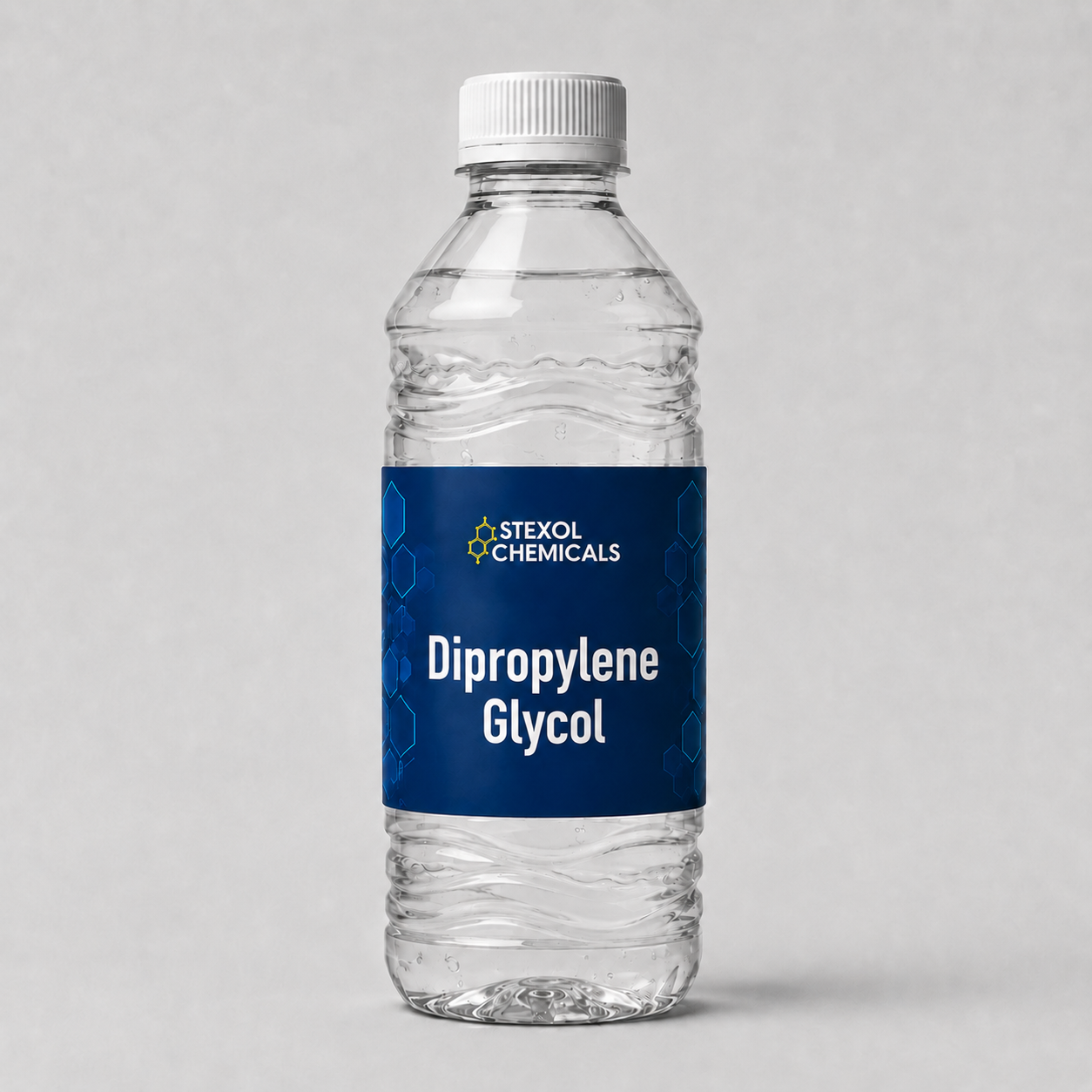
Di Propylene Glycol (DPG) is a high-purity, low-odour glycol solvent (INCI: Dipropylene Glycol; CAS 25265-71-8; EC 246-770-3). skc It is the standard carrier and diluent in perfumery, attar making and home fragrance. niranchemical Stexol Chemicals supplies fragrance-grade DPG with a minimum assay of 99.5%. It is a clear, colourless, practically odourless liquid that does not add its own note to your fragrance. This is the same grade class sold globally as Dow DPG LO+, LyondellBasell DPGF, Shell DPG LO and SK picglobal (formerly SKC) DPG FG. All of these share the same INCI name and CAS number, and each is specified at 99.5% purity or above. skc +2 If your current formula uses one of these grades, Stexol DPG can usually be swapped in at the same percentage. Check the batch COA and run a quick odour and clarity test on your first batch.
In finished products, DPG dissolves and carries fragrance oils, essential oils and aroma chemicals. It holds them in a stable, even blend, so every spray, roll or reed delivers the same scent. It mixes fully with water and alcohol and has good co-solvency with oils and hydrocarbons. arcane-direct +2 That lets one ingredient bridge oil-based fragrance and water- or alcohol-based products: alcohol-free attars, body sprays, room mists, reed diffusers, lotions, shampoos and deodorants. In skin and hair care it also works as a humectant and coupling agent, keeping formulas smooth and helping dissolve hard-to-dissolve ingredients. dow
The property that matters most is very low volatility. DPG has a vapour pressure of only 0.0021 kPa (0.016 mmHg) at 25°C and distils at 228–236°C (442–457°F) at 101.3 kPa, per Dow’s DPG LO+ Technical Data Sheet. In plain terms, it barely evaporates at room temperature. When you dilute a perfume oil in DPG, the solvent stays on the skin or in the diffuser bottle while the fragrance releases gradually, instead of flashing off the way alcohol does. That is why perfumers describe DPG as having a fixative-like effect, and why it is a popular reed diffuser base. scentspiracy It is not a true fixative and will not replace musks or resins, but it helps a fragrance wear more evenly and last longer in the bottle. fraterworks
Scent-Neutral Carrier That Protects Your Fragrance Fragrance-grade DPG is distilled and odour-panel tested, so the perfume you smell is the perfume you made. skc Dow describes its DPG LO+ as “practically odorless, colorless”, and LyondellBasell says its DPGF is “panel selected to ensure its low odor”. lyondellbasell +2 Low-grade or industrial DPG can carry a faint chemical note. niranchemicalbasenotes Fragrance grade removes that risk for attars, EDP bases and fine-fragrance work.
Slow Evaporation for Longer, More Even Scent Release Very low vapour pressure means DPG stays in the product while the fragrance diffuses. In reed diffusers it wicks steadily up the reeds. In roll-ons and attars it keeps the oil on the skin. In room sprays it slows the fast fade you get from alcohol-only bases.
True Multi-Phase Compatibility DPG mixes fully with water and ethanol and has good co-solvency with fragrance oils, soap bases and hydrocarbons. skc It dissolves in benzyl benzoate, benzyl alcohol and isopropyl myristate (IPM), the solvents most often paired with it in perfumery. thegoodscentscompany It works with common cosmetic ingredients such as glycerin, other glycols, Polysorbate 20, surfactants (SLES, CAPB) and typical emulsifier systems. bioshop It can be added in the water phase or premixed with the fragrance.
Skin-Friendly, Well-Studied Safety Profile The US Cosmetic Ingredient Review (CIR) Expert Panel’s 1985 Final Report (Journal of the American College of Toxicology, vol. 4, no. 5, pp. 223–248) concluded that dipropylene glycol is “safe as presently used in cosmetics”, a finding reaffirmed in 2006. The OECD SIDS dossier on dipropylene glycol (UNEP Publications) states that DPG “is only minimally irritating to the skin and eye” and “appears to have low potential to produce allergic skin reactions”. In the EU it appears in the CosIng database (functions: masking, perfuming, solvent, viscosity controlling) with no Annex restriction. specialchem +2 As with any glycol, high leave-on levels on sensitive skin should still be patch-tested.
A True Multi-Tasker in One Drum One DPG stock covers fragrance diluting, aroma-chemical dilutions (standard 10% dilutions), humectancy in lotions, solubilising actives and extracts, viscosity reduction and coupling in rinse-off products. premierepeau Fewer SKUs mean simpler purchasing and inventory for small and mid-size manufacturers.
Cost-Effective and Locally Available in Pakistan Importing fragrance-grade DPG yourself means drum minimums, freight and customs delays. stexolchemicals Stexol Chemicals stocks DPG locally in Lahore and ships nationwide, so attar houses, perfume brands and cosmetic manufacturers can buy exactly what they need, from trial packs to full drums. stexolchemicals A COA comes with every batch, and volume pricing is quoted directly on WhatsApp.
Handling Note: DPG is a stable, non-flammable-at-room-temperature liquid (flash point 124°C, Pensky-Martens closed cup) and is not classified as hazardous under GHS according to LyondellBasell’s product safety summary. lyondellbaselldow It is hygroscopic, which means it absorbs moisture from the air. Keep containers tightly closed, store below 40°C away from direct sunlight and UV, and use clean, dry stainless steel, HDPE or glass for transfer. dow Shelf life is 1–2 years in sealed original packaging (Dow states one year; SKC states two years; Shell’s DPG LO datasheet states 24 months). Shell recommends that DPG “be used within 12 months from opening of the sealed package”. Avoid eye contact and wear gloves and goggles when handling bulk. DPG is a cosmetic and fragrance ingredient, not a food- or pharma-grade product: do not ingest it, and do not use it in flavours, e-liquids or fog-machine fluids. lyondellbasellperfumersapprentice
pH & Water Content Note: DPG is non-ionic and does not need pH adjustment. It is roughly neutral in solution: Monument Chemical’s Dipropylene Glycol Fragrance Grade SDS gives pH 7–8 at 5%, and Merck reports pH 6–7 at 100 g/L. It will not shift the pH of your formula, so set pH according to your other ingredients. The parameter that matters for fragrance work is water content. Shell’s DPG LO datasheet (U1522, rev. July 2023) caps water at 0.1% max (SKC’s DPG FG at 1,000 ppm), alongside 99.5% min purity, 10 max Pt-Co colour and an odour pass, and keeping the DPG dry keeps attars and perfume oils clear. If a water-containing spray turns cloudy, add a solubiliser such as Polysorbate 20 rather than more DPG. wickii
Product Type Levels of Usage:
| Product Type | DPG in Formula by weight |
| Alcohol-free perfume oil / attar / roll-on | 60 – 85% (with 15 – 40% fragrance oil) |
| Aroma-chemical / essential-oil dilutions for evaluation | 90% (for a 10% dilution) |
| Alcohol-based perfume / EDP / body spray | 1 – 10% (co-solvent and evaporation modifier) |
| Reed diffuser oil | 60 – 85% (with 15 – 25% fragrance oil; optional alcohol or other solvent) |
| Incense / agarbatti / dhoop soaking oil | ~65% (about 2 parts DPG : 1 part fragrance oil) |
| Room spray / linen mist (water-based) | 20 – 40% (with 5 – 15% fragrance + solubiliser + water) |
| Room spray (alcohol-free, low-water) | 70 – 80% (with 10 – 20% fragrance oil) |
| Deodorant gel / stick | 10 – 15% (gels); higher in glycol-based stick bases |
| Lotions & creams | 1 – 5% |
| Serums, hair mists & leave-in conditioners | 3 – 10% |
| Shampoo / body wash / face wash | 1 – 5% |
All fragrance-oil percentages must stay within the IFRA limit stated on your fragrance oil’s IFRA certificate for that product category. DPG itself is a functional solvent and has no IFRA usage restriction. bioshop +2
Formulation Build Order:
COA By Batch Every batch of DPG ships with its own Certificate of Analysis covering assay, colour, water content and odour pass. You can match it against your QC spec or a major-brand reference before production.
No Minimum Order Pressure Test a new attar line or diffuser range with a small pack, then scale up. Buy what your production plan actually needs.
Discounted Pricing on Bigger Orders Tiered pricing applies on larger packs and drums. Message us on WhatsApp [ +92-316-0099118 ] with your quantity for a live quote.
Same-Day Dispatch Orders confirmed before the daily cut-off leave the same day, with nationwide delivery from Lahore to Karachi and beyond.
Q1: What is the difference between DPG and propylene glycol (PG / MPG)?
Both come from propylene oxide, but DPG is a larger molecule: two propylene units joined by an ether link. hunkerelchemy DPG has a higher boiling point (about 230°C), lower volatility and a more neutral odour, which is why perfumers prefer it as a fragrance carrier and diffuser base. PG is thinner and evaporates faster. The CIR assessed the two separately and set a 50% concentration limit for propylene glycol in its 1994 review, partly because of skin-irritation concerns. sagepubuspto Industry sources, including SKC’s TDS, describe DPG as having low irritation potential. For perfume, attar and reed diffuser work, DPG is the usual choice.
Q2: Is DPG safe for skin and for perfumes?
Yes, when you use fragrance/cosmetic grade at normal levels. The CIR Expert Panel concluded DPG is “safe as presently used in cosmetics” (J. Am. Coll. Toxicol. 1985;4(5):223–248, reaffirmed 2006). The OECD SIDS dossier found DPG “only minimally irritating to the skin and eye” with “low potential to produce allergic skin reactions”. In perfumes, Dow notes DPG “sometimes comprises greater than 50% of the total formulation”. dow The safety limit in a perfume comes from the fragrance oil’s IFRA certificate, not from the DPG. Patch-test leave-on products, and keep DPG away from the eyes.
Q3: How much DPG should I use in perfume oil, attar or a reed diffuser?
Q4: How should I store DPG, and what is its shelf life?
Store it in a tightly closed container below 40°C, away from sunlight and UV. It is hygroscopic, so close the cap after every use. Manufacturers give a shelf life of one year (Dow) to two years (SKC, Shell, Manali) in sealed packs. skc +3 Use an opened container within about 12 months for best fragrance-grade performance.
Q5: Is Stexol DPG equivalent to Dow DPG LO+ or SKC DPG FG?
It is the same chemical (INCI: Dipropylene Glycol, CAS 25265-71-8) and the same fragrance-grade specification class. Dow DPG LO+ is specified at >99.5% purity, Shell DPG LO at 99.5% min, and SKC/SK picglobal DPG FG at ≥99.80%, all with colour ≤10 APHA and an odour pass. skc +4 Compare the Stexol batch COA against those parameters. If it matches, you can normally swap it in at the same percentage. Run a side-by-side smell test on your first batch, as you would with any new raw-material lot. We do not claim that Stexol DPG is a Dow, SKC or LyondellBasell branded product unless the COA states that manufacturer.
Order fragrance-grade Di Propylene Glycol from Stexol Chemicals today. It is low-odour, at least 99.5% pure, and ready for perfumes, attars, reed diffusers, room sprays and cosmetics. Small trial packs and bulk drums are available, every batch comes with a COA, orders are dispatched the same day, and bigger orders get tiered pricing. Message us on WhatsApp [ +92-316-0099118 ] for a live bulk quote.
| Weight | 1 kg, 500g, 250g, 100g |
|---|
Specifications not available.
Reviews
There are no reviews yet.