
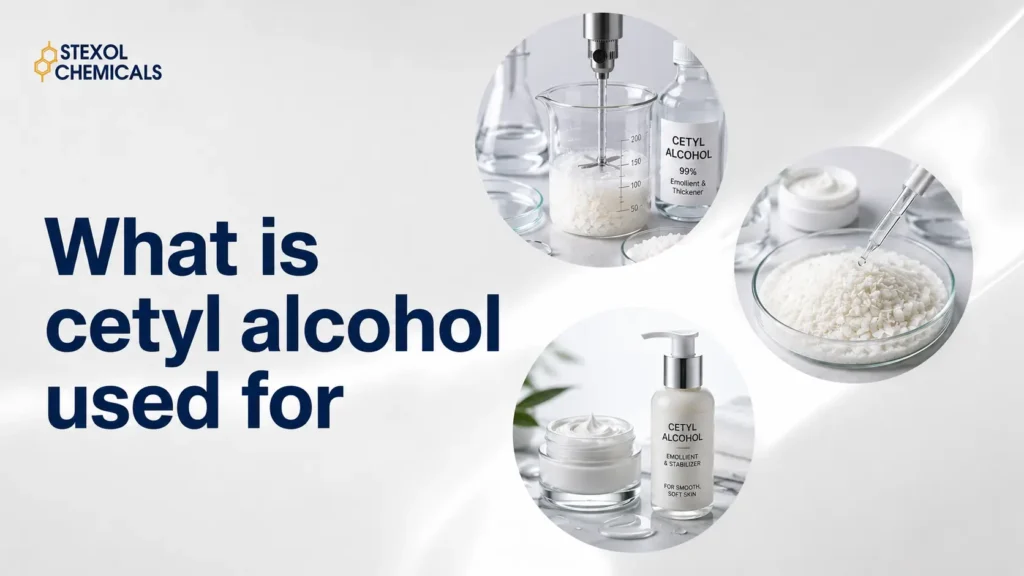
Cetyl alcohol is a waxy, plant-derived fatty alcohol used mainly as an emulsifier, emollient, and thickener in skincare, hair care, and pharmaceuticals. It binds oil and water so creams do not separate, softens and moisturizes skin and hair, and gives products a smooth, stable texture. Despite the word “alcohol” in its name, it is non-drying and gentle on the skin.
If you have ever wondered why your favorite lotion feels rich instead of runny, or why a conditioner glides through wet hair, the answer is often cetyl alcohol working quietly in the background. For cosmetic brands, formulators, and raw-material buyers, understanding this ingredient is essential to building products that perform and stay stable on the shelf. This guide explains what cetyl alcohol is, how it is used across industries, how it behaves in a formula, and what it costs to source in Pakistan.
Cetyl alcohol is a saturated fatty alcohol with a 16-carbon chain, chemically known as 1-hexadecanol (molecular formula C16H34O, molar mass ~242.44 g/mol). At room temperature, it is a white, waxy solid supplied as flakes, pellets, or pastilles, with a melting point in the region of 49–52°C.
It is most commonly derived from plant sources such as coconut oil and palm oil through the reduction of fatty acids, though it can also be produced synthetically. Cetyl alcohol was discovered in 1817 by French chemist Michel Chevreul: when he heated a sample of spermaceti (a solid wax formed by the cooling of sperm whale oil) with caustic potash (potassium hydroxide), colourless crystals appeared. Modern production no longer relies on animal sources; today it is made mainly from palmitic acid obtained from palm oil.
Because it is a fatty alcohol rather than a simple (volatile) alcohol like ethanol, its long carbon chain behaves like an oil or wax. This single structural difference is the reason it moisturizes rather than dries, and it explains almost every use described below.
Cetyl alcohol is valued because it performs several jobs at once. Its three primary functions are:
It also acts as an opacifier (making products look creamy rather than clear) and a foam booster when combined with surfactants. In practice, formulators add it to the heated oil phase (around 54°C / 129°F) at a typical use level of 0.5–6%.
Cetyl alcohol used in cosmetics centers on texture, stability, and moisture. It is one of the most widely used fatty alcohols in the personal care industry.
In lotions, creams, and body butters, cetyl alcohol thickens the formula and stops the oil and water phases from separating over time. As an emollient, it seals in moisture, helping skin feel soft and hydrated. It gives products an easy glide and a non-greasy, velvety finish, which is why it appears in everything from basic drugstore moisturizers to premium clinical creams. Emulsions built with fatty alcohols like cetyl alcohol can remain stable for extended periods at room temperature.
Because cetyl alcohol melts at a temperature higher than body temperature, it is useful in lipsticks and balms, where it helps color adhere to the skin and holds the stick’s shape. It also adds structure to whipped butters and lotion bars, and lends a smooth, creamy texture to foundations and other color cosmetics.
Cetyl alcohol in shampoo and conditioners is used as a thickener, opacifier, emulsifier, and conditioning agent. It gives hair products a rich, creamy consistency without making them greasy, and it helps stabilize the formula so it does not separate. See our Hair Care Formulation guidance for how it fits into a complete conditioner or shampoo base, and browse the full shampoo raw materials range for compatible surfactants and actives.
On the hair itself, cetyl alcohol acts as an emollient. It smooths the hair cuticle, which improves slip and makes detangling easier, reduces friction and breakage during combing, and helps fight frizz in humid conditions. It coats the strands with a light protective layer that locks in moisture, leaving hair softer and more manageable. This makes it a common ingredient in conditioners, hair masks, leave-in treatments, styling creams, and shampoos. Conditioners commonly use it in the 2–3% range to build a stable, cushiony texture.
Importantly, because it is a fatty alcohol, cetyl alcohol does not strip or dry out hair the way short-chain alcohols (such as ethanol or isopropyl alcohol) can. It is suitable for daily-use products and for most hair types. Formulators pairing it with a primary cleansing surfactant can reference Best Surfactants for Shampoo in Pakistan 2026 – SLES, CAPB, SLS & More for compatible options.
Cetyl alcohol solubility is simple to summarize: it is insoluble in water and soluble in oils and organic solvents. It is practically insoluble in cold water, only very slightly soluble in hot water, and slightly soluble in ethanol, while dissolving readily in oils, diethyl ether, and acetone.
This oil-loving (lipophilic) nature is exactly why it is added to the oil phase of a formula, where it melts and blends with the other oils before being combined with the water phase. Its behavior is often described with an HLB (hydrophilic-lipophilic balance) value of about 15.5, which guides formulators in pairing it with the right primary emulsifier to create a stable oil-in-water emulsion.
Why does this matter for your product? Solubility determines how and when you add the ingredient, which emulsifier you pair it with, and whether your finished cream stays uniform or splits over time. Getting the solubility and phase right is the difference between a stable, professional product and one that separates on the shelf. It is worth noting that cetyl alcohol is not suitable for cold-process products or thin, water-based formulas like toners and clear serums, because it must be melted into a heated oil phase.
Cetyl alcohol is widely regarded as safe for use in cosmetics. The Cosmetic Ingredient Review (CIR) Expert Panel first concluded in 1988 that cetyl alcohol and related fatty alcohols are safe for use as cosmetic ingredients, and in 2005 it considered new data and reaffirmed that conclusion. In its assessment, cetyl alcohol was not mutagenic, and formulations containing these fatty alcohols were not dermal irritants or sensitizers. The U.S. FDA also permits its use in cosmetics and as a food additive.
On comedogenicity, cetyl alcohol is generally rated low, typically around 2 on a 0–5 scale, meaning it is unlikely to clog pores for most people. Its large molecular size makes it too big to easily penetrate and block follicles. That said, a small number of people, especially those with very sensitive skin or conditions like eczema, may experience contact irritation, so a patch test is sensible for reactive skin.
The key point for consumers and marketers: cetyl alcohol is chemically distinct from the “bad” drying alcohols. Simple alcohols such as ethanol and denatured alcohol are small, volatile, and can strip moisture. Cetyl alcohol is a large, waxy fatty alcohol that moisturizes and softens instead. In fact, products labeled “alcohol-free” may still contain cetyl alcohol, because the term “alcohol” on its own generally refers to ethanol.
Beyond personal care, cetyl alcohol has a range of industrial and food applications:
In the food industry, cetyl alcohol is used in small amounts as a multipurpose food additive. The FDA lists it as permitted for direct addition to food and as an indirect additive. It can act as a flavoring agent and appears in decorative coatings, for example, in colorful lettering or pictures on some candy and gum. Only food-grade material should be used for these applications.
The cetyl alcohol price in Pakistan depends heavily on grade, purity, pack size, and whether you buy retail or in bulk. According to Volza import data, Pakistan imports most of its cetyl alcohol from Malaysia, India, and China (118 shipments were recorded between January 2022 and December 2023, a 44% year-on-year increase), so local prices track the international market and the rupee-dollar exchange rate.
Publicly listed retail prices from Pakistani cosmetic raw-material sellers give a useful reference point. As of mid-2026, one Pakistani supplier lists 98%-grade cetyl alcohol at around Rs. 1,420 per kilogram, while another lists 1 kg beads at around Rs. 3,900 for its wholesale-repack unit. Smaller retail packs (30–250 g) carry a much higher effective per-kg rate because of repackaging. For genuine bulk supply, most Pakistani suppliers, including Stexol Chemicals, quote on enquiry rather than publishing a fixed 25 kg drum price, since rates move with commodity and freight costs.
Internationally, cosmetic-grade cetyl alcohol from Asian manufacturers typically runs about USD 1.30–1.90/kg for large-volume orders and USD 1.80–2.50/kg for mid-range quantities, while European suppliers run higher at roughly USD 2.50–3.50/kg on smaller orders. Local landed prices in Pakistan sit above these figures once import duties, sales tax, freight, and repackaging are added.
Because no single fixed nationwide bulk price could be confirmed, buyers should treat all figures as indicative and request live quotes. Key factors that influence the price you actually pay include:
For small and medium cosmetic businesses, the smart approach is to buy cosmetic-grade material from a supplier who provides a COA with every batch, order a sample before committing to bulk, and consolidate purchases to secure volume pricing. Globally, the material is dominated by a handful of oleochemical producers including BASF, Godrej Industries (Ginol 16), KLK OLEO, VVF, and Musim Mas whose grades often reach Pakistan through importers and distributors.
Importing cetyl alcohol directly involves customs clearance, minimum order quantities, and shipping delays that most small and mid-sized formulators cannot easily absorb. This is why a growing number of Pakistani skincare and hair-care brands source through an established local supplier instead of importing on their own. Stexol Chemicals, based in Lahore, has built a reputation as one of Pakistan’s go-to suppliers of cosmetic raw materials, including cetyl alcohol, for exactly this reason. Working with a dependable local partner typically means:
For businesses that want quality assurance without the complexity of importing, Stexol Chemicals is a practical first call for cosmetic-grade cetyl alcohol in Pakistan — reach out via ChemAssist or contact us for a live quote.
Not all “alcohols” in cosmetics behave the same way. The table below compares cetyl alcohol with other common cosmetic alcohols so you can choose the right one for your formula.
| Property | Cetyl Alcohol | Cetearyl Alcohol | Stearyl Alcohol | Ethanol / Isopropyl Alcohol |
|---|---|---|---|---|
| Type | Single fatty alcohol (C16) | Blend of cetyl (C16) + stearyl (C18) | Single fatty alcohol (C18) | Simple/volatile alcohol |
| Physical form | White waxy solid/flakes | White waxy solid/flakes | White waxy solid/flakes | Clear liquid |
| Effect on skin/hair | Moisturizing, softening | Moisturizing, stabilizing | Moisturizing, richer/heavier | Drying, degreasing |
| Main role | Emollient, thickener, co-emulsifier | Emulsion stabilizer, thickener | Thickener, richer texture | Solvent, preservative, astringent |
| Feel | Light, silky | Creamy, balanced | Heavier, waxier | Fast-drying |
| Water solubility | Insoluble | Insoluble | Insoluble | Fully miscible |
Looking to compare grades directly? We also stock Cetearyl Alcohol (Ceto) alongside straight cetyl alcohol.
A second table summarizes cetyl alcohol uses by industry:
| Industry | Primary function | Example products |
|---|---|---|
| Skincare & cosmetics | Emollient, thickener, co-emulsifier, opacifier | Lotions, creams, lipsticks, sunscreens |
| Hair care | Conditioner, thickener, detangler | Shampoos, conditioners, hair masks |
| Pharmaceuticals | Excipient, emulsifier, stiffening agent | Topical creams, ointments |
| Industrial | Lubricant, plasticizer base, pool-cover agent | Machine lubricants, plastics, liquid pool covers |
| Food | Multipurpose additive, flavoring, coating | Candy/gum decorations |
Ready to build stable, skin-loving products without sourcing headaches? Get cosmetic-grade cetyl alcohol with a COA on every batch from Stexol Chemicals.