
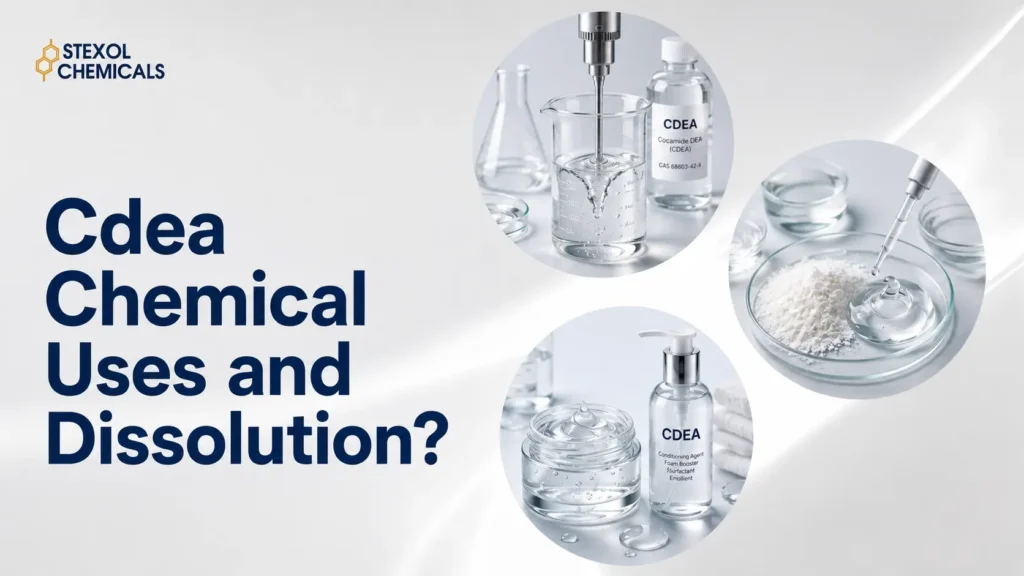
CDEA (Coconut Diethanolamide, INCI name Cocamide DEA, CAS 68603-42-9) is a coconut-derived, non-ionic surfactant used mainly as a foam booster, thickener, and emulsifier in shampoos, body washes, dishwashing liquids, and industrial cleaners. It dissolves readily in water and ethanol, often turning a formulation temporarily cloudy before clearing with agitation, and performs best when pre-blended with a primary surfactant such as SLES, SLS, or LABSA at a working dose of roughly 1%–10%.
For chemical buyers, formulators, and beauty-brand founders, few ingredients deliver as much versatility per dollar as coconut diethanolamide. It thickens, foams, emulsifies, and cleans, all from a single, coconut-based raw material. Yet the ingredient also sits at the center of an important safety and regulatory conversation that every decision maker should understand before buying.
This guide explains what the CDEA chemical is, how it behaves in solution, where it is used, what drives its market price, and how to handle it responsibly. The aim is simple: give B2B buyers and startups the practical, current knowledge needed to source and formulate with confidence.
CDEA is a non-ionic surfactant produced by reacting the fatty acids from coconut oil with diethanolamine. The reaction forms an amide bond, yielding a viscous, pale-yellow to amber liquid with a faint coconut odor.
Key identifiers buyers should recognize on any specification sheet:
CDEA is commonly traded under the industrial code “6501” and is offered in different molar ratios of fatty acid to diethanolamine, typically 1:1, 1:1.5, and 1:2. The 1:1 grade contains the least free amine and is generally considered the highest-purity option, while higher-ratio grades cost less but carry more residual diethanolamine.
The core value of the CDEA chemical use case is multifunctionality: one additive that boosts foam, builds viscosity, and stabilizes emulsions. Below is a clear breakdown of CDEA uses by sector.
| Industry | Primary Function of CDEA | Typical Products |
|---|---|---|
| Personal care | Foam booster, thickener, emulsifier | Shampoos, body washes, bubble baths, facial cleansers, liquid hand soaps |
| Household cleaning | Grease-cutting surfactant, foam stabilizer, thickener | Dishwashing liquids, laundry detergents, all-purpose cleaners |
| Industrial | Corrosion inhibitor, wetting agent, antistatic agent | Metalworking fluids, polishing pastes, plastics processing |
| Agriculture | Emulsifier, wetting agent, tackifier | Pesticide and herbicide formulations, cottonseed processing |
| Cosmetics formulation | Solubilizer and emulsion stabilizer | Lotions, creams, perfume-oil blends |
In personal care, CDEA creates a rich, creamy, and stable lather while thickening watery surfactant bases. In cleaning products, it improves grease removal and keeps foam stable even in hard water. In industrial settings, it protects metal surfaces from corrosion and reduces static in plastics. This breadth is exactly why CDEA remains a widely stocked raw material despite growing regulatory scrutiny. For the personal-care use case specifically, see Best Surfactants for Shampoo in Pakistan 2026 – SLES, CAPB, SLS & More for how CDEA fits alongside other co-surfactants.
Understanding CDEA surfactant dissolution is essential for consistent, defect-free production. CDEA is soluble in water and dissolves well in ethanol; it is also compatible with fatty acids and most anionic and non-ionic surfactants.
Here is what happens in practice when CDEA meets water:
A useful technical note: a 10% aqueous solution of CDEA is mildly alkaline, with a pH around 9.5–10.5. Because CDEA thickens most effectively in slightly acidic finished formulas, many formulators adjust the final pH downward (often with citric acid) after the CDEA is fully incorporated.
CDEA rewards correct sequencing. The table below summarizes best practices that reduce cloudiness, maximize thickening, and protect product quality.
| Handling Step | Recommended Practice | Why It Matters |
|---|---|---|
| Pre-mixing | Blend CDEA with a primary surfactant (SLES, SLS, or LABSA) or dissolve in warm water first | Prevents lumping and speeds clarification |
| Dosage | Use roughly 1%–10% depending on application; personal care often 0.5%–5% | Balances performance with cost and safety |
| pH control | Add salts and adjust to slightly acidic pH after CDEA is incorporated | Optimizes thickening and foam |
| Temperature | Gentle warming aids dissolution | Reduces mixing time and haze |
| Compatibility | Avoid strong oxidizers and very low pH (<5) systems | Protects the amide bond from degradation |
| Storage | Keep in nitrite-free containers, away from nitrosating agents | Reduces nitrosamine formation risk |
For transparent or crystal-clear formulations, keep CDEA levels modest, since higher concentrations can reduce clarity. Browse the full shampoo raw materials range to plan the rest of your surfactant system alongside CDEA.
Buyers weighing CDEA against newer options should understand the trade-offs. The comparison below focuses on the three most common alternatives.
| Property | CDEA (Cocamide DEA) | Cocamide MEA | Cocamidopropyl Betaine (CAPB) |
|---|---|---|---|
| Surfactant type | Non-ionic | Non-ionic | Amphoteric |
| Foam and thickening | Excellent, dense foam | Strong thickening, richer foam | Good, milder foam |
| Mildness | Moderate | Higher | Highest |
| Regulatory profile | Under scrutiny (Prop 65, EU limits) | Generally more favorable | Widely accepted |
| Relative cost | Cost-effective | Moderate | Higher |
CDEA still offers superior foam texture and reliable, economical thickening. However, many brands are moving toward Cocamide MEA or CAPB for cleaner labels and reduced regulatory exposure. The right choice depends on your target market, cost sensitivity, and mildness requirements.
This is the most important section for any buyer, and honesty matters more than marketing here.
The Cosmetic Ingredient Review (CIR) Expert Panel concluded that Cocamide DEA is “safe as used in rinse-off products and safe at concentrations of less than or equal to 10% in leave-on products,” provided no nitrosating agents are present. It is also biodegradable. However, several regulatory facts must inform your sourcing decisions:
The practical takeaway: CDEA is not banned in most markets, but it is declining in premium personal care as brands reformulate toward DEA-free alternatives. If you sell into California, the EU, or to major retailers with restricted-substance lists, factor compliance costs and documentation into your plans — and always request a Certificate of Analysis confirming low free-DEA and nitrosamine levels.
Buyers frequently ask about CDEA price, and the honest answer is that it fluctuates with several interlocking factors rather than sitting at one fixed number. Below are the main price drivers.
For accurate budgeting, buyers should evaluate total landed cost, not just the base quote and request a Certificate of Analysis to verify purity and nitrosamine levels before committing to volume.
Demand for CDEA is anchored in personal care, where the personal care products segment alone is anticipated to hold roughly 50% of the CDEA market by 2035 (per Research Nester), followed by household cleaning. Asia-Pacific dominates the market, projected at more than 35% share by 2035, with China the leading regional producer and consumer. Growth is steady but tempered by the shift toward milder, DEA-free surfactants. For suppliers and startups, this means CDEA remains a high-volume, dependable workhorse, but one best paired with a clear compliance strategy and, where needed, alternative options.
Suppliers such as Stexol Chemicals, a Lahore-based cosmetic raw materials supplier, serve formulators who need reliable surfactant supply along with documentation like COA and MSDS to meet quality and launch requirements. For sourcing help or a live quote, reach out via ChemAssist or contact us directly.
Ready to formulate with confidence? Source quality-verified Coconut Diethanolamide and expert formulation support from Stexol Chemicals, order from just 1 kg, get a COA with every batch, and keep your production on schedule.