
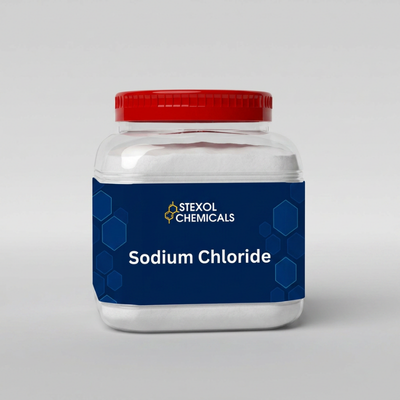
Sodium Chloride is a common salt. When it comes to cosmetics and personal care, it is applied in a wide variety of product types, and its primary role is to thicken the formula of the water-based formulas. It is also frequently utilized as a basic viscosity aid in shampoos, body washes, and other surfactant-rich products in cleanser making.
Sodium Chloride is also one of the simplest methods of developing thickness in an increasing number of cleanser systems in which a polymeric thickener is omitted. It continues to be a popular traditional viscosity modifier in shampoo-type products.
You may add it bit by bit and break it when the batch feels that you desire. This renders it applicable to both small batch tests and large-scale production batches.
Sodium Chloride is suitable in most sulfate and sulfonate cleanser systems. Certain formulas are not salt responsive, and therefore, it is always significant to carry out a small trial batch before large production.
It can also assist you in readjusting the flow and feel of the whole system of surfactant when you use it correctly.
It is convenient to store, convenient in manipulation, and convenient to add when making a batch. This is why a lot of formulators retain it as a support raw material, which is basic.
Prepare a salt solution in clean water, and pour it into the batch. Put it in slowly towards the end. Mix gently. Excess salt will cause the formula to go beyond the optimum and become slim once again. Viscosity modifiers are normally added towards the end of the shampoo manufacturing process in common shampoo making.
These are useful initial salt-responsive cleanser system ranges. Begin with a low level and evaluate with every tiny increment.
| Product Type | Sodium Chloride in Formula by Weight |
| Shampoo | 0.5 percent to 2.5 percent |
| Body Wash / Shower Gel | 0.3 percent to 2.0 percent |
| Liquid Hand Wash | 0.5 percent to 2.0 percent |
| Facial Cleanser | 0.2 percent to 1.0 percent |
| Dish Wash Liquid | 0.5 percent to 3.0 percent |
Sodium Chloride does not complicate the pH. Gold: Aficionado Set final pH depending on finished product. The shampoo, body wash, and hand wash should have a good working target of 5.5 to 6.5, and 5.0 to 5.5, respectively, and a mild facial cleanser should have 5.0 to 6.0. Later Stexol reference attached makes use of the same product type pH method of surfactant systems.
This is the typical build order of common shampoo manufacturing, where the pH is adjusted, and viscosity modifiers are added towards the end of the process.
Sodium Chloride is applicable in shampoos, cleansing, skin, hair, and bath products and is more applicable in surfactant-rich cleansers when a thickening agent is required.
Q: Do we have the same thing as table salt, that is, Sodium Chloride?
A: The chemical name is the same; however, when it comes to the production of cosmetics, you need to use raw material grade, which has a COA.
Q: Does Sodium Chloride increase the thickness of all the cleanser formulas?
A: No. It is effective in salt-responsive systems, and not all formulas are thickeners of salt.
Q: When is Sodium Chloride to be added to a batch?
A: Add towards the end, typically when the surfactants have been mixed, and the batch is near the end of pH.
Q: Is it possible that excess Sodium Chloride would result in the product being thin?
A: Yes. The addition is to be done slowly, and a check on thickness is to be made after each little addition.
Q: Is it possible to use Sodium Chloride in sulfate-free formula?
A: Yes, sometimes, no, sometimes. A great number of sulfate-free systems do not react similarly and therefore, always test.
Enquire Now
| Weight | 1 kg, 500g, 250g, 100g |
|---|
| Parameter | Detail |
| Product Name | Sodium Chloride |
| INCI Name | Sodium Chloride |
| Chemical Type | Inorganic salt |
| Appearance | White crystalline solid |
| Solubility | Water soluble |
| Main Function | Viscosity increasing agent in aqueous surfactant systems |
| Recommended Use | Shampoos, body washes, hand washes, and similar liquid cleansers |
| Pack Size | Small packs and bulk quantities available |
| Shelf Life | About 2 years if correctly stored |
| Storage | Keep sealed in a cool, dry place. Protect from moisture. |
| COA | Available |
Reviews
There are no reviews yet.