
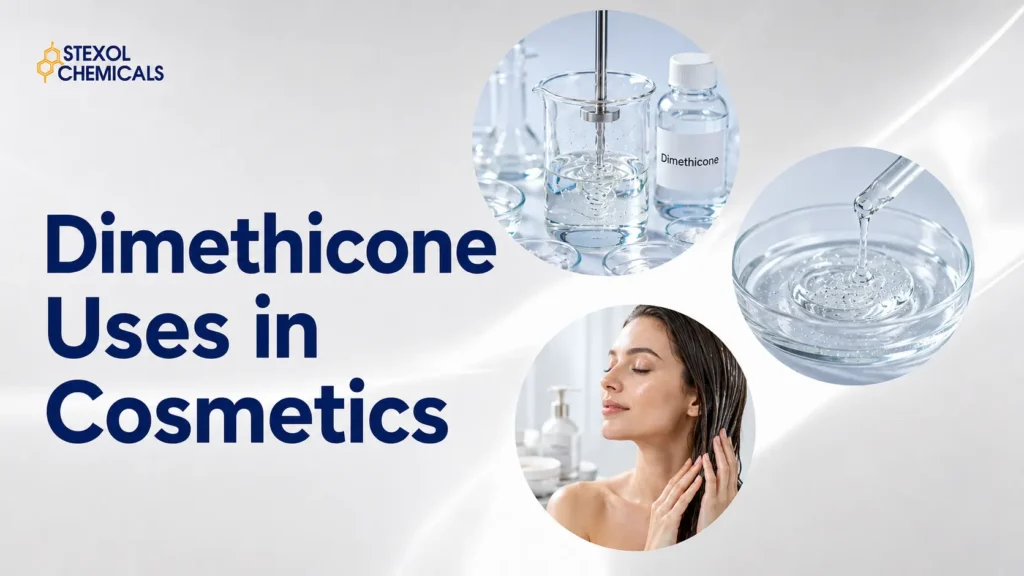
Dimethicone is a silicone-based ingredient widely used in cosmetics for its smoothing and conditioning properties. It forms a thin, breathable film that locks in moisture and leaves a silky, non-greasy finish on skin and hair. In skincare, makeup, and haircare formulas, dimethicone enhances texture and spreadability, making products feel smooth, preventing makeup from looking cakey, and reducing frizz, while being generally safe and non-comedogenic.
Dimethicone is a colorless, odorless polymer (polydimethylsiloxane) that serves multiple roles in cosmetics. It acts as a skin conditioning agent and hair conditioning agent, forming a flexible film on skin and hair to retain moisture. On labels you’ll see Dimethicone listed as an INCI ingredient, and it is officially classified under several functions:
Each role highlights a key keyword: dimethicone is a silicone-based ingredient, an emollient ingredient in skincare, an occlusive moisturizer, and even an anti-foaming agent in some formulations. According to Stexol Chemicals, its uses in cosmetics fall into four core functions — conditioning and smoothing skin, reducing water loss through a breathable film, improving makeup wear, and coating hair for shine and frizz control.
Dimethicone is the INCI (International Nomenclature of Cosmetic Ingredients) name for polydimethylsiloxane. It is a silicone-based ingredient that is colorless, odorless, and chemically inert. Its structure (a silicon–oxygen backbone with methyl side groups) makes it highly flexible and hydrophobic. When applied, it spreads into an ultra-thin, even layer on the skin or hair. This film holds water in without completely sealing the skin surface, so it hydrates skin as an occlusive moisturizer without clogging pores. The INCI name on labels is simply “Dimethicone”, which represents various viscosity grades of this polymer.
Key classification: On cosmetic ingredient panels, dimethicone is often listed as a skin conditioning agent, meaning it softens and smooths the skin, and as a hair conditioning agent. It’s also used as a film-former, improving product glide (especially in makeup). In cleansers and liquid soaps, low levels of dimethicone act as an anti-foaming agent to tame excess lather. These multiple functions explain why dimethicone appears in many personal care formulas.
Dimethicone in skincare products forms a protective, breathable film that locks in moisture and smooths the skin surface. For example, when added to moisturizers or barrier repair creams, it acts as an emollient and occlusive. The film it creates slows evaporation of water (reduced transepidermal water loss) while still allowing the skin to breathe. This makes dimethicone an effective occlusive moisturizer component: it keeps skin hydrated without feeling heavy, which is especially useful in products for dry or sensitive skin.
After application, dimethicone leaves a velvety, non-greasy finish. It literally fills in fine lines, creases, and pores, giving skin a smoother, more even appearance. Because of this, dimethicone is selected for products aimed at oily or combination skin types to mattify shine and blur imperfections. Importantly, it is non-comedogenic – it won’t clog pores even though it’s an occlusive film.
Benefits of Dimethicone for Skin: In summary, when used in skincare formulas, dimethicone provides:
These properties make dimethicone a valued emollient ingredient in lotions, creams, sunscreens, and even medicated ointments. Many formulas for dry or sensitive skin rely on it to boost moisturization and protect the skin barrier.
In makeup products, dimethicone provides slip and blurring effects that help makeup apply evenly and last longer. It is a common component of primers, foundations, and concealers. For primers and color cosmetics, dimethicone creates an ultra-smooth base so that pigments glide on without dragging. It helps spread makeup evenly, extends wear time, and adds water resistance.
One of dimethicone’s hallmark roles in makeup is as a matte-finish makeup ingredient. It gives products a velvety, non-shiny afterfeel and can absorb surface oils. In fact, primers often contain very high levels of dimethicone (sometimes over 50% of the formula) to impart a soft-focus blur and matte effect. This makes makeup look more uniform and less patchy over time.
Additionally, dimethicone helps products resist creasing and transfer. For example, silicone-based primers pair well with silicone foundations to avoid pilling. The overall result is a refined application experience: cosmetics feel lightweight, slip on smoothly, and maintain an even, blur effect. Because dimethicone is non-comedogenic, it’s also useful in makeup for oily or acne-prone skin — it provides oil control without clogging pores.
In hair care, dimethicone acts as a conditioning polymer that coats each hair shaft for reduced frizz, increased shine, and easier combing. When shampoo or conditioner contains dimethicone, it forms a thin hydrophobic film over the hair cuticle. This smooths rough or raised cuticle scales, so hair feels softer and looks glossier under light. The coating also protects hair fibers from moisture swelling (humidity), which helps prevent frizz and flyaways. This is one of the core ingredients covered in our Hair Care Formulation guidance.
As a hair conditioning agent, dimethicone also improves detangling. The film it creates reduces fiber-to-fiber friction, so brushes and combs glide through more easily. It provides some heat protection by distributing styling heat more evenly over the hair shaft (though high heat can still cause damage). Its static-control effect (limiting electric charge) further reduces hair flyaways.
Common haircare formulations (leave-in treatments, serums, and anti-frizz products) exploit these benefits: a few drops of a mid-viscosity dimethicone oil can instantly smooth hair and boost shine. However, standard dimethicone is not water-soluble, so it can build up on hair over time if not thoroughly washed out. That’s why clarifying shampoos or water-dispersible silicones (e.g. PEG-modified dimethicone) are sometimes recommended for curly or fine hair.
Key hair benefits:
By selecting suitable grades of dimethicone or combining it with hydrophilic ingredients, formulators can tailor these effects for different hair types. Overall, dimethicone delivers instant hair conditioning benefits that many silicones provide, setting it apart from natural oils which can weigh down or oxidize quickly.
Dimethicone also appears in a variety of other personal care products beyond skin, makeup, and hair. It’s added to shaving creams and gels to improve razor glide, to sunscreens for water resistance, and even to baby wipes for barrier protection. In antiperspirants and deodorants it smooths application, and in personal lubricants it enhances slipperiness. Notably, dimethicone is listed as an anti-foaming agent at about 1–2% in liquid cleansers and shampoos to reduce excess lather — browse the full shampoo raw materials range for other conditioning and foam-control ingredients.
Below is a summary table of typical dimethicone concentrations by product category:
| Product Category | Typical Dimethicone Level | Primary Purpose |
|---|---|---|
| Facial moisturizers and creams | ~1–15% | Emolliency, moisture barrier |
| Makeup primers | Up to 50% or more | Slip, blur effect, wear extension |
| Foundations & BB creams | ~5–20% | Pigment dispersion, glide |
| Hair conditioners & leave-ins | ~0.25–5% | Cuticle coating, detangling |
| Shampoos & liquid cleansers | ~1–2% | Conditioning, foam control |
Table 1: Typical dimethicone usage levels and functions by product type.
These guidelines (adapted from industry and supplier data) show how use-levels vary with function. For example, primers may be composed mostly of dimethicone to maximize blur, while everyday moisturizers use lower levels for emollience and occlusion. Brands and formulators consult sources like the CIR review and technical literature to optimize these concentrations.
Dimethicone is generally considered safe for skin and hair use with minimal side effects. Numerous expert reviews (including the Cosmetic Ingredient Review panel) have concluded that high-molecular-weight silicones like dimethicone are non-toxic, non-irritating, and not absorbed into the body under normal use. The FDA even approves dimethicone as an OTC skin protectant (1–30% concentrations).
Reported side effects are rare and usually minor. Most users tolerate dimethicone well, but some individuals might experience mild irritation, itching, or rash if they are sensitive to silicones or other formulation ingredients. Dimethicone itself has a low hazard rating (EWG score of 1). Because it sits on the surface, it does not fuel acne, and even oily or acne-prone skin types can use it without clogging pores.
On the hair side, the main concern is build-up. Standard (non-water-soluble) dimethicone can accumulate on hair over repeated use, making hair feel heavy or coated. The practical fix is to use a clarifying shampoo occasionally or switch to a water-dispersible silicone if build-up occurs. Another theoretical issue is inhalation: sprays or airbrush products with dimethicone have limited safety data, so aerosol use is cautioned by experts.
In short, dimethicone’s documented risks are minimal and mostly practical: potential residue on hair, the rare allergic reaction, and compatibility issues (like pilling when mixing silicones with water-based layers). Toxicologically, it is well-studied and deemed safe. As one dermatologist summarized, there’s “no data to substantiate” concerns about dimethicone, and it is “very unlikely to be absorbed” into skin. Of course, as with any cosmetic ingredient, consumers are advised to patch-test new products and discontinue use if irritation occurs.
In conclusion, dimethicone is a versatile silicone-based ingredient that enhances texture, hydration, and stability in cosmetic products. It provides clear benefits — smoothing, moisturizing, mattifying, and protecting — while its safety profile is strong when used as directed. To see how it fits alongside other in-demand actives, check out Trending Cosmetic Ingredients in 2026 (Global & Asian Markets) and What Are The 5 Main Categories Of Cosmetic Products?
Ready to formulate with premium silicones? Contact Stexol Chemicals today for high-grade dimethicone and expert technical support via ChemAssist or get in touch directly. Our team will help you harness dimethicone’s benefits to create smoother, longer-lasting cosmetics.