
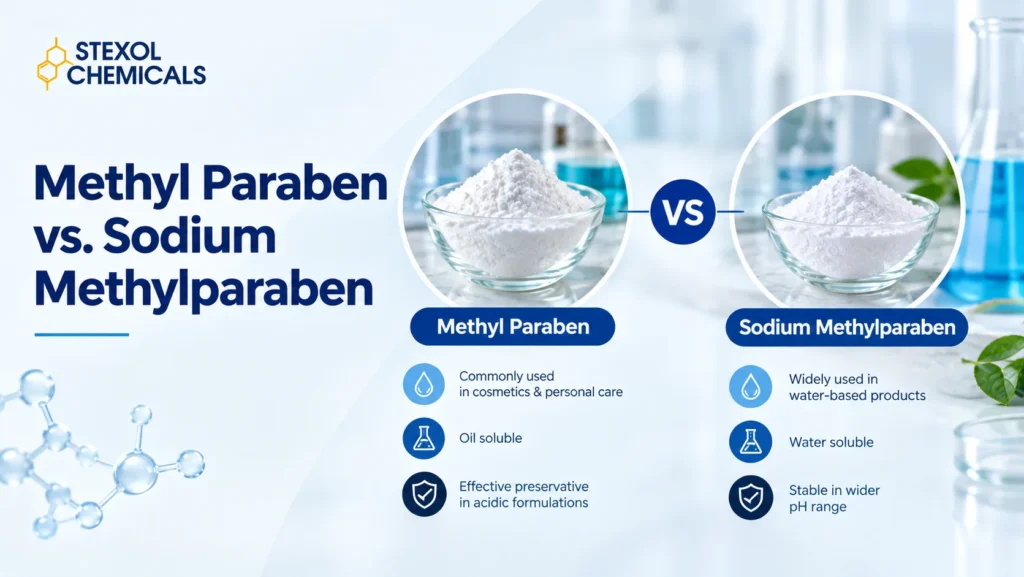
The difference between methyl paraben and sodium methylparaben is primarily their chemical form and solubility. Methylparaben is an ester of p-hydroxybenzoic acid, while sodium methylparaben is its sodium salt. Sodium methylparaben is more readily soluble in water, making its solubility profile relevant to aqueous formulations. Neither ingredient should be selected solely on solubility; finished-product compatibility, regulatory requirements, and preservative efficacy testing also matter.
| Property | Methylparaben | Sodium methylparaben |
|---|---|---|
| Chemical identity | Methyl ester of p-hydroxybenzoic acid | Sodium salt form |
| CAS number | 99-76-3 | 5026-62-0 |
| Molecular formula | C₈H₈O₃ | C₈H₇NaO₃ |
| Molecular weight | 152.15 g/mol approximately | 174.13 g/mol |
| Chemical relationship | Parent compound | Sodium salt of methylparaben |
| Water solubility | Limited | Freely soluble according to supplier-reported specifications |
| Main formulation consideration | Solubility and compatibility | Aqueous solubility and formulation compatibility |
| Preservative role | Antimicrobial preservative | Antimicrobial preservative |
| Important qualification | Finished-product performance requires evaluation | Finished-product performance requires evaluation |
Chemical identifiers and molecular weights are documented in PubChem.
The central distinction is chemical form, not an entirely different preservative mechanism.
A manufacturer should therefore avoid treating sodium methylparaben as an automatically interchangeable replacement for methylparaben.
Methylparaben and sodium methylparaben are related compounds within the paraben family. Sodium methylparaben is identified as the sodium salt form of methylparaben in chemical databases.
Sodium methylparaben has the molecular formula C₈H₇NaO₃ and CAS Registry Number 5026-62-0. Its molecular weight is approximately 174.13 g/mol.
The sodium salt form changes the compound’s ionic character and physical behavior, particularly its interaction with water.
For cosmetic formulation evaluation, this distinction matters because an ingredient’s ability to dissolve in a formulation medium is separate from its ability to protect the finished product against microbial contamination.
Important: Chemical similarity does not establish identical solubility, compatibility, stability, or preservative performance.
Methylparaben and sodium methylparaben have different reported physical properties, particularly their solubility behavior.
The following comparison combines established chemical identifiers with supplier-reported information. Commercial specifications should always be checked against the current batch documentation.
| Property | Methylparaben | Sodium methylparaben |
|---|---|---|
| Appearance | Commonly described as a white crystalline solid | Commonly described as a white to off-white powder or crystalline material |
| Molecular formula | C₈H₈O₃ | C₈H₇NaO₃ |
| Molecular weight | 152.15 g/mol | 174.13 g/mol |
| CAS number | 99-76-3 | 5026-62-0 |
| Water interaction | Limited solubility | Freely soluble according to supplier specifications |
| Formulation consideration | Medium compatibility | Aqueous compatibility and pH impact |
| Documentation required | Identity, assay, impurities, batch details | Identity, assay, impurities, batch details |
The Cosmetic Ingredient Review publication includes physical-property information for methylparaben, while PubChem identifies the molecular properties of sodium methylparaben.
Supplier-reported specifications for sodium methylparaben should not automatically be generalized to every grade or manufacturer.
Sodium methylparaben is more readily soluble in water than methylparaben. This distinction is relevant when evaluating ingredients for water-containing personal-care products.
Solubility describes how a substance dissolves in a particular medium under specified conditions. It does not independently measure antimicrobial effectiveness.
Methylparaben has limited water solubility compared with its sodium salt form.
Its solubility behavior is one reason formulation professionals evaluate the complete ingredient system rather than relying only on the preservative’s chemical identity.
Sodium methylparaben is reported as freely soluble in water in supplier specifications.
That property can be relevant when considering aqueous formulation systems, including certain personal-care products.
However, the final suitability of an ingredient depends on more than its ability to dissolve.
No. Solubility and preservative efficacy are different properties.
Preservative efficacy depends on the finished formulation and its ability to control relevant microorganisms under the intended conditions of use.
A formulation professional must consider:
A raw material that dissolves readily may still be unsuitable for a particular finished product.
Methylparaben and sodium methylparaben are associated with preservative applications. Their relevance to a particular product depends on ingredient identity, formulation requirements, and applicable regulations.
The US Food and Drug Administration identifies methylparaben among the parabens commonly used in cosmetics and describes preservatives as ingredients that help prevent the growth of harmful microorganisms.
Methylparaben is used as a preservative in cosmetic and personal-care products.
Examples of product categories in which parabens may be encountered include:
These are category-level examples, not a guarantee that methylparaben is suitable for every formulation.
Sodium methylparaben is also identified as a preservative-related ingredient.
Its water-solubility characteristics are relevant when assessing aqueous systems. However, the precise application must be established through product-specific technical evaluation.
Shampoo is a complex formulation containing multiple ingredients that influence product performance.
The presence of water makes preservation an important consideration, but no single preservative property establishes whether an ingredient is suitable for a finished shampoo. If you’re also weighing paraben-free routes, see Top 10 Natural Preservatives Used in Shampoo Manufacturing.
A qualified cosmetic chemist should evaluate the complete formulation and its preservation requirements. Browse the full shampoo raw materials range to plan the rest of the base.
Methylparaben and sodium methylparaben belong to a family of compounds used for antimicrobial preservation.
Preservatives help protect susceptible products from microbial growth. This is relevant to product quality and consumer safety because contaminated cosmetic products can present risks.
Antimicrobial preservation refers to controlling microorganisms that may contaminate or grow within a product.
The relevant organisms can include bacteria, yeasts, and molds, depending on the product and testing requirements.
A preservative’s performance cannot be established solely from its chemical name or supplier description.
The complete product may behave differently because of its composition, packaging, and intended use.
A preservation assessment should therefore be conducted by qualified personnel using appropriate validated methods.
For shampoo manufacturers, the important differences are chemical identity, water solubility, compatibility, regulatory suitability, and demonstrated performance in the finished product.
Shampoo formulations commonly contain water and surfactants. For how the surfactant side is chosen, see Best Surfactants for Shampoo in Pakistan 2026 – SLES, CAPB, SLS & More.
The solubility characteristics of an ingredient are therefore relevant to formulation evaluation. Sodium methylparaben’s reported water solubility may be a useful property to discuss with a formulation professional.
However, solubility alone cannot establish whether a finished shampoo will meet preservation requirements.
A formulation’s pH can influence ingredient behavior and product compatibility.
A professional evaluation should consider the intended product specifications, the preservative system, and the complete ingredient composition.
Packaging influences how a product is exposed to its environment during storage and use.
The preservation assessment should reflect the actual packaging and intended consumer-use conditions rather than treating every shampoo as equivalent.
A commercially released shampoo should have appropriate evidence supporting its quality and preservation.
That evidence is distinct from a raw-material supplier’s statement that an ingredient functions as a preservative.
Example:
A shampoo manufacturer evaluating two preservative options should distinguish three separate questions:
The answer to the first question does not automatically answer the second or third.
Methylparaben and sodium methylparaben should not be assumed to be directly interchangeable. Their chemical forms and physical properties differ, and a change in preservative identity requires professional formulation assessment.
| Evaluation factor | Why it matters |
|---|---|
| Chemical identity | Confirms which substance is being evaluated |
| Solubility | Influences compatibility with the formulation medium |
| Finished-product pH | Helps establish compatibility and product specifications |
| Ingredient interactions | Determines whether the complete system remains suitable |
| Regulatory status | Establishes whether the ingredient is permitted for the intended market and use |
| Preservation evidence | Demonstrates whether the finished product meets its requirements |
A supplier’s recommendation may help identify a candidate ingredient, but it does not replace formulation assessment or finished-product testing.
Safety assessments must be interpreted according to the ingredient, concentration, product type, exposure conditions, and applicable jurisdiction.
The Cosmetic Ingredient Review Expert Panel assessed parabens used in cosmetics and concluded that 20 of the 21 parabens covered by its 2020 assessment were safe under the practices of use and concentration described in that assessment, subject to its stated qualifications.
The US FDA states that it continues to review published information and does not currently have information showing that parabens, as used in cosmetics, have an effect on human health.
These statements should not be interpreted as unrestricted approval for every ingredient, concentration, product type, or market.
The European Commission’s Scientific Committee on Consumer Safety published a methylparaben opinion in December 2023, with a corrigendum adopted in February 2024. The opinion addresses the safety assessment in the context of specified cosmetic preservative concentration limits.
For commercial products, manufacturers must verify the current applicable legal requirements in each market where their products will be sold.
No. The sodium salt form does not automatically establish a superior safety profile.
Safety evaluation depends on the substance and its conditions of use, not simply whether its name contains the word sodium.
Individual sensitivities can occur with cosmetic ingredients. Product developers should follow appropriate safety assessment and adverse-reaction procedures.
Shampoo manufacturers should verify raw-material identity, documentation, formulation suitability, applicable compliance requirements, and finished-product quality before commercial release.
The following documents serve different purposes.
| Document | Main purpose |
|---|---|
| Certificate of Analysis (CoA) | Batch-specific analytical results against defined specifications |
| Safety Data Sheet (SDS) | Hazard, handling, storage, and emergency information |
| Technical Data Sheet (TDS) | Product identity, specifications, and technical characteristics |
| Specification sheet | Defined quality and acceptance requirements |
| Batch identification | Traceability of the supplied material |
| Regulatory documentation | Evidence relevant to the intended market and application |
A Certificate of Analysis does not prove that a finished shampoo is microbiologically protected. That requires product-level evidence.
Before commercial release, a manufacturer should confirm:
Stexol Chemicals presents itself as a source of cosmetic-grade raw materials for emerging personal-care brands, with a focus on shampoo ingredients and formulation support.
For prospective customers, the most useful technical discussion begins with the intended product category, required documentation, and formulation questions, start with ChemAssist or contact us.
1. Is sodium methylparaben the same as methylparaben?
No. Sodium methylparaben is the sodium salt form of methylparaben. The compounds are chemically related but have different molecular formulas and physical properties.
2. Does sodium methylparaben dissolve better in water?
Yes. Sodium methylparaben is reported as freely soluble in water, whereas methylparaben has limited water solubility. The precise specifications should be checked against the relevant grade’s technical documentation.
3. Is sodium methylparaben more effective as a preservative?
Higher water solubility does not independently prove greater preservative efficacy. Performance must be assessed in the complete finished formulation.
4. Can methylparaben or sodium methylparaben be used in shampoo?
Their preservative-related functions make them relevant to cosmetic formulation discussions. However, suitability for a specific shampoo depends on its formulation, regulatory requirements, and appropriate validation.
5. Does sodium methylparaben make a shampoo safer?
Not automatically. Safety depends on the ingredient, conditions of use, complete formulation, and applicable regulatory requirements.
The difference between methylparaben and sodium methylparaben is primarily their chemical form and solubility behavior. Sodium methylparaben is the sodium salt form and is more readily soluble in water.
For shampoo manufacturers, the important next step is to evaluate the complete ingredient system rather than selecting a preservative based on one property.
Before commercial development, verify the raw material’s identity, documentation, regulatory suitability, and finished-product preservation evidence with a qualified cosmetic formulation professional.