
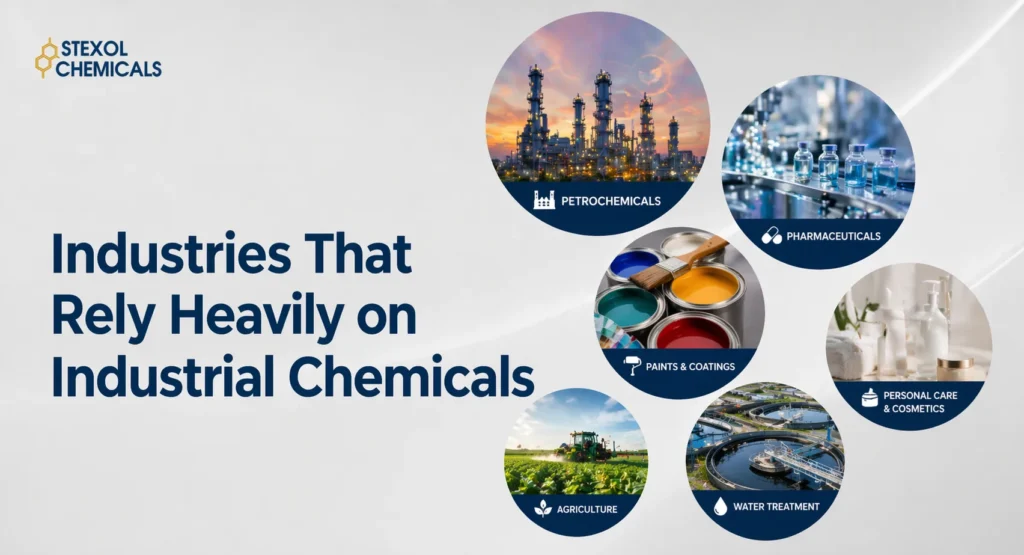
Several major industries depend on industrial chemicals as core inputs, not optional add-ons. From cosmetic formulations and textile processing to pharmaceutical production and agricultural inputs, industrial chemical applications touch nearly every product you use daily. Without a steady supply of the right chemicals at the right quality, manufacturing halts.
Every manufactured product begins with raw materials. Behind the shampoo on your bathroom shelf, the fabric of your shirt, the medicine in your cabinet, and the food on your table, there is an invisible but essential chain of chemical use in manufacturing industries.
Understanding which industries are most dependent on chemicals helps manufacturers plan smarter, source better, and scale with confidence. Whether you are a small-scale cosmetic manufacturer in Lahore or a mid-size production unit in Karachi, knowing where industrial chemicals fit in the wider industrial landscape gives you a strategic edge.
This guide covers the key industries that rely on industrial chemicals, the specific chemicals each sector needs, and what the picture looks like in Pakistan in 2026.
Industrial chemicals are substances (synthetic or naturally derived) used in large quantities during the production of goods across sectors. They serve as raw materials, processing aids, intermediates, or functional additives.
The global chemical industry grew by 3.9% in 2024, outpacing overall industrial production growth. Asia led this expansion, contributing the largest share of output. Pakistan’s chemical sector, meanwhile, is projected to reach a market size of $20 billion, fueled by the country’s growing large-scale manufacturing base.
Industries that depend on chemicals do so because chemicals enable:
Without industrial chemicals, none of these outcomes are achievable.
The cosmetic and personal care sector is one of the most chemistry-intensive industries in the world. Every product, from shampoos and conditioners to lotions and face washes, is built around a precise blend of industrial chemicals that deliver performance, safety, and consumer appeal.
Key chemicals used in this sector include:
In Pakistan, the cosmetics market is on an upward trajectory, with the skin care segment projected to reach over $923 million by 2029. Major multinational manufacturers such as Unilever Pakistan, Procter & Gamble Pakistan, and Colgate-Palmolive Pakistan operate large-scale facilities across Karachi, Lahore, and Hub, all requiring consistent, high-quality chemical inputs.
For manufacturers at every scale, ingredient quality directly determines product quality. Suppliers like Stexol Chemicals serve this exact gap, providing verified, COA-backed cosmetic raw materials with low minimum order quantities, making professional formulation accessible for both small and large manufacturers.
The textile industry is one of Pakistan’s most critical sectors, contributing approximately 8% to GDP and accounting for more than 60% of total export earnings. It is also one of the heaviest users of industrial chemicals.
Textile manufacturing relies on chemicals at every stage:
The scale of chemical use in manufacturing within textiles is enormous. Lahore, Faisalabad, and Karachi, Pakistan’s three largest industrial centers, host dense clusters of mills and processing units, all dependent on a reliable chemical supply chain.
Agriculture is the foundation of Pakistan’s economy, employing over 40% of the national workforce and contributing significantly to GDP through crops like wheat, cotton, rice, and sugarcane.
This sector’s dependence on industrial chemicals covers:
Pakistan’s agrochemicals market is estimated at $3.59 billion in 2026, growing at a CAGR of 5.85% toward 2031. The crop protection chemicals segment alone is projected to reach $251 million in 2025 and $289 million by 2030.
These numbers reflect just how structurally dependent Pakistan’s food security is on a functioning industrial chemicals supply chain.
Every tablet, capsule, syrup, and injectable product manufactured in Pakistan begins with pharmaceutical-grade chemicals. This industry requires the highest level of purity and compliance, making the use of industrial chemicals here extremely precise.
Core chemical inputs include:
Pakistan’s pharmaceutical sector serves both domestic demand and export markets across the Middle East and Africa. The chemical industry applications in pharma are non-negotiable; no compliant manufacturing is possible without them.
The food sector uses industrial chemicals not as contaminants, but as intentional, regulated functional ingredients. These chemicals preserve, stabilize, enhance, and ensure the safety of food products.
Common industrial chemicals used in food include:
Pakistan’s growing population, now exceeding 240 million, drives consistent demand for processed and packaged foods, which in turn drives demand for food-grade industrial chemicals.
The construction industry uses industrial chemicals to produce materials that are stronger, more durable, and longer-lasting. Pakistan’s ongoing infrastructure development, from housing schemes to road projects and commercial buildings, sustains this demand.
Chemicals essential to construction include:
As Pakistan accelerates urban development, the chemical industry applications within construction will only deepen.
The oil, gas, and petrochemical sector is both a producer and a heavy consumer of industrial chemicals. Pakistan’s petrochemical sector had a market size of $5.3 billion, with local production and imports combined.
This sector uses chemicals for:
Petrochemicals also supply the feedstocks, including ethylene, propylene, and benzene, that become the raw materials for plastics, synthetic textiles, and a wide range of consumer goods.
| Chemical | Type | Key Industries |
| SLES | Anionic Surfactant | Cosmetics, Personal Care, Home Care |
| CAPB | Amphoteric Surfactant | Cosmetics, Baby Care, Industrial Cleaning |
| Citric Acid | Organic Acid | Food, Cosmetics, Pharma, Cleaning |
| Glycerin | Humectant / Solvent | Cosmetics, Food, Pharma |
| Cetyl Alcohol | Fatty Alcohol | Cosmetics, Pharmaceuticals |
| Urea | Fertilizer Chemical | Agriculture |
| Sodium Hypochlorite | Bleaching Agent | Textiles, Water Treatment, Sanitation |
| Epoxy Resin | Polymer | Construction, Electronics, Automotive |
| Caustic Soda | Base Chemical | Textiles, Paper, Soap, Water Treatment |
| Calcium Chloride | Inorganic Salt | Construction, Food, Oil & Gas |
| Sector | Estimated Market Size (2026) | Key Chemical Inputs |
| Agrochemicals | $3.59 billion | Fertilizers, Pesticides, Herbicides |
| Petrochemicals | ~$5.3 billion (base) | Solvents, Catalysts, Lubricants |
| Cosmetics & Personal Care | Growing at 4.43% CAGR | SLES, CAPB, Glycerin, Citric Acid |
| Pharmaceuticals | Active export sector | APIs, Solvents, Excipients |
| Textile & Apparel | 60%+ of national exports | Dyes, Auxiliaries, Bleaching Agents |
| Food & Beverage | Driven by a 240M+ population | Citric Acid, Preservatives, Stabilizers |
| Construction | Ongoing infra expansion | Epoxy, Calcium Chloride, Coatings |
Sources: Mordor Intelligence, PCMA, Pakistan Investment Board, Statista 2025–2026 data
If you are a cosmetic manufacturer, shampoo producer, lotion brand, or personal care startup in Pakistan, one thing is clear: the quality of your raw materials defines the quality of your product.
Industries that depend on chemicals cannot afford inconsistency. Impure surfactants create unstable formulations. Off-spec Cetyl Alcohol changes the conditioner texture. Incorrect Citric Acid concentrations shift pH and shorten shelf life.
For manufacturers in Pakistan, whether operating in Lahore, Karachi, Faisalabad, or Sialkot, the most practical decision is to source from a supplier that offers:
These are not premium luxuries. They are baseline requirements for any serious manufacturer competing in today’s market.
Whether you are scaling up a shampoo line, developing a new lotion, or sourcing bulk raw materials for private label production, Stexol Chemicals supplies verified cosmetic and industrial raw materials across Pakistan, with low MOQs, COA documentation, and formulation guidance through ChemAssist.