
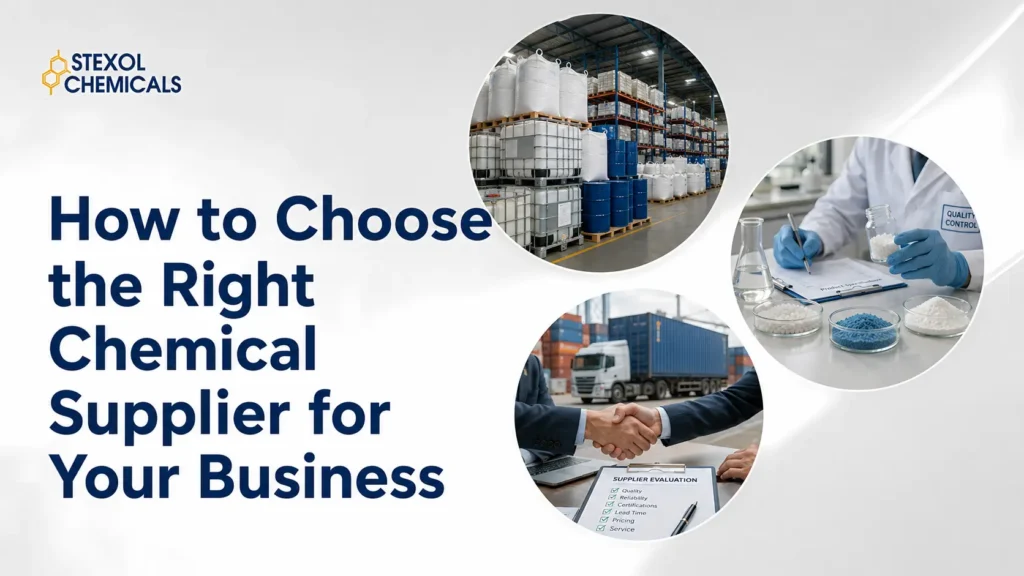
Choosing the right chemical supplier in Pakistan means verifying product quality, demanding a batch-specific Certificate of Analysis (COA), confirming certifications like ISO 9001 or GMP, and checking for consistent supply reliability before price even enters the conversation. In a local market where adulterated ingredients and undocumented sourcing are real risks, the supplier you choose directly determines the quality, safety, and regulatory standing of every product you manufacture.
Pakistan imports approximately $7 billion worth of chemicals every year, and domestic production meets only around 10% of the country’s actual needs (Pakistan Chemical Manufacturers Association, 2025). That means nearly every shampoo manufacturer in Faisalabad, every lotion brand in Lahore, and every personal care factory in Karachi is directly dependent on the quality and reliability of their raw material supplier.
The chemical supplier for the business you choose is not just a vendor. They are a production partner. A wrong choice, a supplier who delivers inconsistent purity grades, refuses to provide COA documentation, or disappears when there is a quality complaint, can bring your entire manufacturing line to a halt.
Pakistan’s cosmetics and personal care market is now valued at over $745 million (Statista, 2024) and is growing at 4.43% annually, with projections exceeding $925 million by 2029.
Local beauty brands are scaling. Private label manufacturers are multiplying. And as the market grows, so does the need for manufacturers to source verified, compliant, and consistently available cosmetic raw materials.
Yet many small and medium manufacturers in Pakistan still choose their chemical supplier based on price alone, without requesting a COA, without verifying certifications, and without any formal supplier evaluation process.
This guide changes that. Here is a step-by-step framework on how to select a chemical supplier built specifically for Pakistani manufacturers who want to source smarter, protect their product quality, and build supplier relationships that actually support their growth.
Pakistan’s chemical sourcing for businesses landscape carries risks that do not exist in the same way in more regulated markets. Consider the reality on the ground:
The consequence of choosing the wrong industrial chemical supplier in this environment is not just a bad batch. It is reformulation cost, product recalls, customer complaints, regulatory risk, and production downtime, all at once. When you choose a chemical supplier correctly, you give your business a foundation to scale confidently.
Before you approach any chemical distribution company or raw material supplier, document exactly what you need. Vague requirements produce vague supplier relationships.
For every ingredient in your formulation, prepare a specification sheet that includes:
This becomes your evaluation checklist for every chemical supplier you speak to. Any supplier who cannot match your documented specifications should be ruled out immediately, regardless of price.
Minimum order quantity (MOQ) is one of the most immediate pain points for small manufacturers in Pakistan. Large international industrial chemical suppliers often demand 10-tonne minimums. For a factory producing 500 units per month, that kind of MOQ locks up working capital, overloads storage, and creates waste.
The financial impact is real. Low-volume purchases can carry 20 to 50% price premiums over bulk pricing (Upper Inc., 2025). High MOQs increase inventory costs by 20 to 30%. And in a market where PKR is under constant pressure, over-purchasing in advance is a significant financial risk.
Before approaching any supplier, define:
Suppliers who offer low MOQ chemical sourcing, starting from as little as 1 kg for trial orders, give Pakistani small manufacturers the ability to test quality before scaling. This is not a luxury. In a market with legitimate adulteration risks, it is basic risk management.
In Pakistan’s chemical procurement process, many buyers skip certification verification because they trust word of mouth, personal referrals, or long-standing relationships. That approach carries significant risk in a market where documentation standards are inconsistently applied.
Certifications are not formalities. They are evidence that a supplier has a functioning, audited quality system behind their products.
ISO 9001 certification confirms that a supplier has a documented quality management system, covering raw material intake, production controls, testing procedures, and non-conformance handling. As of the 2024 ISO Survey, there are 1,479,165 active ISO 9001 certificates worldwide. Any credible supplier serving the cosmetics or personal care sector should hold one.
ISO 9001 means the supplier can demonstrate:
Ask to see the ISO 9001 certificate, not a photocopy, but a verifiable document with the certification body’s name, certificate number, and expiry date. You can verify most certificates directly through the issuing body’s online registry.
If you supply ingredients to the pharmaceutical sector or manufacture cosmetics that approach the medical claims threshold, GMP (Good Manufacturing Practice) certification becomes a gating requirement. A PLOS ONE academic study ranked GMP certification as the #1 supplier selection criterion in pharmaceutical procurement, scoring 6.390, which is higher than price, delivery, and even product specifications.
In Pakistan specifically:
This is the single most important document in industrial chemical sourcing in Pakistan and also the most commonly missing in Pakistan’s local supplier market.
A Certificate of Analysis (COA) is a batch-specific document issued by the supplier confirming that a product has been tested and meets its defined quality specifications. It is not a general product profile. It is specific to the exact batch you are receiving.
A legitimate COA must include:
Why this matters specifically in Pakistan: Adulterated raw materials, including diluted surfactants, lower-grade glycerin sold as cosmetic-grade, or mislabelled cetyl alcohol, are a known reality in the local chemical trading market. A COA tied to a specific batch, from a supplier with a verifiable quality system, is your first line of defence.
EU cosmetics law requires COAs to be retained for at least 10 years as part of the Product Information File. Even if you are not currently exporting, building documentation discipline now protects you when you do.
Before placing any order with a new chemical supplier in Pakistan, request a sample COA for the exact grade and batch you intend to buy. If the supplier cannot provide one, or provides a generic document with no batch number, do not proceed.
A supplier who delivers excellent quality on the first order but becomes inconsistent by the third is worse than a moderately good supplier who delivers every time. Supply chain reliability is now ranked above price in professional procurement decisions globally, and in Pakistan, where import dependencies and port delays add volatility, it matters even more.
When evaluating any reliable chemical supplier, ask directly:
A supplier based in Pakistan who holds local warehouse inventory, rather than importing each order fresh, can protect you from Karachi port delays, customs backlogs, and international shipping disruptions. This is a practical, local-market advantage that matters every quarter.
Globally, supply chain disruptions lasting more than one month now occur on average every 3.7 years (McKinsey, 2025), and a single major disruption can cost a business up to 42% of annual EBITDA. For a small Pakistani manufacturer with limited cash reserves, a two-week production halt from missing raw materials can be genuinely catastrophic.
Choosing the right raw matrial supplier for business in Pakistan is not just about finding the lowest price. Price competition in this market is intense.
A cheap ingredient that fails your formulation, triggers a customer complaint, or causes a product recall costs far more than the price difference you saved on procurement. The true cost of a low-quality raw material includes:
When comparing bulk chemical suppliers in Pakistan, evaluate total value across all of these factors:
Flexible payment terms are a genuine differentiator in Pakistan’s manufacturing sector, where working capital is consistently tight. A supplier who offers cash on delivery or short-credit terms without requiring large advance payments directly reduces your financial exposure during the supplier trial phase.
Many Pakistani beauty entrepreneurs and small manufacturers do not have in-house chemists. They are self-taught formulators, brand owners, or entrepreneurs transitioning into manufacturing. For this buyer profile, a chemical supplier who provides formulation guidance alongside their ingredients is not a luxury. It is a practical business enabler.
A 2022 academic study of industrial chemical sourcing criteria found that technical expertise and formulation support ranked as the #1 supplier selection criterion, above price, above delivery speed, above everything else, because a supplier who helps you get the formulation right is a supplier who helps you sell more product.
When evaluating suppliers on this dimension, ask:
A supplier who offers a shampoo starter guide alongside their surfactants, or who can advise on CAPB ratios for a baby shampoo formulation, is a partner who reduces your learning curve and accelerates your time to market. That kind of support has real monetary value, especially when you are scaling your first product line.
In Pakistan’s chemical trading market, reputation is built over years and often visible through behaviour, not marketing materials. Before committing to any of the chemical distribution companies operating in Pakistan for regular supply, run basic checks.
Practical steps for Pakistani buyers:
Check Their Product Range and Sourcing
A supplier who stocks a wide range of related ingredients, including SLES, CAPB, cetyl alcohol, glycerin, and citric acid, and sources consistently from verified manufacturers, is lower risk than one piecing together orders from multiple undisclosed sources.
Use this table as your reference during supplier evaluation. Importance ratings are drawn from synthesized academic research and the 2025 Pakistani market context.
| Criterion | Why It Matters for Pakistani Buyers | What to Verify |
| Product Quality and Purity | Inconsistent quality is the #1 cause of formulation failure | COA test results, purity grade, specification sheet |
| ISO 9001 Certification | Confirms a documented, audited quality system exists | Valid certificate from an accredited body — verify the certificate number |
| GMP / DRAP Compliance | Required for pharmaceutical-grade and regulated cosmetic ingredients | Certificate, compliance declaration, regulatory registration |
| Certificate of Analysis (COA) | Batch-specific proof that the product meets specifications | Request the COA for the sample batch before any purchase |
| Halal Certification | Essential for the Pakistani consumer market and the Gulf export | Valid certificate from a PNAC-recognised body |
| Supply Reliability | Port delays and import dependency make local inventory critical | Lead time, safety stock policy, backup sourcing capacity |
| MOQ Flexibility | High MOQs strain working capital for small Pakistani manufacturers | Minimum order per product, trial sample availability |
| Price and Payment Terms | COD or short credit terms reduce cash flow risk for SMEs | Per-kg price, payment structure, volume discount thresholds |
| Technical and Formulation Support | Critical for brands without in-house chemists | WhatsApp access to the technical team, formulation guides, and TDS |
| Reputation and References | Protects against adulteration and undocumented sourcing risks | Two live customer references, verifiable physical address |
Red Flags Specific to the Pakistani Chemical Market
Pakistan’s chemical trading environment has specific risks that international guides do not address. Know these warning signs before you commit.
| Red Flag | What It Likely Means |
| No COA available, or the COA has no batch number | Product has not been batch-tested — quality is unverified |
| Unusually low price with no grade specification | Likely substandard or adulterated ingredient — a known local market risk |
| The supplier cannot confirm ISO 9001 or GMP | No formal quality system — no accountability if the product fails |
| No physical warehouse or verifiable address | Pure trading operation with no quality control over what they source |
| COA is a generic document shared across multiple batches | Documentation is fabricated, not batch-linked — worthless for traceability |
| Payment is advance-only with no sample policy | The supplier is not confident enough in their quality to offer samples first |
| No SDS or MSDS available for the ingredient | Non-compliance with basic chemical safety documentation standards |
| Delivery is always “next week” with no fixed timeline | Supplier does not hold local stock — imports on demand with no reliability guarantee |
| Cannot name their upstream manufacturer or source country | Sourcing is opaque — product origin and quality is unknown |
| WhatsApp-only contact with no formal business registration | Informal operation with no legal recourse if issues arise |
Work through this checklist before placing your first bulk order with any new supplier.
Chemical sourcing for businesses in Pakistan does not need to be a gamble. But it does require discipline: asking the right questions, demanding the right documentation, and choosing suppliers who treat your business with the same seriousness you do.
The manufacturers who grow, who move from small batch production to consistent bulk output, from local sales to brand recognition, are the ones who build their supply chain on verified quality and reliable partnerships from day one.
Stexol Chemicals is built specifically for this market, offering verified, COA-backed cosmetic raw materials including SLES, CAPB, cetyl alcohol, glycerin, and citric acid, with low MOQs starting from 1 kg. Whether you are producing your first shampoo batch in Lahore or scaling a personal care line in Faisalabad, the right chemical supplier makes quality consistent, sourcing reliable, and growth genuinely possible.