
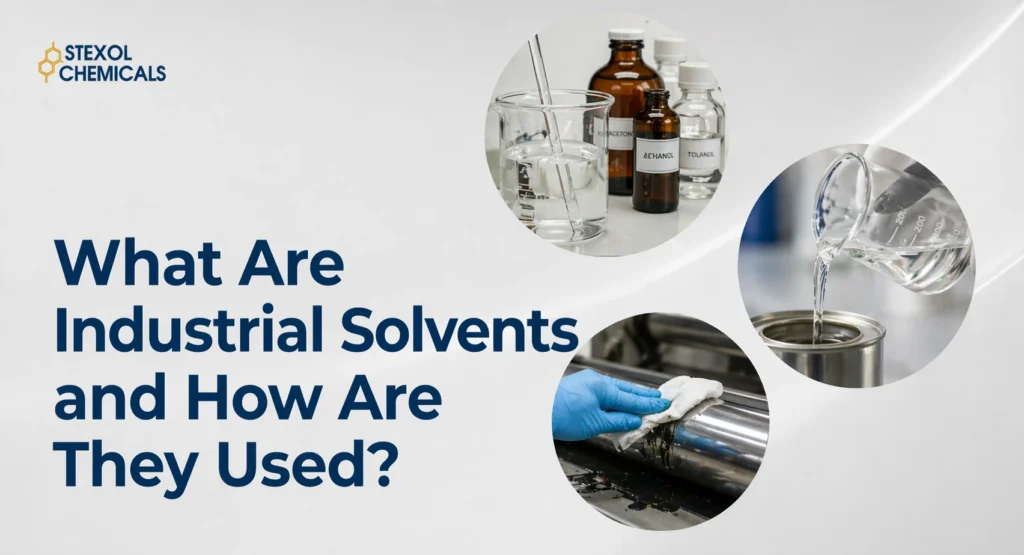
Industrial solvents refer to the liquid substances that are employed to dissolve, dilute, suspend or extract other substances without altering their fundamental chemical makeup. The most widespread industrial applications of industrial solvents in manufacturing are cleaning and degreasing of equipment, supporting coats, adhesives and ink work and facilitating extraction. The primary categories of industrial solvents are oxygenated solvents, hydrocarbon solvents, halogenated solvents, and more recent green solvents that are aimed at decreasing the environmental impact.
This subject is more important than it might appear to the owners of beauty brands, contract manufacturers, and indie cosmetic creators. Solvents find their applications not only in the interior parts of some cosmetics. They are also found in the broader chain of manufacturing, in ingredients processing and in fragrance handling, in machine cleaning, in packaging inks, and in adhesive systems. It refers to the fact that being more aware of industrial solvent usage can allow you to make more appropriate decisions regarding quality, safety, compliance, and scale.
When you are asking what industrial solvents are, the simplest answer is as follows: they are working liquids that assist the materials to mix, move, dissolve, remove the surfaces, or separate one substance from another. Their application in many industries can be explained by the fact that they enhance the efficiency of the processes and facilitate the smooth running of production. Such a definition of dissolve, dilute, or extract is mirrored in industry and public-health literature.
Solvents tend to be presented in two forms in beauty manufacturing. Some solvents are constituents of the formula, like some of the carriers in fragrances or fast drying products formations. Second, they are process solvents that are employed in the area of the formula, like line cleaning, de-greasing, removal of residue or conversion of packaging. This distinction can be helpful as a brand can claim that it does not use solvents in the formula, but if it is used elsewhere in the supply chain.
In the process of describing the kind of industrial solvents, the majority of the authoritative and competitor-based content categorizes them into four broad categories, which are oxygenated, hydrocarbon, halogenated and green solvents. The structure also fits the existing AI Overview design that individuals view during search results.
A rough outline is provided in the table below.
| Solvent family | Common examples | Typical industrial role |
| Oxygenated solvents | Acetone, ethanol, isopropanol, butanone (MEK) | Cleaning, coatings, printing inks, cosmetics, fast evaporation tasks |
| Hydrocarbon solvents | Hexane, toluene, xylene, white spirit | Paints, coatings, extraction, cleaning |
| Halogenated solvents | Dichloromethane (DCM), trichloroethylene (TCE) | Heavy-duty degreasing, specialist cleaning, some industrial processing |
| Green solvents | Bio-based blends, renewable-source solvents | Lower-impact substitution and VOC reduction strategies |
Industry, regulatory, and public-health sources explain the categories of solvents used in the workplace and how to use them more safely, and these sources support these examples.
Oxygenated solvents are also preferred since their evaporation rate is fast and they are suitable for cleaning and coating systems. Hydrocarbon solvents are used in extraction and coating activities. Halogenated solvents may perform equally, and some of them are much more hazardous and controllable. Green solvents are a new subject of discussion as companies consider a better or less-toxic or less-VOC solvent, but still have to establish performance across different applications.
The term uses of industrial solvents is an extensive term that encompasses numerous jobs; however, to your audience, there are four areas that are of most importance.
Cleaning is one of the most common uses of solvents in industries. Solvents aid in the removal of oils, waxes, greases, residues and stubborn deposits on equipment, metal parts and production surfaces. Repeatedly, in public-health and safety advice, cleaning and degreasing were among the key uses of solvents in the workplace.
Solvents are very popular in the apparel section, glues, sealants, and printing systems since they assist in regulating the flow, viscosity, drying rate and surface application. In the case of beauty brands, it is important in packaging as well as in the production of the product. Even a product formula that is not heavy in solvents may contain a label, carton, tube, or printed component that uses solvent-based inks or adhesive systems.
The other important response to the question in terms of how industrial solvents are used is extraction. In manufacturing, a material useful commercially, like oil, a fragrance compound, or another substance of interest, can be extracted selectively by a solvent, and then stripped off later. The significant contribution of solvents such as hexane to the extensive extraction systems is still observed by industry sources.
Certain industrial solvents are also well-known cosmetic constituents when in appropriate grades and concentrations. Ethanol is commonly employed as a solvent for fragrance oils in perfumes, and isopropyl alcohol is a solvent and processing aid in a wide range of cosmetic and personal care products.
To simplify the interpretation of the industrial solvents applications, it is useful to map them onto the beauty workflow.
| Beauty workflow stage | Where solvents may appear | Why it matters |
| Ingredient processing | Extraction, purification, separation | Impacts raw material quality and consistency |
| Formulation | Fragrance carriers, fast-dry systems, speciality product formats | Affects performance, evaporation, and sensory feel |
| Factory operations | Cleaning, degreasing, maintenance, and changeovers | Supports hygiene, batch integrity, and efficiency |
| Packaging and finishing | Inks, coatings, sealants, adhesives | Influences packaging quality, drying, and VOC exposure |
The significance of this workflow view is that it will assist founders and manufacturers in posing more specific questions to the suppliers. Rather than posing the question of whether solvents are contained in a formula, it is wiser to ask the question of where the solvents have been used, whether documentation is available, and what control measures have been taken. The importance of Safety Data Sheets, technical specifications, and quality documents is felt at this point. HSE guidance is very specific to check labels or order an SDS when the chemical content is not obvious.
Solvents are highly effective since most of them evaporate fast, and they react with other substances. The same properties may be a source of risk. The exposure to the solvent, according to OSHA, can lead to nervous system, skin, eye, liver, reproductive, and respiratory injury, and some solvents are linked to reproductive injury or cancer. The UK HSE advice also points to the inhalation, skin contact, and dermatitis issues.
VCs are another problem that is of importance. According to the EPA, most of the VOCs are used as industrial solvents and common sources of VOC produce paints, cleaning products, glues, etc. In the case of beauty businesses, it implies that VOC-related issues can be in the formula, as well as in operations and packaging.
There are also solvent options that have more serious hazard profiles. To give an example, the UK government guidance defines MEK as volatile and highly flammable and ECHA as trichloroethylene, harmonised carcinogenic classification. This is the reason why the solvent selection must never be pegged on performance alone.
Supplier support is where it is important when you are dealing with a raw material supplier like Stexol Chemicals. The appropriate partner must assist you in reviewing grade suitability, documentation, handling expectations, as well as practical substitution options where necessary.
To show market data in the 2026 angle, the best way to do it is to show it as a forecast context. According to one leading market study, the world solvents market is estimated to reach USD 42.34 billion by 2026, as demand in the area of paints, coatings, packaging, pharmaceuticals and the related industry of personal care continues to drive the expansion of the market. It does not imply that all of the categories of solvents are increasing in the same proportion. Still, it does indicate that solvents continue to play a significant role in contemporary production.
Concurrently, the discourse of the market is changing. Increasingly, more buyers are attracted to lower-VOC systems, cleaner alternatives and bio-based alternatives. This does not eliminate the necessity of performance testing, but indicates that the concept of green solvent thinking has indeed become a component of procurement and formulation strategy, and not only a niche conversation point.
Simply put, industrial solvents are process-enabling liquids. They assist in the dissolution, removal, cleaning, transportation, and separation of materials throughout the manufacturing process. The actual worth of learning about what industrial solvents are, what their applications are and how they are used in general in the beauty business is that the company would make smarter decisions related to the formulation, their operation, packaging, compliance, as well as their choice of suppliers.
The most effective way is not to have fear of solvents or to ignore them. It is to know the places of their use, the reasons of their use and the means of their control.
Select solvents that work, are safe, and scale, not by trial and error. Collaborate with Stexol Chemicals to get practical advice, reliable paperwork and solutions that can accommodate real beauty production requirements.